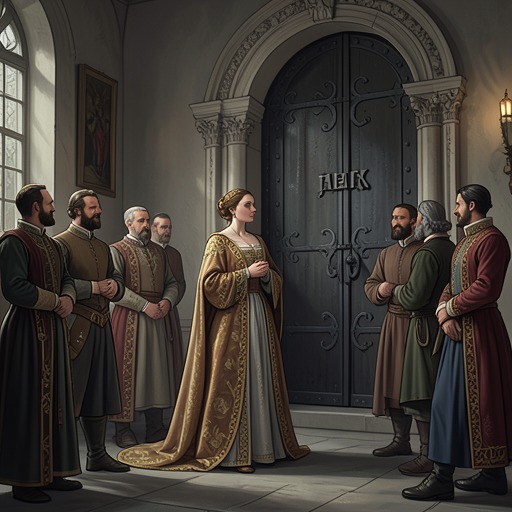
Tudor heirs and England’s future
The Constant PrincessTudor heirs and England’s future are inseparable in the novel: the need to secure the succession shapes Katherine’s marriage, gives political meaning to her body and public status, and makes the birth of a son appear to promise national stability. That promise is repeatedly shaken. A child lost before birth and the later death of Prince Henry Tudor leave Katherine confronting the gap between dynastic expectation and personal grief, while her understanding of royal duty changes with each reversal.
Succession as a political bargain
The hope for a secure Tudor future begins within negotiations over a royal marriage. Katherine’s parents had spent heavily to bring about the match, and the death of Edward Plantagenet, Duke of Warwick, was part of its political cost. Katherine understands that Edward was a royal prince with a stronger claim to the English throne than her father-in-law’s. In her account, he was arrested and executed so that no rival claimant would threaten the throne her marriage was intended to support. His death makes the hoped-for succession morally uneasy from the outset: the political security purchased for Katherine and the Tudor dynasty rests, in her mind, on another prince’s destruction.
The dowry dispute further reveals how closely marriage and succession are bound to material bargaining. When Margaret Pole raises the question, Katherine acknowledges that Henry VII had been displeased over the dowry. After Arthur’s death, the stakes become more immediate: the Spanish ambassador explains that Katherine is owed a third of the revenues of Wales, Cornwall, and Chester as her widow’s jointure, while her parents also seek the return of her dowry. The payments are not merely private financial claims. They affect whether Katherine will leave England or remain available for another dynastic marriage.
Henry VII proposes marrying Katherine himself and absorbing her goods into his household, but the plan changes when marriage to Prince Harry is put forward. De Puebla tells Henry that a betrothal to the prince would bring the remaining half of the dowry and end the jointure obligation. The proposed match therefore answers several political and financial problems at once: it retains Katherine in England, secures a possible future heir, and releases revenues to the king. A child is anticipated long before one exists, as the solution to a negotiation between rulers.
Queenship, maternity, and the royal body
Katherine’s coronation gives that dynastic expectation sacred and public form. On 24 June 1509, she is carried from the Tower of London to Westminster in a cloth-of-gold litter, wearing white satin and a pearl coronet. After Henry VIII is crowned, she receives the holy oil, takes the scepter and ivory wand, and understands herself as an anointed queen appointed to rule. The ceremony makes her status more than an honor: she sees it as the fulfillment of a destiny she has long awaited. Her body, marked by the anointing, stands at once for her individual identity and for the continuity of the crown she is expected to help secure.
That expectation enters intimate conversation as well. Katherine proposes that a future son might be named Arthur, at first invoking the ideal of King Arthur and Camelot, then explaining the name as one for England. Her choice links the child she hopes to bear to both national legend and the memory of Arthur, Prince of Wales. When she later believes herself pregnant, she privately imagines naming the child Arthur Henry, honoring the dead prince while accepting her new husband. She also regards guiding Henry VIII as part of her task: she hopes to temper his selfishness and help him become a responsible king. The imagined heir is thus not only a successor to be born but a future ruler whose character, education, and service to England she intends to shape.
Pregnancy and the fragile promise of an heir
The court treats Katherine’s first apparent pregnancy as public evidence of a settled future. At the Christmas festivities, her fuller skirts reveal her belly; Henry VIII has a chair brought for her, and the court celebrates the young king’s health and the queen’s fertility. The mood changes in January 1510. Katherine wakes in pain and bleeding, and, before the midwives arrive, believes the child is lost. After a long day, she gives birth to a dead girl. Her grief is entangled with the names and hopes already attached to motherhood: she remembers that Arthur had wanted a daughter called Mary, and feels that she has failed her husband, Henry, England, and Spain.
A later pregnancy appears to restore the promise. In the winter of 1510, the child kicks strongly enough for Henry VIII to feel it, and Katherine’s hope for a son becomes shared confidence at court. She imagines teaching the child Christian faith, court life, and the skills of rule, while passing on her mother’s courage and her father’s abilities, as well as her own constancy and determination. She expects that a prince raised with these qualities could protect England and make his mark in Europe. The future she envisages is both familial and political: a son would be loved as a child, remembered in relation to Arthur, and trained to preserve the realm.
Prince Henry Tudor is born on New Year’s Day 1511, and the news prompts celebration throughout England. People feast in the streets and ring church bells, welcoming the boy as the heir who, they hope, will preserve peace and alliances and defend the kingdom. Henry VIII enters the queen’s chamber despite the rules of confinement, approaching the cradle cautiously. He arranges a household of at least forty people for the baby, chooses future rooms for his council, and plans an elaborate christening. These arrangements turn the infant into a figure of national expectation almost from birth. Katherine, meanwhile, delights in the simple intimacy of placing a finger in his hand and feeling his fingers close around it.
Loss, authority, and the meaning of the future
The child’s death on 22 February reverses the public joy. Katherine receives the news at the height of her happiness, withdraws behind closed shutters and bolted doors, and cannot bear the sounds of ordinary life beyond her room. She recalls the baby’s blue eyes, small hands, and tiny feet, while the people around her become indistinct in her grief. The loss also breaks the religious interpretation that had sustained her: she can no longer understand how an innocent child could be taken, and loses her faith in God, her desire to live, and her ambition to rule England and keep it safe. The imagined future of the dynasty collapses together with her private hopes for her son.
Yet the novel does not make royal responsibility disappear with that collapse. When Henry VIII sails for France, he appoints Katherine regent, governor of the realm, and captain general of the forces for home defense. She welcomes the authority and resolves to act against the Scots. Her position shows that Katherine’s political contribution to England’s future is not confined to producing an heir: she can also govern and defend the kingdom directly. At Blackfriars in 1529, the promise she made decades earlier to Arthur returns as a matter she must answer for before the world. The novel thereby connects dynastic continuity not only to the children who live, but also to vows, political choices, and the burdens carried by the queen. Its central tension is stark: England treats heirs as guarantees of tomorrow, but no ceremony, pregnancy, or promise can make that tomorrow secure.