Wales, the principality
The Constant PrincessWales, the principality, is more than a destination in Catalina of Aragon’s dynastic marriage: it gives her first life with Arthur, Prince of Wales, a territorial setting, and later becomes part of the financial bargaining over her future. At Ludlow, her inherited title is joined to the practical rhythms of a court and household; after Arthur’s death, the revenues associated with Wales become one element of the settlement sought for his widow.
A title fixed in childhood
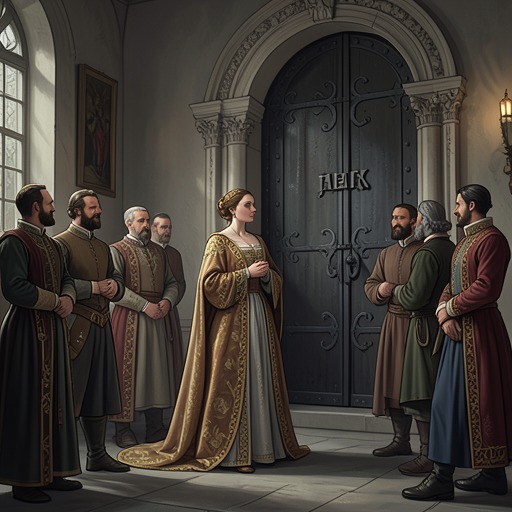
Catalina’s identification with Wales precedes her arrival in England. Since she was three, she had been betrothed to Arthur, and she understood herself as Princess of Wales long before the marriage ceremony. When Henry VII of England later spoke of her becoming the princess, she corrected him: the title had been hers from childhood, and she had always understood her marriage to Arthur as destiny. Wales was therefore not simply a place she might visit after leaving her Spanish home. It was part of the future political identity arranged for her while she was still a child.
That expectation shaped how Catalina imagined her responsibilities. She expected to become Arthur’s wife and then his queen, and regarded the country entrusted to her care as a duty rather than merely a prize. Her settled conviction that she would rule in England did not erase the earlier title; it made the Welsh principality the first stage of a larger dynastic future. When her arrival in England finally brought her face to face with Arthur, she spoke of having known all her life that they would marry. His letters, although written at his father’s direction as part of his studies, had at least helped them feel less like strangers.
Life and court at Ludlow
In the middle of December, as the court prepared for the Christmas feast, Arthur was ordered by his father to make ready to leave for his castle at Ludlow. Henry asked whether Arthur wished to take his wife with him; Arthur answered cautiously that he would do as his father wished. The departure places the young couple within Wales, at Ludlow Castle, Wales, rather than at the king’s central court. The available account presents the move as a royal household decision, made in a period when the conduct of the marriage and the couple’s future were closely watched.
Ludlow was also a site of household management and local business. A woman who had been there described having a little court of her own, mostly Welsh-speaking and mostly given to singing. She explained that, because neither the king nor the prince came to Wales, the business had fallen to her husband. The detail gives the place a distinct texture without presenting it as remote from royal authority: the absent king and prince still shaped who had to take responsibility, while a small household gathered around those who remained.
The court’s domestic life carried financial consequences as well as personal ones. Catalina raised the question of her dowry with Margaret Pole, who already knew that negotiations between Henry and Catalina’s father were strained. The agreed sum had not all been sent in cash; the remaining value was contested in relation to the plate and treasure Catalina had brought for her household. Margaret suspected that sending the couple to Ludlow also meant they would use those goods in daily life. The gold plates were repeatedly put into service, and careless marks could diminish their value in the eyes of the men bargaining over the dowry. Wales thus became part of a household economy in which the ordinary use of a princess’s possessions could affect a much larger diplomatic dispute.
Widowhood and the value of Welsh revenues
After Arthur’s death, Wales acquired a new place in the negotiations because Catalina’s widow’s jointure was defined partly through its income. Her parents’ emissary told her that Henry was required to pay her a third of the revenues of Wales, Cornwall, and Chester, while they were also asking for the return of her dowry. Catalina doubted that Henry would pay: in her view, he had failed to provide her allowance even while his son was alive, and had little reason to meet the larger obligations after Arthur’s death. The contract established a claim, but did not by itself settle the dispute.
Those revenues also gave Henry a reason to seek a different arrangement. When he proposed marrying Catalina himself, he offered to absorb her goods into his household and provide an allowance. Later, the prospect of her betrothal to Prince Harry was presented as a way to resolve the dowry and jointure problem: Spain would pay the second half of the dowry, and the widow’s jointure would cease. The sequence shows Wales functioning as a negotiable resource within a marriage alliance. Its income could support Catalina as a widow, but the prospect of remarriage could remove that claim and restore the revenues to Henry’s control.
Catalina did not accept that her future should be decided solely through accounts and family instructions. At a window in Durham House, she set aside memories of home and insisted that England was her home now. She rejected the idea that her parents could simply bring her back and arrange another marriage, and declared that she would decide her own future. Her resistance did not make the financial terms disappear, but it placed the question of Welsh revenues within a larger struggle over whether she could retain the identity and political place for which she had been raised.
From Welsh princess to ruling queen
Catalina’s later authority in England gives the earlier Welsh title a retrospective significance. After Henry VII’s death, she consulted experienced members of the court and worked with the Privy Council on the law, coastal defenses, ships, and military musters. Her account of taking responsibility for the kingdom connects her political practice to the statecraft she had learned from her parents. The evidence does not present Wales as the sole source of that capacity; rather, it shows the Welsh period as one part of a life in which the roles assigned through dynastic marriage became a foundation for later rule.
The transition was marked by ceremony. Before her coronation, Catalina organized the funeral of Lady Margaret Beaufort, using the Royal Book and handwritten instructions to arrange an appropriately dignified observance. She reduced the scale of the proposed ceremony and issued the necessary orders. The event showed the court that the princess who had waited through years of uncertainty could exercise authority in England. On 24 June 1509, she was crowned Queen Katherine of England beside Henry VIII. The title associated with Wales had not been the end of her political identity, but its first named form: a promise of rule that she had carried from childhood into widowhood and, ultimately, queenship.