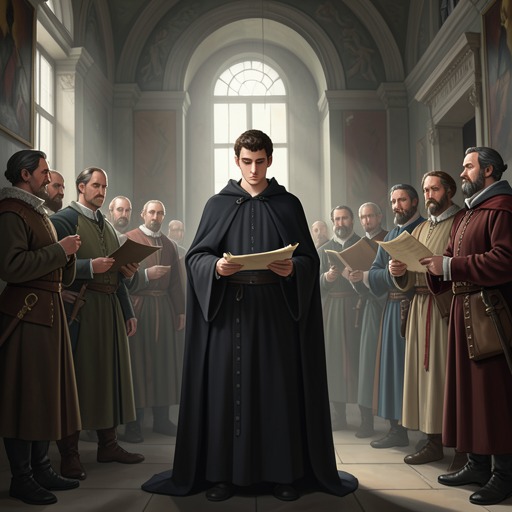
Wedding of Arthur, Prince of Wales, and Catherine of Aragon
The Constant PrincessThe Wedding of Arthur, Prince of Wales, and Catherine of Aragon was a major public ceremony that joined the Tudor heir to the daughter of the rulers of Spain. In the novel, the wedding’s later significance lies not only in the alliance it celebrated but in the claims surrounding the marriage: Catalina’s assertion that it had never been consummated became essential to her proposed marriage to Arthur’s brother and, much later, to the dispute over her marriage to Henry.
Dynastic Alliance and Its Price
The marriage was the culmination of prolonged negotiations and a substantial dowry. As Catalina remembered on the day of the wedding, her parents had paid dearly for the match, and the arrangements involved both difficult bargaining and the risks of her voyage to England. She also understood the union in the shadow of another cost: Edward Plantagenet, Duke of Warwick, had been executed before she was sent to England. Her father had told Henry VII that he would not send Catalina while Warwick lived, because Warwick’s royal descent and claim to the throne made him a potential rival. The marriage therefore joined two dynasties in a settlement secured amid concerns about succession as well as diplomacy.
The dowry remained a source of tension after the wedding. Catalina later described Henry as having been displeased over the money, while the dispute also involved the valuable household goods she had brought with her. After Arthur’s death, the financial terms became inseparable from her position as his widow: her mother’s instructions tied her possible return to Spain to the payment of her jointure, while the Spanish representatives also sought the return of the dowry. The wedding’s promised exchange thus continued to shape Catalina’s choices even when its original political purpose had been disrupted.
Public Ceremony and Later Accounts
Catalina recalled the wedding as a glorious day at St Paul’s Cathedral. Its scale and public character stood in sharp contrast to her later marriage to Henry, which took place quietly at Greenwich Palace, with only a few witnesses and no public bedding. That contrast makes the first wedding’s place in the court’s public record especially important: Doña Elvira later objected that Catalina and Arthur had been bedded in the sight of the whole court. Catalina answered that the marriage had not been consummated, and maintained that position when challenged about their regular marital encounters.
The evidence therefore presents two competing accounts rather than a simple uncontested record. The public ceremony and bedding could be invoked as evidence that the marriage had been completed; Catalina’s account was that Arthur had been unable to consummate it. When Henry VII considered marrying Catalina himself, he raised the question of affinity and said that he would seek a papal dispensation, asking whether the marriage to Arthur had been consummated. The ambassador confirmed Catalina’s account, and later stressed that the Pope’s dispensation would still be needed. The wedding’s legal meaning consequently depended on a private fact that courtly witnesses and political representatives disputed or reported secondhand.
Widowhood, Negotiation, and Remarriage
After Arthur’s death, the marriage left Catalina a widowed princess whose future was negotiated through money, succession, and competing royal plans. Her mother’s letter directed her to remain where she was until she knew whether she was pregnant; if she was not, she was to seek her jointure and then return to Spain. The amount owed to her was described as a third of the revenues of Wales, Cornwall, and Chester, in addition to the demand that Henry return her dowry. Catalina doubted that he would pay, noting that he had not even paid her allowance while Arthur was alive.
Henry VII eventually proposed marriage to Catalina, treating the question of consummation as relevant to obtaining a dispensation. The proposal made the first wedding’s disputed status a practical matter of church law and dynastic policy, not merely a recollection between former spouses. Catalina later asserted to Doña Elvira that she was still a virgin when she left Spain. At the end of the novel, however, she acknowledges that this was a lie and stakes her defense in court on Henry’s reluctance to state publicly that she had been Arthur’s wife and lover before becoming Henry’s queen. The original wedding thus becomes the foundation of a later argument over marriage, royal legitimacy, and the truth each side is willing to avow.