Whitehall Palace
The Constant PrincessWhitehall Palace serves as a stage for the Tudor court’s public authority and private negotiations. In its dining rooms and stable yard, royal hospitality, dynastic succession, and strained relations with Spain appear not as abstractions but as encounters among a king, his heir, and an ambassador whose favor has become useful again.
A royal court and its hierarchy
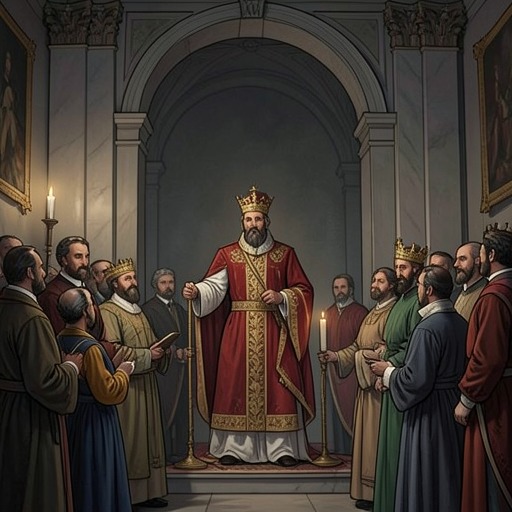
After weeks spent mourning Elizabeth of York, Henry VII returned to court at Whitehall Palace and invited Catalina of Aragon to dine with the royal family. She sat with Mary Tudor and the ladies of the court, while the young Harry Tudor, Prince of Wales, was placed between his father and his grandmother, Margaret Beaufort. His position at the table reflected the care with which Margaret guarded the kingdom’s only surviving heir: unlike his elder brother, he had not been sent to Ludlow Castle for a prince’s rigorous upbringing, and his grandmother kept him close, even shielding him from dangerous sports.
The arrangement also defined the limits of Catalina’s access. Seated farther down the table, she could scarcely see Harry and had no chance to speak with him. Their brief exchange of glances offered a private moment inside a highly managed public gathering, where family proximity did not mean freedom of contact.
Hospitality as diplomacy
Whitehall’s formal dining could also signal a shift in political favor. Henry VII invited Dr. de Puebla, the Spanish ambassador, to dine at the palace, seated him at one of the top tables, and gave him the best wine. The king sent him venison from his own table; the ambassador accepted the food eagerly while privately wondering what the unusual generosity meant. He understood that such public favors would carry an expectation, but after the previous year’s disappointment over Spanish debts, he took the welcome as a hopeful sign that Henry once again had a use for him.
The meal made diplomacy legible through ceremony and small privileges. De Puebla’s improved standing did not erase the earlier dispute over Catalina’s dowry; it suggested instead that Henry might again employ the ambassador, rather than treat him chiefly as the representative responsible for Spain’s failure to pay. At Whitehall, a shared table could mark the reopening of a political channel without resolving the conflict behind it.
Succession announced
In June 1503, Whitehall was the setting for Henry VII’s announcement that his younger son was to be betrothed to Catalina. He told the blond boy that he would be betrothed to Catalina of Aragon, thinking of the son who had died before him. Harry blushed and assented. The announcement tied the Spanish princess’s future to the Tudor succession and placed the marriage plan within the king’s immediate family circle.
The stable yard audience
Whitehall’s stable yard provided a starkly different setting for diplomacy. Dr. de Puebla came there carrying firm letters of refusal from the Spanish monarchs, alongside Catalina’s determination to retain her position as Princess of Wales. Henry VII was inspecting new Barbary horses intended to improve English stock. De Puebla considered making a tactful remark about foreign blood and breeding, but the king’s dark expression made clear that the news would not be easy to deliver.
The scene brings the palace’s functions together: the royal household’s practical interests in its horses share space with a high-stakes political audience. Whitehall is not only a backdrop for ceremonial meals and announcements; it is also where the Spanish ambassador must face the king directly, with Catalina’s title and the unresolved demands surrounding her status at issue.