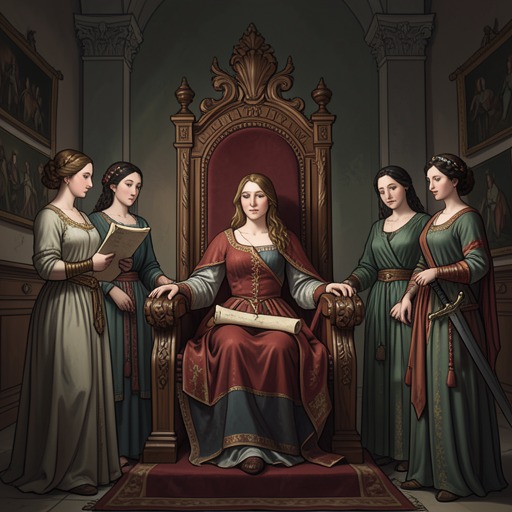
Women’s political agency and dynastic constraints
The Constant PrincessCatalina of Aragon’s political agency develops inside institutions that make women’s status dependent on marriage, male succession, and dynastic finance. She learns how queens negotiate these limits from Isabella of Castile and Margaret Pole, challenges the assumption that women cannot rule or command, and eventually exercises authority as Queen of England and regent. Her story does not erase the constraints: her title, resources, and future are repeatedly treated as contingent on a husband, a pregnancy, or an heir. Instead, it shows how she turns education, political relationships, and formal office into means of governing.
Inherited Models of Female Power
Catalina’s earliest lessons in the politics of marriage come from observing her mother, Isabella of Castile, manage the consequences of Ferdinand II of Aragon’s attention to women at court. Isabella’s response, as Catalina recalls it, was not a public confrontation: she arranged generous marriages for the women and sent them away from court. The practice offered Catalina a model of strategic restraint, but also exposed the unequal expectations placed on wives. A queen might have to absorb humiliation and continue to perform her duties even when her husband failed in his own.
Isabella’s counsel treats marriage as a bond that a husband’s conduct cannot dissolve. A wife who is also a queen must continue to deal with her husband as king, while the question of whether another woman accepts his attention belongs to that woman and her conscience. Catalina’s mother thus distinguishes between the choices available to a man and the constancy demanded of a queen. The lesson is not that a wife has no feelings; it is that her public position requires her to carry on regardless. Catalina remembers this instruction when she misunderstands Arthur, Prince of Wales, and fears he is bringing a former lover into her household. Instead of confronting him with accusation, she answers with careful composure and cites the limits on her small, unfunded establishment.
Margaret Pole gives Catalina a different, more intimate account of survival. Once a princess royal and, in her description, the last Plantagenet princess, Margaret explains that a woman’s life can be shaped by the decisions of husband, parents, king, and God. Yet her account of obedience is not simple submission: she presents it as a conscious choice made by someone who retains private judgment. Catalina finds in this distinction room to think for herself even when she must bow to circumstances. Their friendship develops through shared conversation, language lessons, and comic attempts to communicate across what they do not know; it gives Catalina an English confidante with whom to discuss her future and her unease about her father-in-law.
Succession, Marriage, and the Limits of Choice
A conversation with Arthur makes the gendered assumptions of succession explicit. He tells Catalina that England does not accept a reigning queen and expects her to give him a son. In his account, a daughter could rule only alongside a husband who would become king consort. Catalina distinguishes this arrangement from the different political relationships of Castile and Aragon, and refuses to accept that a daughter must be incapable of sovereignty. She argues that a woman could defend the country and command an army; if soldiers will not obey a woman, she reasons, they need to be trained to follow their commander. Arthur insists that Englishmen would not take orders from a woman. Their disagreement makes the restriction more than a matter of inheritance law: it rests on a belief about who can exercise military authority and whose orders will count.
The exchange also sets competing accounts of legitimacy beside one another. Arthur says his father won the crown through conquest and acclaim, while the next generation is meant to inherit it. Catalina, drawing on her mother’s view, answers that a new king’s manner of obtaining power matters less than his ability to keep it. The discussion gives her a political vocabulary beyond personal ambition: authority is tested by whether a ruler can defend and maintain a realm. Her insistence that a woman could perform that work anticipates the later responsibilities she will take on herself.
Widowhood exposes how little protection a royal title may offer when it is detached from a husband. After Arthur’s death, Catalina describes herself as reduced to the status she had as a small child: the Infanta, rather than the Princess of Wales, and seemingly of no consequence. Margaret explains the underlying rule as she understands it: a woman without a husband or son has no position except what she was born to. Catalina fears that returning to her homeland and marrying an archduke would replace her Welsh title with another marital identity, without fulfilling her hope of becoming Queen of England.
Margaret’s own history sharpens the warning. Her brother was confined in the Tower of London because he had been born a prince; Margaret says that refusing her marriage would have put her in danger too. Marriage allowed her to change her name and survive, but also placed distance between her and the possibility of the English crown. She tells Catalina that past opportunities cannot be recovered and that she must find a way to live without regret. Catalina’s response is to resolve to claim what she understands as hers and to shape her own destiny, even while acknowledging duty and divine will. Her ambition is therefore neither unconstrained choice nor passive acceptance: it is an effort to act within a position whose terms others have repeatedly defined.
Money, Pregnancy, and Dynastic Leverage
The material terms of Catalina’s status make those limits concrete. At Ludlow Castle, the dispute over her dowry joins the interests of her father and father-in-law to the costs of her household. A maternal letter instructs her to remain where she is until she can determine whether she is pregnant. If she is not, she is to seek the Widow's jointure owed to her as Dowager Princess of Wales and leave only once the money is paid. If she is pregnant, the instructions change: she is to seek prompt payment of the dowry in cash, secure her allowance, and hope for a boy. Her future is organized in advance around two possibilities—departure without a child, or continued political value through a potential male heir.
Rodrigo Gonsalvi de Puebla spells out the financial claims involved: the English king owes Catalina a third of the revenues of Wales, Cornwall, and Chester, while her parents are also seeking the return of her dowry. Catalina doubts that the king will pay, noting that he did not provide her allowance even while Arthur lived. The contract may establish what is owed, but it cannot by itself make the king comply. Dowry, household plate, allowance, and widow’s provision are not incidental details; they determine whether Catalina can maintain a household, wait in England, or be sent away. Her political position is inseparable from negotiations over who controls the resources that support it.
Pregnancy further binds her private life to public expectations. In January 1510, her first pregnancy ends in the loss of a daughter. Catalina experiences the event as a failure toward England and Henry VIII, toward her family, and, most privately, toward Arthur. The episode shows the pressure attached to the royal duty to produce an heir: even a personal bereavement becomes entangled with the future of a dynasty. The narrative registers her grief, but it also makes clear how thoroughly her body is treated as a site where political hopes are invested.
From Queen to Governing Authority
Catalina’s coronation gives her an authority that is at once ceremonial, religious, and political. On 24 June 1509, she travels from the Tower to Westminster in a cloth-of-gold litter carried by four white palfreys, dressed in white satin and crowned with pearls. After Henry VIII is crowned, Catalina receives the holy oil, sceptre, and ivory wand. The ceremony confirms her as an anointed queen, and she understands it as the fulfilment of the destiny for which she has waited. Her public elevation follows years of uncertainty and dependence; the crowd’s welcome recognizes her not merely as a foreign bride but as a queen in her own right.
The death of Margaret Beaufort soon tests whether ceremonial standing can become practical authority. With the court unsure how to arrange the king’s grandmother’s funeral, Catalina summons the Duke of Buckingham and asks Margaret Pole to join her. She consults the Royal Book, written by Margaret Beaufort, and finds handwritten funeral instructions tucked inside it. Rather than follow the elaborate arrangements unchanged, Catalina reduces their scale and issues orders for a dignified ceremony. The event demonstrates her command of court protocol and her judgment about public display. Those who had overlooked her during her years of poverty now see that she understands how to govern court life; before her own coronation, she has established herself as a leading figure in the new court.
Her authority extends beyond ceremony into administration. Catalina consults allies and members of the Privy Council, drawing on the statecraft she learned by observing her parents at court. She joins them in considering how to extend law across the kingdom, strengthen coastal defenses, assess ships for a fighting navy, and prepare army muster rolls. These measures give substance to her sense that ruling is a craft she has studied, not simply a status conferred by marriage. Her influence depends on counsel and cooperation, but the work is also presented as a direct exercise of political judgment.
When Henry VIII prepares to sail for France, he formally invests Catalina with the Great Seal of State and appoints her regent, governor of the realm, and captain general of the forces assigned to home defense. The appointment converts her queenly status into defined responsibility. She receives the office in public, but privately welcomes what it gives her: authority over the country and its defense. Her first priority is to confront the Scottish invasion. Before the assembled troops, she rides past each of five hundred men, following the example she had seen from her parents, so that each soldier knows he has been noticed as an individual. She then addresses them as their queen and presents the defense of their homes as a shared undertaking. The scene combines military command with the deliberate work of making authority visible and recognizable to those expected to obey it.
A Political Agency Made Under Constraint
Catalina’s experience reveals the gap between women’s formal limitations and the political work they can perform. The expectation that a woman’s position derives from husband or son shadows her as princess, bride, and widow; male-preference succession and the demand for a male heir narrow the futures available to her. Even the obligations written into marriage contracts depend on powerful men choosing to honor them. Yet Catalina’s competence is not confined to influence behind the scenes. She learns from Isabella of Castile, debates succession with Arthur, builds a relationship of trust with Margaret Pole, directs court ceremony, advises on administration, and accepts a regency with responsibility for the realm’s defense.
Her rise does not make those constraints disappear. Rather, the contrast between her years of financial insecurity and her later authority makes visible how much depends on recognition, resources, and office. Catalina can govern most fully when dynastic circumstances place an official seal and a defined charge in her hands. Her story therefore presents female agency neither as an exception that disproves women’s subordination nor as an illusion. It is a hard-won capacity to interpret the rules, cultivate alliances, and act decisively within a system that repeatedly makes a woman’s authority conditional.