al-Yanna: the garden as paradise
The Constant PrincessAl-Yanna: the garden as paradise is both the design principle of the Alhambra Palace and a defining idea in Catalina of Aragon’s understanding of her life. The garden offers her an image of beauty and protection at the moment of victory, then becomes the home she knows she must leave. Its lasting force lies in that contrast: Catalina’s first conviction that she is favored by God takes shape in a place whose peace and abundance she cannot keep.
Meaning and Design
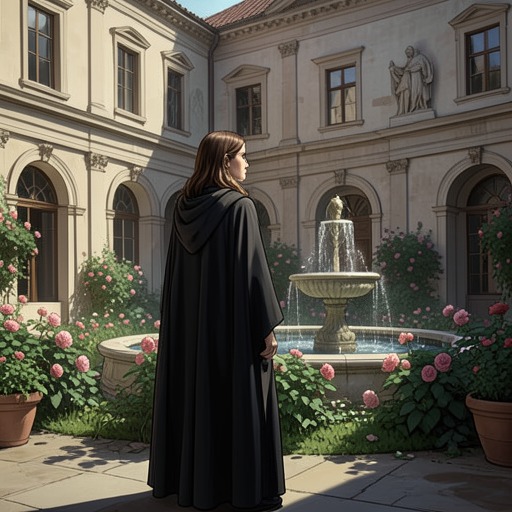
In Catalina’s account, al-Yanna means garden, secret place, and paradise. The Moors understand a garden as paradise on earth, and the Alhambra Palace was made to embody that belief. It is not simply a palace, castle, or fort: its connected courtyards are arranged for flowers and people, while its rooms allow their occupants to live in relation to the open spaces. Walls, tiles, pillars, climbing plants, fruit, and herbs combine to make architecture seem continuous with cultivated nature.
The design therefore represents more than luxury. It offers a way of imagining earthly life as sheltered, ordered, and abundant. Catalina singles out an inscription in the Courtyard of the Two Sisters, where a question about the garden’s beauty is answered with an image of fruitfulness and fragrance. She asks Madilla to teach her the meaning of the flowing inscriptions throughout the rooms. Learning to read them makes the place a source of thought as well as pleasure: its words preserve an account of justice and beauty that survives the change of rulers.
Catalina’s First Paradise
Catalina enters the Alhambra Palace with her parents after the Spanish victory at Granada, the Nasrid stronghold. The family’s arrival is part of a public triumph, but the place alters the meaning of the day for the young princess. She had been raised amid military campaigning and adult fears; at the palace, she experiences herself, for the first time, as a princess. The change is inward as well as ceremonial. She imagines herself as a Moorish princess born to luxury and beauty, while remaining a Princess of England.
The setting gives that new identity its force. Catalina sees the Alhambra Palace as an exceptional place, protected by an imposing fort and filled with a peace that the soldiers’ arrival cannot dispel. She understands her life there as evidence that God has favored her, just as God favored her mother, Isabella of Castile. The palace consequently becomes part of her sense of divine election: she is not merely a child enjoying an extraordinary home, but a chosen daughter destined for high things.
That confidence is bound to a political reversal. The family that enters the palace in victory takes possession of a place made by the people it has defeated. Catalina’s attachment to its beauty does not undo that conquest; instead, the book lets her recognition of the palace’s distinct culture coexist with her family’s new rule. The Arabic inscriptions, the courtyards, and the garden’s conception of paradise remain meaningful to her even as the place becomes a setting for Spanish royal authority.
Paradise Lost
Catalina’s knowledge of the Alhambra Palace is inseparable from the knowledge that she cannot remain there. Even as a child, she understands that it is her secret place and paradise, but that God’s will and her mother’s will require her to leave. She arrives at six and departs at fifteen, carrying the memory of a home whose loveliness makes separation more acute. Paradise is not a permanent refuge in her story; it is discovered early, cherished, and relinquished.
At Dogmersfield Palace in autumn 1501, the memory belongs to a young woman already displaced from that childhood home. The Alhambra Palace thus stands behind her later life less as a destination she can recover than as a standard against which other places and conditions may be measured. Her homesickness is sharpened by the sense that happiness and peace have been brief. The paradise she remembers is at once a real architectural space and an emblem of a life she cannot return to.
Destiny and Political Afterlife
The conviction formed at the Alhambra Palace accompanies Catalina into her English queenship. At her coronation, she understands anointing and the royal insignia as confirmation that she has fulfilled the destiny for which she was born. Her crown does not reproduce the childhood garden, but it gives political and religious form to the same belief in divine appointment. The girl who felt chosen in a protected palace becomes a queen who sees her authority as granted by God.
Later, when Henry leaves for France, Catalina is invested as regent, governor of the realm, and captain general of the forces for home defense. She regards this authority as a God-given opportunity and declares that the country is hers to rule. Read beside her childhood account, this moment marks a movement from imagined protection to the exercise of power: the princess who once found herself sheltered by a fortress now assumes responsibility for the realm. The Alhambra Palace does not determine her later actions, but its formative association of beauty, divine favor, and destiny helps explain why she understands queenship as more than rank.
Al-Yanna remains, finally, an ideal made poignant by its loss. Its gardens offer Catalina a first experience of belonging and a language for imagining a favored life; her departure teaches that such belonging can be taken away even when it seems blessed. The concept therefore joins the book’s images of paradise to its account of political change: a place can outlast conquest in memory, while the person who once called it home must seek her future elsewhere.