Castel Gandolfo
The Da Vinci CodeCastel Gandolfo, the sixteenth-century papal summer residence perched on a cliff in the Alban Hills southeast of Rome, serves as the narrative's hidden fulcrum—the place where the Church's decision to abandon Opus Dei is delivered, a blow that drives Bishop Manuel Aringarosa into a desperate alliance with the mysterious Teacher and sets the novel's chain of murders and revelations in motion.
Location and Architecture
Castel Gandolfo is a sixteenth-century citadel built on a cliff's edge, leaning out over the valley where the Curiazi and Orazi clans fought before the founding of Rome. The building's tiered, defensive architecture once conveyed potency, but the Vatican has since added two large aluminum telescope domes on the roof, giving the edifice the appearance of "a proud warrior wearing a couple of party hats." The castle houses the Specula Vaticana—the Vatican Observatory, one of Europe's most advanced astronomical observatories—as well as the Vatican's Astronomy Library, the Biblioteca Astronomica, which contains more than twenty-five thousand volumes including rare works by Copernicus, Galileo, Kepler, Newton, and Secchi. The library is also the site where the Pope's highest officers hold private meetings they prefer not to conduct within the walls of Vatican City.
The Fateful Meeting
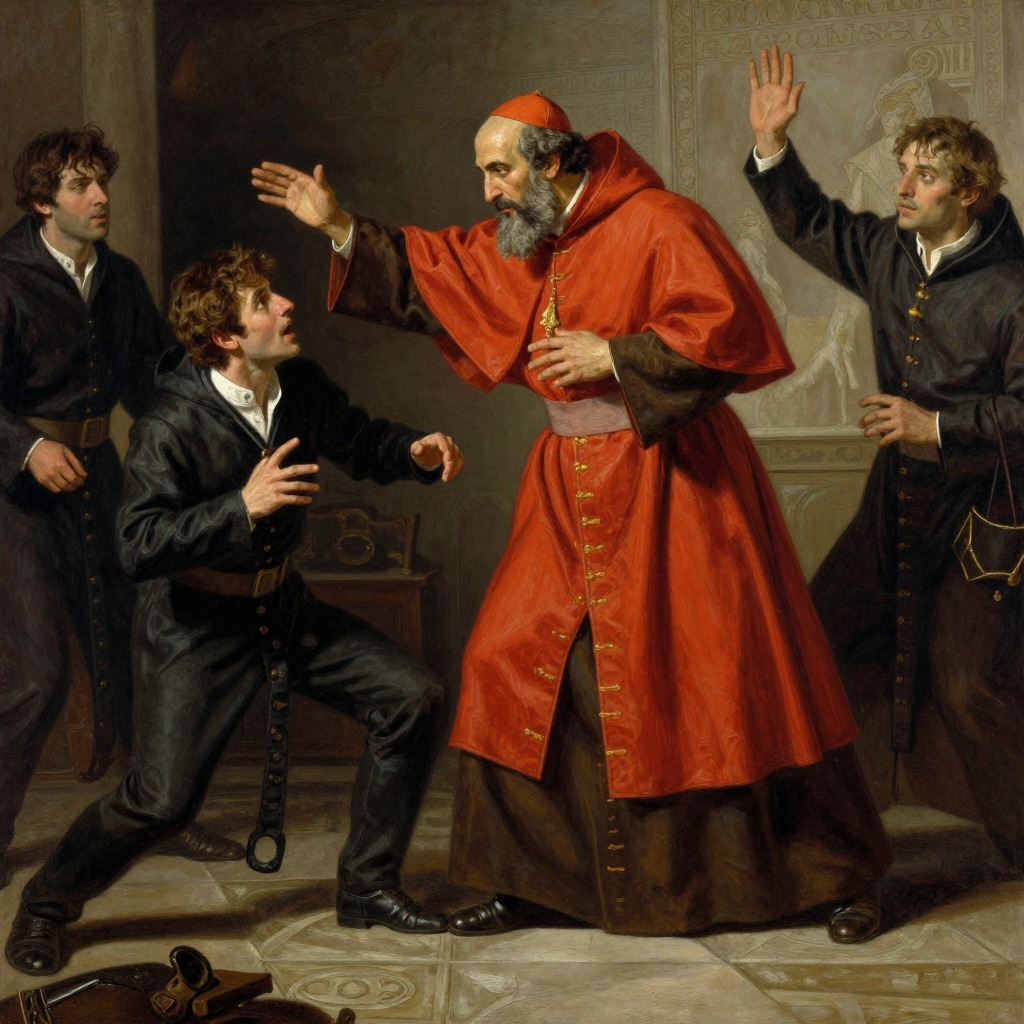
Five months before the novel's main events, Bishop Aringarosa is summoned to Castel Gandolfo without explanation. He arrives expecting a photo opportunity celebrating Opus Dei's new World Headquarters in New York City, which Architectural Digest had called "a shining beacon of Catholicism sublimely integrated with the modern landscape." Instead, he is met in the dimly lit Astronomy Library by three men: the obese Secretariat Vaticana, overlord of all legal matters within Vatican City, and two high-ranking Italian cardinals. The secretariat informs Aringarosa that the Secretariat Council has voted unanimously to revoke the Vatican's sanction of Opus Dei, giving the prelature six months to break away voluntarily. The reasons cited include Opus Dei's aggressive recruiting policies, its practices of corporal mortification, and its policies regarding women. Aringarosa protests that Opus Dei is the only Catholic organization whose numbers are growing, with over eleven hundred priests, but the secretariat calls this "a troubling issue." When Aringarosa reminds them of Opus Dei's financial assistance to the Vatican Bank in 1982, the secretariat implies that this assistance was the only reason Opus Dei was granted prelature status in the first place and offers to reimburse the money in five installments. Aringarosa refuses to accept the decision and demands to see the Pope, but is told the Holy Father no longer cares to meet with him.
Consequences and Narrative Significance
The meeting at Castel Gandolfo leaves Aringarosa devastated and desperate. Weeks later, he receives a phone call from a man calling himself the Teacher, who claims to know of the Vatican's plans and proposes a scheme to uncover a sacred relic that would bring Aringarosa enough power to make the Vatican bow before him. The Teacher's plan requires Aringarosa to put Silas under the Teacher's command and to obtain twenty million euro in Vatican Bank bearer bonds—funds that Aringarosa secures during a second, tense visit to Castel Gandolfo on the night of the murders. The castle thus becomes the geographical and moral origin of the conspiracy: the place where the Church's rejection of Opus Dei creates the desperation that the Teacher exploits, and where the financial instruments for the Teacher's payment are obtained. The castle's dual identity—a place of astronomical science and papal power—mirrors the novel's central tension between revealed truth and institutional authority.