Louvre Museum
The Da Vinci CodeThe Louvre Museum, officially the Musée du Louvre, is the world's most famous art museum, housed in a monolithic Renaissance palace in Paris. In The Da Vinci Code, it is not merely a backdrop but an active participant in the narrative, a vast repository of art and secrets where the novel's central murder occurs and where its deepest mystery is finally resolved. The building's architecture, from its controversial glass pyramid to its hidden subterranean chambers, is woven into the plot as a series of symbols and clues.
Architecture and Symbolism
The Louvre's most prominent modern feature, the glass pyramid designed by I. M. Pei, serves as the museum's main entrance. The pyramid is described as a controversial neomodern structure, hailed by some as a dazzling synergy of ancient and modern, but scorned by traditionalists who feel it destroys the dignity of the Renaissance courtyard. It was commissioned by the late French president François Mitterrand, a man with an affinity for Egyptian culture so consuming that the French still referred to him as the Sphinx. The pyramid was constructed of exactly 666 panes of glass at Mitterrand's explicit demand, a fact that is a hot topic among conspiracy buffs who claim 666 is the number of Satan. Beneath the pyramid lies a 70,000-square-foot subterranean lobby, built fifty-seven feet below ground level, which is usually vibrant with sunlight and tourists but becomes a cold, crypt-like atmosphere when empty at night. The museum also features a lesser-known pyramid, La Pyramide Inversée, a huge inverted skylight that hangs from the ceiling like a stalactite in an adjoining section of the entresol. This inverted pyramid, a V-shaped contour of glass, is ultimately revealed to be the Chalice, the feminine symbol guarding the Holy Grail.
The Crime Scene and Investigation
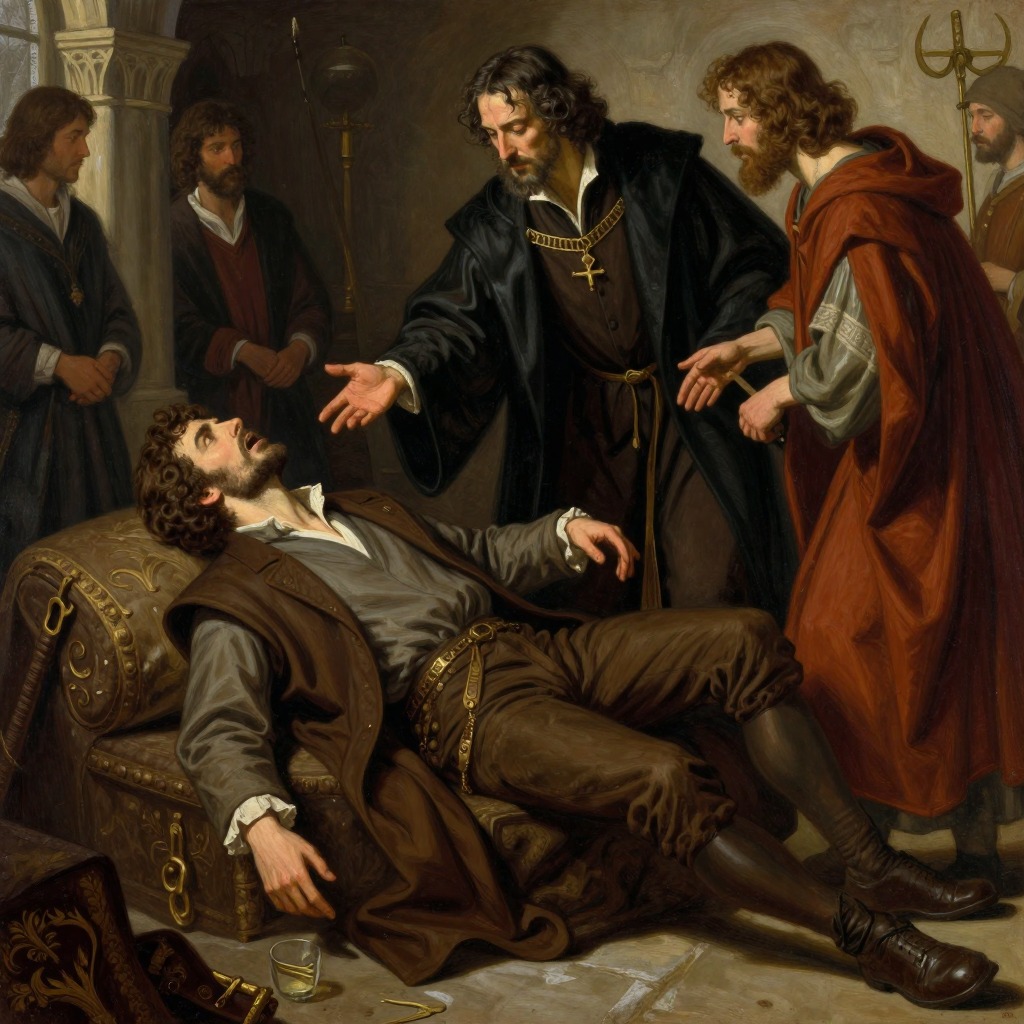
The novel opens with the murder of renowned curator Jacques Saunière inside the Grand Gallery, the Louvre's most famous section. Saunière, after being shot, staggers through the vaulted archway of the Grand Gallery and pulls a Caravaggio from the wall, activating a security gate that traps him inside. He then arranges his own body in the shape of Leonardo da Vinci's Vitruvian Man, draws a pentacle on his abdomen with his own blood, and scrawls a cryptic message on the floor using a black-light pen. The message, which includes a Fibonacci sequence and the anagram "O, Draconian devil! Oh, lame saint!" (which decodes to "Leonardo da Vinci! The Mona Lisa!"), is intended for his granddaughter, Sophie Neveu. The investigation is led by Captain Bezu Fache of the French Judicial Police, who initially suspects Robert Langdon, a Harvard professor of religious symbology who had been scheduled to meet Saunière. The Louvre's security systems, including its containment security and red service lighting, play a crucial role in the investigation, creating a dark, oppressive atmosphere that heightens the suspense.
The Final Revelation
In the epilogue, Robert Langdon, having solved the final clues, returns to the Louvre. He follows the ancient Rose Line, the earth's original prime meridian, which is marked by 135 bronze medallions embedded in the streets of Paris. This line leads him directly to the Carrousel du Louvre, where he stands before La Pyramide Inversée. Looking down through the glass, he sees the miniature pyramid directly beneath it, a small structure protruding up through the floor. He realizes that the two pyramids—the inverted one above and the small one below—form the blade and chalice, the male and female symbols guarding the Holy Grail. The Holy Grail, he understands, rests beneath the starry skies, at the heart of the Louvre, the very place where Saunière had kept watch. The novel concludes with Langdon falling to his knees in reverence, hearing the wisdom of the ages whispering up from the chasms of the earth.