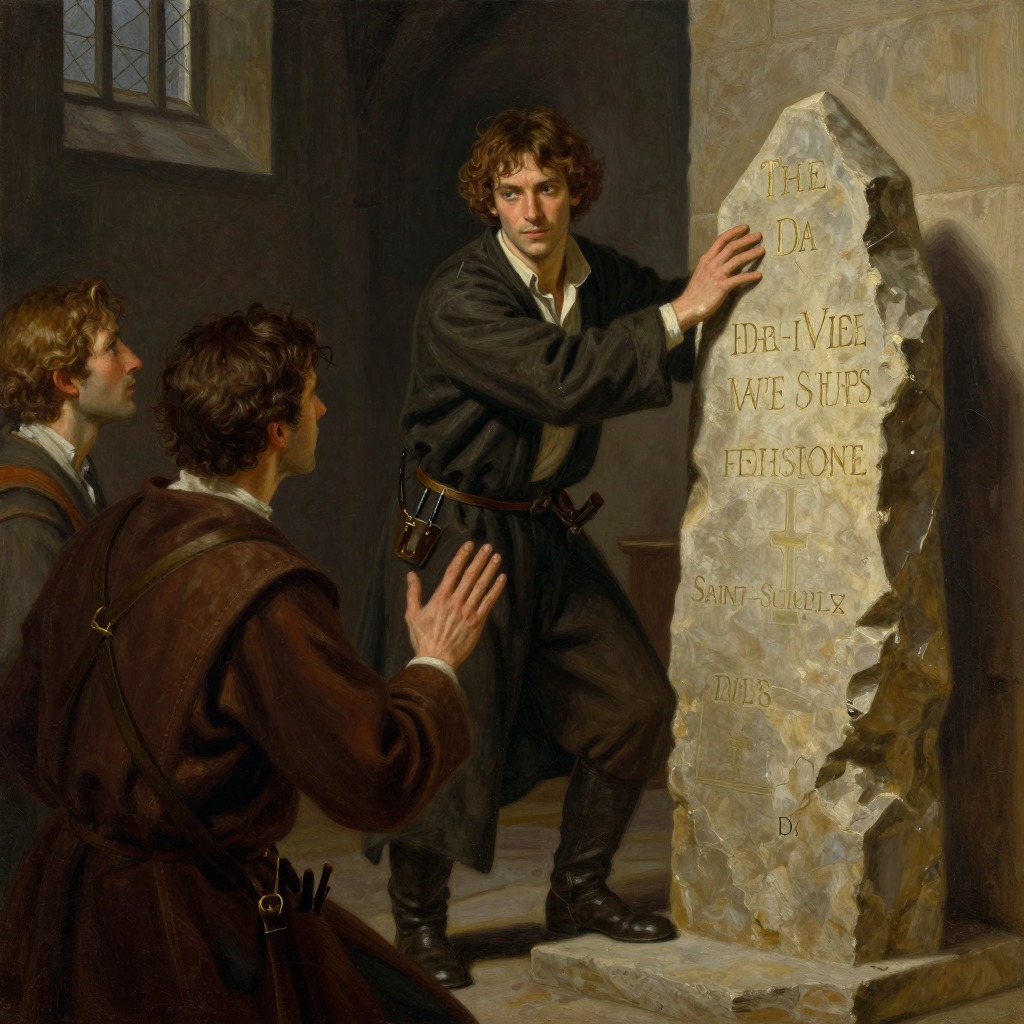
Saint-Sulpice Obelisk
The Da Vinci CodeThe Saint-Sulpice Obelisk is a massive marble shaft standing at the base of the brass Rose Line within the Church of Saint-Sulpice, a building whose history is as eccentric as any in Paris. The church itself was built over the ruins of an ancient temple to the Egyptian goddess Isis, and its architectural footprint matches that of Notre Dame to within inches. The obelisk, rising thirty-three feet to a pyramidical apex, is the terminal point of a thin, polished brass strip embedded in the gray granite floor—a gnomon, or pagan astronomical device, that marks the world's first prime meridian, the original Rose Line, which passed through Paris before Greenwich stripped the city of the honor in 1888.
The Obelisk as the Target of Silas's Quest
Silas, acting on information extracted from the four murdered Priory leaders, believes the keystone is hidden beneath the Rose Line at the base of the Saint-Sulpice obelisk. He enters the church, having been granted access through a call from Bishop Aringarosa to the abbé, and after dismissing the nun Sister Sandrine, he kneels at the obelisk's base. He runs his hands across the stone floor, rapping his knuckles on each tile adjacent to the brass line until one echoes strangely, revealing a hollow area beneath. Using a heavy iron votive candle holder as a battering ram, he shatters the marble covering and retrieves a stone tablet from the compartment. The tablet bears a simple inscription—"Job 38:11"—which Silas interprets as a Bible verse leading him to the altar, only to find the verse reads "Hitherto shalt thou come, but no further," a cruel dead end.
The Obelisk as a Signal for the Priory's Sentry
Sister Sandrine, who has been watching Silas from the choir balcony, recognizes the threat. She is more than the church's conservatrice d'affaires; she is a sentry for the Priory of Sion. The arrival of the monk at the obelisk is a silent call of distress, a signal that the upper echelon has been breached. She retrieves a sealed envelope hidden beneath her bed frame containing four Paris phone numbers, which she begins to call, only to discover that the first three contacts are already dead. Before she can complete her warning, Silas finds her and, in a rage, kills her with the iron candle stand, believing she has scorned the work of Opus Dei.
The Obelisk's Narrative and Thematic Significance
The Saint-Sulpice Obelisk functions as a powerful symbol of the Priory's layered deception and the Church's historical manipulation of sacred sites. The obelisk, a pagan artifact, stands within a Christian church, marking a line that once defined the world's geography. Silas's quest for the keystone beneath it is a literal and figurative search for a truth that is not where he expects it to be. The obelisk's connection to the Rose Line, a symbol of secrecy, womanhood, and guidance, ties it directly to the novel's central themes of the sacred feminine and the hidden history of Mary Magdalene. The structure itself becomes a monument to a lost truth, a physical point on a map that leads not to the Grail, but to a deeper understanding of the Priory's protective measures and the lengths to which they will go to guard their secret.