1961 Algiers putsch
The Day of the JackalThe 1961 Algiers putsch was a failed revolt by French military officers who sought to prevent Charles de Gaulle from abandoning French rule in Algeria. Its decisive reversal came not through a conventional battle but through a radio broadcast: when the army’s loyalty was tested, De Gaulle’s appeal reached conscripts across the territory and helped break the mutiny. The defeat scattered the conspirators’ hopes of winning the army as a whole, while Rodin’s surviving followers became part of the underground movement that continued the struggle.
Causes and political setting
Rodin’s path to the putsch had been shaped by years of combat and by his belief that politicians had betrayed the soldiers who fought in the Indochina theater where Rodin served. The French withdrawal from that conflict deepened his loathing of politicians and Communists, whom he regarded as one and the same. Having seen men die in combat, he revered soldiers as people who sacrificed themselves for civilians; he interpreted civilian criticism of the military, including criticism of torture, as further evidence that the army was unsupported by the society it defended.
When Rodin was sent to Algeria in 1956, he treated the conflict as a chance for the army to redeem that earlier defeat. He believed that the army could still prevail if the authorities and the public backed it. As the rebellion spread, he discounted its growing costs and the demoralization of conscripts. In the cities, his campaign against bombers earned him the name “Butcher” in the Casbah. His military convictions had become inseparable from a political program: he expected the French state to preserve Algeria as French territory and regarded retreat as another betrayal.
De Gaulle’s return to power in 1958 initially seemed to confirm Rodin’s hopes. The founding of the Fifth Republic established by de Gaulle and the general’s use of the words “Algérie Française” led Rodin to expect full support for the army and the settlers. But De Gaulle’s actual policies, and the eventual evidence that his vision for France did not include a French Algeria, shattered that expectation. Rodin’s response was not to reconsider his faith in military rule but to turn his anger against De Gaulle and the political system.
The revolt and its defeat
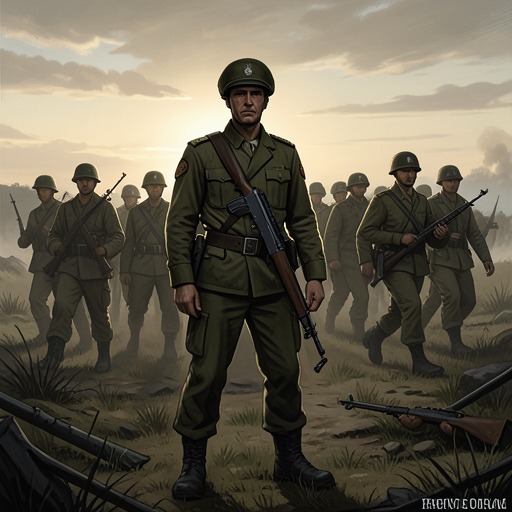
Rodin led almost his entire battalion into the April 1961 putsch, with only a few young officers refusing to join. The revolt depended on military loyalties that its leaders assumed they could command. De Gaulle’s government, however, had already placed a simple means of communication in the hands of the troops: thousands of transistor radios had been distributed in the weeks before the announcement that talks with the FLN would begin. Many officers and senior noncommissioned officers considered the sets harmless, useful chiefly for bringing music from France to soldiers enduring heat, flies, and boredom.
The radios became decisive when the army’s allegiance was put to the test. Tens of thousands of conscripts in barracks across Algeria turned them on for the news and then heard De Gaulle speak directly to them: “You are faced with a choice of loyalties. I am France, the instrument of her destiny. Follow me. Obey me.” The broadcast invoked the same voice Rodin had heard in June 1940, but now it was directed at troops whose loyalty the putschists needed. Some battalion commanders awoke to find that only a handful of their officers and most of their sergeants remained with them. The mutiny was broken before it could establish itself as a successful seizure of power.
The remaining force and the Secret Army Organisation
Rodin was less isolated than many commanders. One hundred and twenty of his officers, noncommissioned officers, and rankers remained with him, in part because his unit contained a higher proportion of experienced soldiers from the Indochina theater and the Algerian countryside. That surviving group did not reverse the putsch’s defeat, but it gave Rodin a body of committed followers after the wider army had failed to rally behind the revolt.
Together with other putschists, Rodin and his remaining men formed the Secret Army Organisation. The new organization’s members were bound by opposition to De Gaulle, whom they regarded as a traitor, and by the hope of overturning his government. The transformation mattered: the failure of an attempt to mobilize the army did not end the conflict. It shifted part of the struggle from an open military revolt toward an underground organization operating beyond the reach of ordinary command structures.
Aftermath and significance
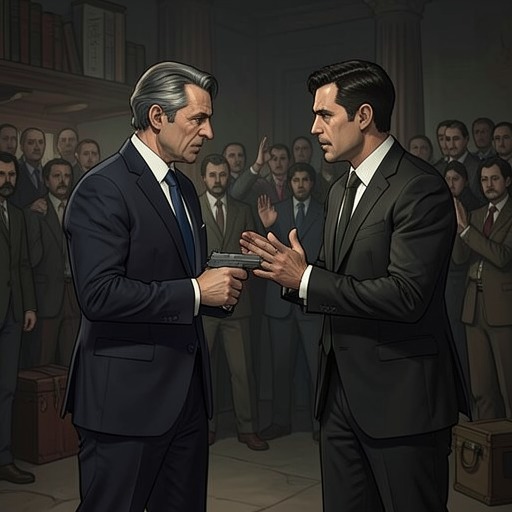
The putsch’s defeat helped set the course of Rodin’s subsequent career in exile. In the winter of 1961 he became deputy to Antoine Argoud, the OAS operations chief whose role included directing the organization’s campaign against Gaullist France. Argoud’s capture later left Rodin to assume command of operations aimed at assassinating De Gaulle. The succession illustrates how the movement adapted after losing its chance to act through a substantial part of the army: its surviving military personnel and organizers turned toward clandestine action.
The episode also exposes the opposing forms of authority at the center of the conflict. Rodin believed that the army, formed by combat and sacrifice, should determine the state’s course; De Gaulle appealed over the heads of rebellious officers to the conscripts themselves. The transistor radios, initially accepted as a modest comfort for troops, became instruments through which that appeal could reach them. The putsch failed not because Rodin’s followers had vanished, but because their loyalty was not enough to carry the army with them. Their survival gave the rebellion another form, while the broadcast made plain that the army’s allegiance could not simply be assumed by its commanders.