Algerian independence and the end of French rule
The Day of the JackalAlgerian independence and the end of French rule mark the political rupture at the heart of the novel’s account of Marc Rodin and the Secret Army Organisation. The transition is shown less as a single decision or battlefield outcome than through its consequences: a colonial war that Rodin believes could still be won, Charles de Gaulle’s turn toward negotiations, the collapse of a military putsch, and the flight of French settlers. For Rodin, withdrawal is not merely the loss of territory. It destroys his faith in the army’s political purpose and redirects his allegiance toward an underground campaign against the government he believes has betrayed it.
The colonial war and Rodin’s expectations
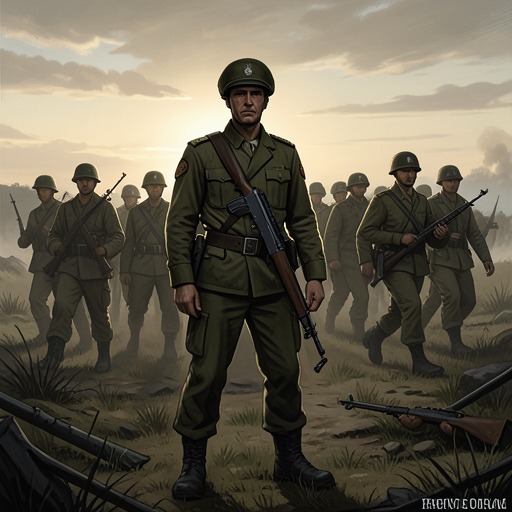
Rodin’s understanding of the conflict takes shape through years of military service and accumulated disappointment. After serving in a colonial regiment and becoming a company commander during the campaign in Indo-China, he is promoted to major. The French withdrawal from that war, followed by an unhappy year at home, deepens his contempt for politicians and Communists, whom he regards as interchangeable. He comes to believe that only rule by a soldier can rescue the country from civilian politicians and what he sees as their disloyalty to the army.
The novel links that political conviction to Rodin’s experience of combat. He reveres soldiers as men who endure and die so that civilians can live in comfort. The criticism of military conduct he encounters after returning home, including criticism of the torture of prisoners for information, sharpens his sense that civilians neither understand nor value the army’s sacrifices. He sees the French withdrawal from Indo-China as a betrayal of the men who died there and resolves that there must be no repetition. When he is sent to Algeria in 1956, he believes the campaign will vindicate the army and restore its standing.
His early confidence is not shaken by the widening rebellion. Rodin and his men shoot insurgents, villages are razed, and prisoners are tortured, yet the revolt spreads through the countryside and into the cities. His answer is that the military needs more support from the government at home. He regards the territory as an integral part of the nation, inhabited by three million Frenchmen, and expects it to be defended like a region of metropolitan France. After becoming a lieutenant-colonel, he moves from the countryside to the cities, first Bone and then Constantine. There, the conflict changes in his eyes: bombs planted in cafes, supermarkets, and play areas turn the urban struggle into a war against civilians as well as insurgents. The measures he takes in Constantine earn him the name Butcher in the Casbah.
De Gaulle’s reversal and the failed putsch
When Charles de Gaulle returns to power in 1958 and establishes the French Fifth Republic, Rodin initially believes that a soldier at the head of government will supply the support he has long demanded. He interprets de Gaulle’s declaration of French sovereignty over the territory as a promise of decisive action. The novel emphasizes the distance between that expectation and the policy that follows: Rodin imagines an assault on Communists, intellectuals, and trade unions, and a military victory; de Gaulle instead begins measures that lead toward talks with the National Liberation Front.
Rodin first treats rumors of negotiations as something temporary, a tactical choice by a leader who must know what he is doing. Proof that de Gaulle’s vision of national renewal does not include continued French rule shatters that trust. The betrayal Rodin perceives is political rather than personal: he has lost nothing directly through withdrawal, but believes the government has abandoned the army, the settlers, and the cause for which soldiers died. His response is hatred of the political system and, above all, of the president whose authority he had once welcomed.
Rodin leads almost his entire battalion into the April 1961 putsch. The attempt fails before it can gain momentum, in part because de Gaulle’s government has prepared the ground among the troops. Radios distributed to soldiers as an apparently harmless diversion become a means for the president to address them directly. Across barracks, conscripts hear the same appeal to loyalty; commanders wake to find that many officers and sergeants have left them. The radios, initially treated as a comfort in the heat and boredom of military life, thus become instruments of political authority and help break the mutiny.
From mutineers to an organisation in exile
Rodin retains 120 officers, non-commissioned officers, and enlisted men. His unit contains a larger proportion of experienced soldiers from Indo-China and the Algerian countryside than many other units, and those veterans remain with him when the wider army fractures. Together with other putsch participants, they form the Secret Army Organisation, pledged to overthrow the president. Independence and the end of French rule therefore do not conclude the novel’s conflict: they help transform a failed attempt to preserve colonial authority into an underground campaign against the government.
The final retreat is presented as both political defeat and material dislocation. As the National Liberation Front triumphs, French settlers sell the work of their lives for little and flee the war-torn coast. In the last seven weeks, Rodin’s organisation exacts what the narrative calls a final revenge on what the settlers are leaving behind. The account does not treat that violence as an alternative route to retaining the territory; it shows the destruction accompanying withdrawal and the narrowing choices left to a defeated movement. For the leaders known to the government, exile follows.
The legacy of withdrawal
The event’s consequences persist in the structure and aims of the opposition. In the winter of 1961, Rodin becomes deputy to Antoine Argoud, the operations chief of the Secret Army Organisation in exile. Argoud supplies flair and inspiration for the campaign against metropolitan targets; Rodin contributes organisation, cunning, and practical judgment. Their partnership connects the collapse of the putsch to the later assassination plans: the military defeat does not dissolve the cause, but relocates its surviving leadership and changes its methods.
The novel also makes clear that Rodin’s interpretation is not a neutral account of independence. He understands the territory as inseparable from the nation, discounts the economic costs of the war and the demoralisation of conscripts, and treats further force as the obvious solution. His conviction that more support could have defeated the National Liberation Front shields him from evidence that the war is becoming unwinnable. By placing that certainty beside the army’s fracture, the settlers’ flight, and the formation of an exile organisation, the narrative shows how a political ending can be experienced by its opponents as both a national decision and a private collapse of faith. The end of French rule becomes the decisive break that carries Rodin from serving a state to trying to destroy its government.