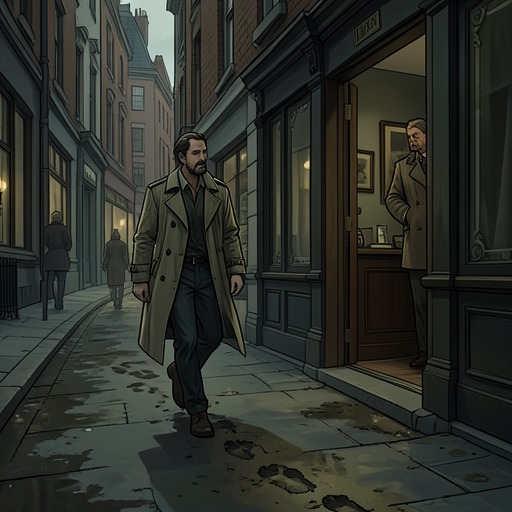
Barrie Lloyd
The Day of the JackalBarrie Lloyd is a Secret Intelligence Service officer whose specialist knowledge helps Bryn Thomas extend the search for an unidentified political assassin beyond ordinary police records. A former rugby player and a discreet colleague of Thomas, Lloyd retrieves a dismissed report about the assassination of Rafael Trujillo and uncovers the name Charles Calthrop. His contribution is not a confirmed identification: the report rests on island gossip. Its value lies in turning a vague description of a possible British contract killer into a specific lead that can be checked against the wider investigation.
Identity and position
Lloyd works for the Secret Intelligence Service, in a department operating under the auspices of the Foreign Secretary but not attached to the Foreign Office. The public, the narrative notes, commonly calls the organization MI-6, an incorrect name. The distinction places Lloyd within an intelligence service separate from Thomas’s police work, and helps explain why Thomas approaches him when ordinary criminal records and Special Branch inquiries have produced no answer.
Lloyd is also part of the London Welsh rugby club’s circle. Thomas knows him through the club, where Lloyd is known to the other members as a Foreign Office employee. Thomas understands that Lloyd’s actual position is more sensitive. The discrepancy between the public impression and the work behind it gives their meeting its understated character: an apparently familiar sporting connection provides access to a source of information that routine police searches have not reached.
Thomas’s request
Thomas has two years remaining before retirement and is careful enough to check his information rather than assume that an old rumor will be useful. He asks Lloyd to meet in a quiet riverside pub between eight and nine. They begin by talking rugby and exchange the routine greeting over their drinks, but Lloyd quickly recognizes that the meeting is not about the coming season. Thomas leads him out to the terrace by the wharf, away from the young couples leaving for dinner, and explains the request from Paris and the blank drawn by Criminal Records and Special Branch.
Thomas’s reasoning is specific: if a British assassin of the kind sought by the French authorities exists, he might avoid committing crimes in Britain and operate abroad instead. Any trace might therefore have come to the attention of the Service. Lloyd does not claim immediate knowledge of such a man. Instead, he recalls a potentially relevant episode from the Service’s own files, shifting the inquiry from an unsupported guess toward a record that can be retrieved and assessed.
The report about Trujillo
Lloyd’s recollection begins with the damage caused by the Philby affair. Philby had gone over from Beirut in January 1961, although the news became public later. The exposure caused serious disruption inside the Service: personnel were moved, and much of the Arab Section, along with other parts of the organization, had been compromised. Lloyd recalls that one of the men moved quickly was the Service’s top resident in the Caribbean, who had been with Philby in Beirut six months earlier and was then transferred to the Caribbean.
Around the same period, Rafael Trujillo, the dictator of the Dominican Republic, was assassinated on a lonely road outside Ciudad Trujillo. The reported account said that partisans stopped his car and that a single marksman’s rifle shot initiated the attack. From about one hundred and fifty yards, the shot passed through the small triangular window on the driver’s side—the one section not made of bullet-proof glass—and struck the driver in the throat. The car crashed, and the partisans then closed in. The vehicle was armored, and the target was moving at speed, making the reported shot an unusually demanding one. The rumor that the shooter was English gives Thomas a possible connection to the kind of overseas professional he is seeking, but it does not establish who fired it.
From rumor to a name
Lloyd is careful about the quality of the information. He describes the surviving record as a routine report of a rumor circulating on the island, marked “No action to be taken” almost as soon as it was filed. The low priority and uncertain source matter: the account is not an official finding that an Englishman carried out the assassination, still less proof that the same person is now being sought. Lloyd presents it as a lead whose limitations should remain visible.
At Thomas’s request, he checks the files for the identity of the reported marksman. Just after midnight, on August 13, he calls Thomas at home with the result: the gossip had linked the killing to a British businessman on the island who disappeared around that time. The name in the report is Charles Calthrop. Lloyd emphasizes that Calthrop might have had nothing to do with the assassination; his name was connected to it only through the island’s rumor. The distinction between a recorded association and a verified fact is central to the clue’s proper use.
Narrative role
Lloyd’s brief appearance shows how the investigation can advance through personal access as well as formal authority. Thomas has been entrusted with extensive police resources, but an international appeal cannot by itself retrieve knowledge held in another organization’s old, overlooked files. Lloyd supplies the institutional route to those records, then tests Thomas’s memory of the rumor against the surviving report. The result is neither a solution nor a certainty. It is a name, a location in the assassin’s possible past, and a reason to continue checking.
That modest contribution suits the procedural shape of the search: information emerges in fragments, each carrying its own provenance and degree of reliability. Lloyd does not convert rumor into proof, and the report does not settle Calthrop’s involvement. Instead, his disciplined retrieval makes an uncertain story usable without disguising its uncertainty, helping the police inquiry move from the general profile of a foreign-operating political assassin toward an identifiable British suspect.