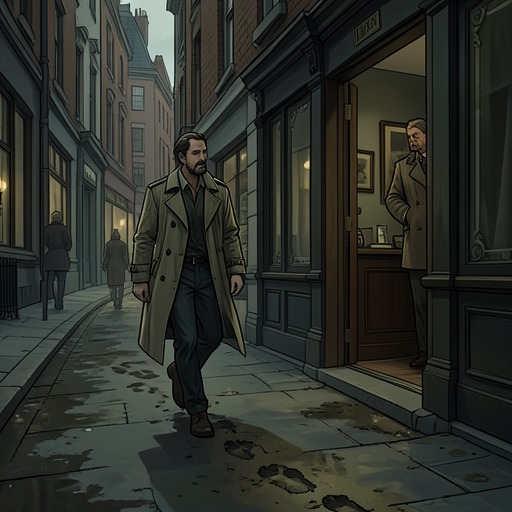
Bryn Thomas
The Day of the JackalBryn Thomas is the Superintendent of Special Branch whose investigation gives the British side of the manhunt its decisive lead: the identification of Charles Calthrop as The Jackal. Initially faced with little more than a French request to name any professional political assassin known to British files, Thomas moves from a negative records search to a second, more searching inquiry. His contribution is not a solitary stroke of intuition but a sequence of judgments: he doubts the official-looking blank, consults a trusted contact, revisits neglected information, and organizes investigators around the resulting evidence.
Identity and investigative temperament
Thomas is an experienced police officer nearing retirement, with two years left before he expects to return to the little house he and Meg bought overlooking the Bristol Channel. The case reaches him under pressure: after hours of calls checking people surfaced in records and files, each lead has proved negative. He is physically worn down by a raw throat, a heavy cold, a headache, and the cigarette smoke of a long day, yet he continues to test whether the absence of a match means the search itself has been too narrow.
That doubt grows out of professional pride. Thomas considers the record of Scotland Yard, and especially Special Branch, a point of personal responsibility. He recalls helping to look after Ivan Serov, head of the KGB, before Khrushchev’s visit, when Serov was surrounded by armed security men and other people wanted to attack him. The visit passed without even a shooting. Thomas’s memory of that success does not make him complacent; it makes the possibility of a threat on British soil harder to dismiss. He decides that it is safer to check everything than to file a clean but potentially premature report.
From a blank search to a live inquiry
The original request comes from Paris through the French Judicial Police. Thomas understands that the French are asking for suggestions about a professional assassin, but the request supplies neither an explanation of the threat nor evidence that the suspect is English. The two young inspectors working with him find no suitable person in the records. One suggests that a contract killer might operate abroad and perhaps have come to the attention of the Secret Intelligence Service. Thomas initially tells him to leave the idea alone and prepares to write a report recording a complete failure.
After the inspector has gone, however, Thomas reconsiders the implications. If the French have little information and are checking internationally, an English-born suspect could still escape the domestic security files precisely because he worked outside Britain. The possibility is uncertain, but it is enough to make a negative report feel unsafe. Thomas reaches out to Barrie Lloyd, a contact in the Secret Intelligence Service, rather than treating the first search as conclusive.
The two meet in a quiet riverside pub, where Thomas explains the request from Paris and the failure of Criminal Records and Special Branch to identify anyone. Their conversation begins with rugby, but Thomas has asked Lloyd to meet for a reason. Later, after Thomas has gone home and is preparing to sleep, Lloyd telephones with news from an old file: the report was merely a routine account of a rumour circulating in Britain, marked for no action soon after it was filed. Its neglect is itself a clue to how little weight the earlier inquiry had received. Thomas’s willingness to ask again turns an apparently exhausted search into an active line of investigation.
Building the British investigation
When the British Prime Minister asks about the French inquiry, Thomas describes its limits plainly. The French have requested names of possible professional assassins; they have not explained why they want them. The exchange makes clear that Thomas is dealing with a danger whose scale is suspected but whose details remain withheld. He does not claim to know more than the request establishes.
Once the investigation develops, Thomas rapidly assembles a task force of six of Special Branch’s best detective inspectors. One is recalled from leave, two are diverted from watching a suspected source of classified information, two have already helped search the files, and the last is called in from his day off in a greenhouse. Thomas briefs the group exhaustively, requires secrecy, and directs the work through phone calls and records checks. The arrangement is practical and costly in personnel: the search for an unnamed assassin takes priority over other duties, while the requirement for silence limits who can be told why the work is being done.
A tax inquiry supplies the name that the earlier police-file search had not. The Inland Revenue finds the returns of Charles Calthrop, and Thomas obtains the man’s employment file. Calthrop had been unemployed for the previous year and had spent a year abroad before that. For most of the 1960–61 financial year, he had worked for a leading British manufacturer and exporter of small arms. Thomas recognizes the significance of the firm, finds its managing director, Patrick Monson, and drives to meet him that evening. Monson confirms that Calthrop worked there for just under a year and had been sent to Ciudad Trujillo in December 1960 and January 1961 to sell surplus British Army submachine guns to the police chief. The records have now connected a previously obscure candidate with arms, overseas travel, and an assignment involving weapons.
The identity behind the passport
The passport evidence sharpens the identification but also exposes a problem. Thomas’s colleague points to an entry recording travel to Ciudad Trujillo in December 1960, matching the arms firm’s account of Calthrop’s trip. Thomas accepts that the man is the one they are seeking, then immediately notices that the investigators are holding the very passport associated with the journey. The document confirms the travel history, but its presence in police hands raises the next question: what document is the suspect using now?
This moment captures Thomas’s method. He does not treat one confirming fact as the end of the inquiry; he asks what else must follow if the fact is true. A passport that links Calthrop to the overseas arms mission also makes it unlikely that he is travelling under that same identity. The identification therefore opens onto a wider search for an assumed name, rather than closing the case around the first name found in the records. Thomas’s subsequent work belongs to a multinational manhunt, but the British contribution has been made possible by his decision to reopen a supposedly negative search, consult Lloyd, and follow the administrative trail from tax returns to employment records, travel, and identity documents.
Narrative role
Thomas embodies the institutional labor behind the pursuit: files must be retrieved, old reports reconsidered, specialists approached, and inspectors reassigned before a name can be placed against the French warning. His caution is neither paralysis nor instant certainty. He first resists an unsupported suggestion, then revises that position when the possibility of an overseas operator makes the blank search less reassuring. The shift is small but consequential, and it gives the investigation a human measure of uncertainty: the danger is not yet proved, but the cost of failing to check is too high.
His investigation also supplies a contrast between official records and operational identity. Tax forms and an employer’s recollection reveal Calthrop’s past; the passport in police custody warns that the present-tense suspect may be moving under another name. Thomas’s work helps convert an abstract request about a hypothetical assassin into a traceable person, while leaving the central challenge unresolved: identifying the man is not the same as knowing where he is or what name he is using.