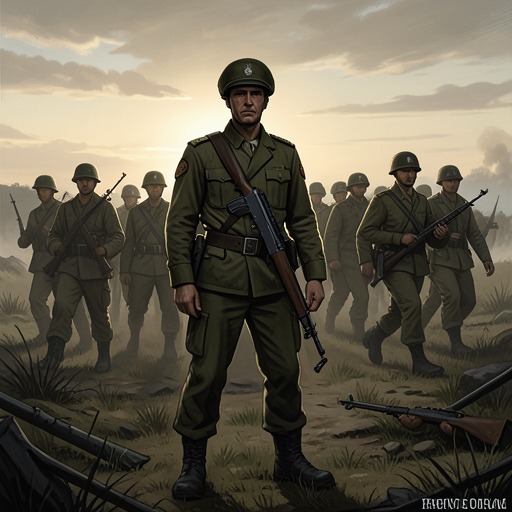
Charles de Gaulle's return to power in 1958
The Day of the JackalCharles de Gaulle’s return to power in 1958 was both a change of government and a turning point in Marc Rodin’s political life. De Gaulle displaced the failing Fourth Republic and founded a new republic; Rodin, a career officer shaped by colonial war, initially understood the change as a guarantee that the military would receive the backing it needed to retain French Algeria. When de Gaulle’s policy moved toward negotiations and the territory’s separation, that confidence gave way to hatred and armed opposition. The episode connects the novel’s political history to the OAS campaign against de Gaulle and, ultimately, the plot to assassinate him.
Political Return and a New Republic
In June 1958, de Gaulle returned to power as Prime Minister. He efficiently disposed of the corrupt and tottering Fourth Republic and founded the Fifth Republic. For Rodin, the change seemed to offer a decisive break with the civilian politicians he blamed for France’s failures. He had left Marseille for French Algeria in 1956 believing that the military campaign there could fulfill his life’s work and restore the Army’s standing. The new government appeared to give that belief a political future.
De Gaulle’s declaration of support for French Algeria was the signal Rodin had been waiting for. When de Gaulle visited the territory, Rodin experienced his presence as confirmation that the country’s leader would now act on behalf of the Army and the French settlers. Rodin expected political opponents to be swept aside, the trade unions subdued, and the military given the wholehearted support he believed necessary to defeat the insurgency. These were Rodin’s expectations, not policies that the novel presents as de Gaulle’s settled programme.
Rodin’s Expectations and Their Collapse
Rodin’s reading of de Gaulle drew on years of resentment. He believed that the French withdrawal from the Indochina theater where Rodin served had betrayed soldiers who had died there, and he resolved that there would be no comparable betrayal in French Algeria. He had fought in the countryside and later in the cities, where his measures against bombers brought him the name Butcher in the Casbah. The widening war and its costs did not shake his conviction that more support from the mainland could secure victory.
At first, de Gaulle’s actions did not immediately dislodge that faith. Rodin treated the first reports of preliminary talks with Ben Bella and the National Liberation Front as a possible tactical manoeuvre. He had sympathised with the 1960 settlers’ revolt but still believed de Gaulle knew what he was doing. The decisive break came when it became clear that de Gaulle’s vision of a restored France did not include French Algeria. Rodin’s faith and hope collapsed into hatred directed at the political system and, above all, de Gaulle himself. The return to power that he had welcomed thus became the precondition for his revolt against the new regime.
From Disillusionment to the Putsch
Rodin led almost his entire battalion into the April 1961 Algiers putsch. De Gaulle defeated the challenge before it could gain momentum, using radio to reach troops across the territory. In the weeks before the crisis, simple transistor radios had been distributed to soldiers and treated by many officers as harmless entertainment. When the Army’s loyalty was tested, conscripts heard de Gaulle’s appeal over those same sets. The radios that had seemed a comfort in the barracks became a means of breaking the mutiny.
Rodin retained 120 officers, non-commissioned officers, and enlisted men, in part because his unit contained more veterans of Indochina and the Algerian countryside than most. With other putschists, they formed the Secret Army Organisation, pledged to overthrow de Gaulle. The political transition of 1958 therefore did not simply replace one republic with another in the novel’s account: it generated competing claims to national loyalty, and Rodin’s military allegiance hardened into an underground campaign against the head of state.
Consequences in the Assassination Plot
After the putsch failed, Rodin became deputy to Antoine Argoud, the OAS operations chief in exile. Argoud supplied the initiative behind the organisation’s offensive against metropolitan France; Rodin brought organisational skill and strategic caution. When the Action Service removed Argoud, Rodin assumed command of operations aimed at assassinating de Gaulle. The shift from political disappointment to attempted assassination is presented as a consequence of the conflict opened by de Gaulle’s return, but it is not treated as inevitable: it follows from Rodin’s particular conviction that the military had been betrayed.
The novel later places this history in the shadow of a public commemoration of liberation. De Gaulle refuses to alter his published itinerary, and the ceremony proceeds amid extensive policing and protective arrangements. The contrast is sharp: the leader whose return had once seemed to Rodin a promise of military triumph is now the target of an OAS operation, while the public rituals of national memory proceed under threat. The return of 1958 matters, then, not only as the establishment of a republic but as the political reversal that gives Rodin’s radicalisation and the later assassination conspiracy their historical logic.