Claude Lebel
The Day of the JackalClaude Lebel is the painstaking French detective entrusted with identifying and stopping the Jackal, the professional assassin planning to kill Charles de Gaulle. His importance lies not in a single stroke of intuition but in the disciplined accumulation of records, conversations, and field reports. As the investigation grows into a race against an adversary who repeatedly learns how close the police are, Lebel makes routine procedure itself a weapon—and must also recognize that the pursuit’s failures are being shaped by a leak.
Identity and Appointment
Lebel has spent twenty years in police work, beginning as a young detective in Normandy under the French Fourth Republic. He has become Chief of the Homicide Division and is known as a good, careful officer: slow, precise, methodical, and painstaking. His working assumption is that most effective police work is unspectacular—checking and double-checking, and joining separate pieces of information until they form a case capable of standing up in court. He has occasional flashes of inspiration, but he does not mistake inspiration for a substitute for the routine that makes a conclusion dependable.
His appointment to the investigation follows the death of Commissaire Hyppolite Dupuy, the Deputy Chief of the Brigade Criminelle, who suffers a severe stroke at the Paris Judicial Police headquarters at Quai des Orfèvres. A short notice in Le Figaro announces that Lebel will take over Dupuy’s duties immediately, citing the summer pressure on the department. The Jackal reads the notice in London after noticing the word Criminelle in its headline, but attaches no importance to the change. The succession therefore places Lebel in position just as the threat is becoming urgent, while the future opponent remains unaware of the detective who will pursue him.
When the Minister of the Interior briefs him, Lebel is told that he is the best detective in France. He emerges from the fifty-minute meeting dazed and bewildered by the scale of what has been placed before him. The compliment does not make the assignment seem simple: the police do not yet know the suspect’s name, have only a poor description, and are still assessing whether the tip concerns a formed intention or an operation already in preparation. Lebel must build an investigation around a criminal whose identity and timetable are both hidden.
Method and the Secret Investigation
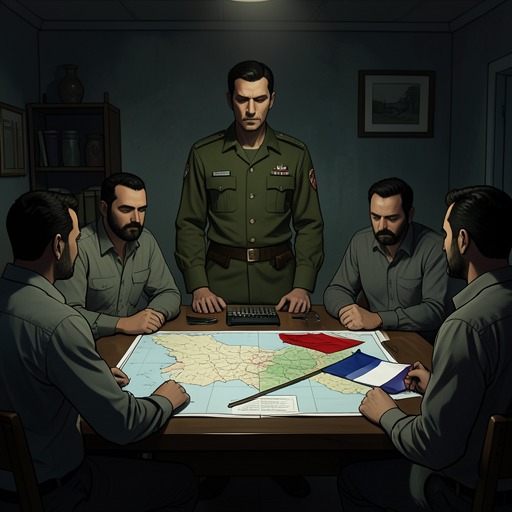
Lebel’s first response is organizational. He points out that he and his assistant have unusually broad powers, then turns those powers into a tightly controlled working arrangement. He orders his normal secretary transferred or placed on paid leave so that no one outside the secret team can enter the office. His assistant is to serve as secretary as well; a camp bed, linen, washing and shaving supplies, and a coffee percolator are brought in. The details establish the investigation as an improvised, round-the-clock operation rather than a normal departmental enquiry.
He also directs that seven calls be arranged through the International Criminal Police Organization’s communications facilities, at twenty-minute intervals between seven and ten in the morning. Each is to be a person-to-person call on a UHF frequency, with no listening in. The police chiefs receiving them are to understand that the information is for their ears alone and may concern not only France but their own countries. This secrecy reflects the unusual reach of the suspected assassin: Lebel’s first practical hypothesis is that the foreigner, if listed anywhere, is more likely to appear in a foreign police file than in French records.
In his initial approach to a foreign commissioner, Lebel carefully distinguishes an official capacity from a formal enquiry between police forces. He cannot yet present the matter as an established criminal investigation between the two services; for the moment, he describes it as a routine tip-off and acknowledges how little is known. He then defines the kind of person they need to identify: not a gangland gunman, but a political assassin with several successful killings behind him. The distinction turns a vague request for information into a search for a particular professional profile, while keeping the uncertainty of the case explicit.
Lebel later briefs senior officials on what has been done: French files have been checked, the foreign-file hypothesis has gained support, permission has been obtained to make enquiries abroad, and person-to-person calls have been arranged with police chiefs in seven major countries. His approach makes the investigation dependent on many people and systems, but keeps the central task legible: identify a man first, then locate him under whatever name he is using.
Clues, Hypotheses, and Reversals
Lebel’s reasoning repeatedly weighs competing explanations instead of treating the first plausible one as fact. After seventy-two hours of investigation, he explains that the assassin alone knows his timetable. The police cannot tell where in that schedule they intervened, and they do not know what the killer has learned beyond the existence of the plot. Lebel sees an opportunity in that uncertainty: if the police can identify and locate the man under his new name, they may still catch him unaware. The plan depends on distinguishing what the police know from what the assassin knows.
The archive search for Alexander Duggan produces a concrete lead. Records show that Alexander James Quentin Duggan entered France on the Brabant Express from Brussels on July 22. A separate report from the customs unit that checks passengers on trains while they are moving records him travelling from Paris to Brussels on the Etoile du Nord Express on July 31. These entries turn an alias into a traceable sequence of movements. A subsequent call to the Milanese police yields a more immediate location: Duggan has registered at the Hotel du Cerf in Gap for two days, beginning the previous night.
When another official proposes that the assassin may have abandoned the operation after receiving a message from Marc Rodin, Lebel calmly identifies the weakness in that conclusion. It assumes that the Jackal has in fact decided to stop. He may not have received the message, or he may have received it and chosen to continue. Lebel’s refusal to build the response around an unverified decision leads the room to accept his orders, although the other men present outrank him. His authority here comes from testing what a theory assumes, not from rank.
The trail then goes cold for three days. At each evening meeting, more people conclude that the Jackal has secretly left France; by the meeting on the nineteenth, Lebel is alone in maintaining that the killer remains in the country, lying low and waiting. He orders a team to Ussel and specifies how to search: start where the car was found, use that point as the centre of a square on the map, and ask at every farmhouse, among farmers who regularly use the road, and at village shops, cafés, hotels, and woodcutters’ shelters. The search is deliberately local and exhaustive, designed to recover the human observations that a central file cannot supply.
Lebel connects the car evidence to the suspect’s possible escape from Gap. If the vehicle was driven overnight from Gap to Ussel already transformed, then the paint may have been bought in Gap. That would mean someone had tipped the Jackal off—either by calling him or by receiving a call from him—and that he learned Duggan had been discovered before the police could close in on the car. Lebel’s explanation accounts both for the altered vehicle and for the speed of the escape, but it also changes the nature of the problem: the adversary may be receiving information from inside the investigation.
The Leak and the Pursuit’s Final Stage
After twice missing the Jackal by hours, Lebel tells Lucien Caron that he cannot accept the explanation that the failures are simply the result of bad luck or police stupidity. The first escape from Gap follows the morning after Lebel reports to the Ministry that the suspect is effectively in hand; later, the Jackal leaves the château and kills his mistress within hours of the Alfa Romeo being found. Lebel admits that mistakes have been made, including his own, but notices the repeated timing. He responds by deciding to use his powers to arrange wire-tapping.
The surveillance confirms the pattern. Lebel reports that the Jackal has been kept informed of police progress at every stage. The early warning explains the sudden departure from Gap and the killing of the woman at La Chalonnière before the police net could close. A third escape follows the arrest of Valmy: because Lebel cannot convincingly impersonate Valmy on the telephone, the Jackal leaves his hiding place and adopts another identity. Lebel distinguishes these separate mechanisms of warning rather than reducing every setback to one cause. In the first two instances, the tip arrives early in the morning after his Ministry briefings; in the third, the arrest and the failed impersonation themselves alert the fugitive.
Lebel also revises his understanding of the Jackal’s apparent delay in France. For a week he has believed that the assassin selected a particular day for the killing, but he recognizes that the time spent after arriving in the country cannot be explained simply as a failed attempt to leave promptly. His questions about why the Jackal did not immediately become Pastor Jensen or take the express from Valence lead him back to the possibility that the delay was part of a plan. By the final approach, he is certain the killer is still somewhere nearby and asks about the arrangements for the next day.
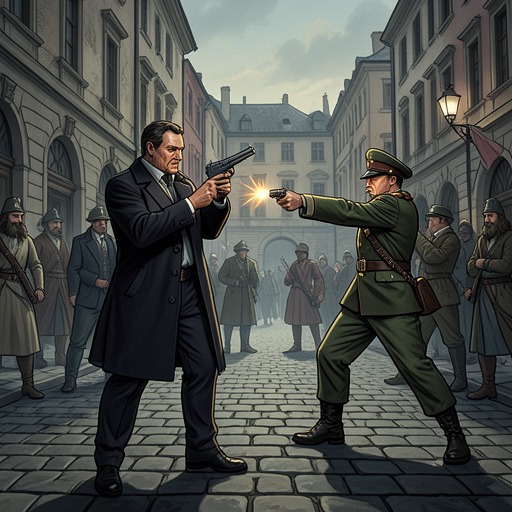
The pursuit ends in the apartment building. A local reply narrows the search to the old cripple living below, and Lebel reaches the sixth floor out of breath. With a CRS officer beside him, holding a submachine carbine, he faces two doors leading toward the front of the building. A soft, distinct sound comes from behind one of them; Lebel points to the lock. In the final confrontation, he stands over the Jackal’s body and looks into the other man’s eyes. The chase that began with an unknown name and a poor description ends at close quarters, after the painstaking work of records, calls, searches, and revised hypotheses has brought Lebel to the assassin himself.
Narrative Role
Lebel is a counterweight to the Jackal’s solitary professionalism. The assassin relies on false names, rapid movement, and advance knowledge of police actions; Lebel counters with shared information, careful verification, and the patient reconstruction of a network of clues. Yet the novel does not present procedure as infallible: the leak turns the investigation’s regular briefings into a source of danger, and Lebel’s own confidence that capture is near coincides with escapes. His strength is the capacity to notice that recurrence, admit error, and alter the method.
That method also explains why Lebel’s decisive quality is not a dramatic display of brilliance. He earns confidence by listening, separates what is known from what is merely assumed, and makes a search specific enough for others to carry out. The seven confidential calls, the train records, the square search around the car, and the eventual wire-tapping all belong to the same logic: assemble small facts, test the explanation they suggest, and change course when new evidence demands it. In a story organized around the Jackal’s carefully controlled timetable, Lebel is the investigator who keeps rebuilding the net even when the quarry appears to have slipped through it.