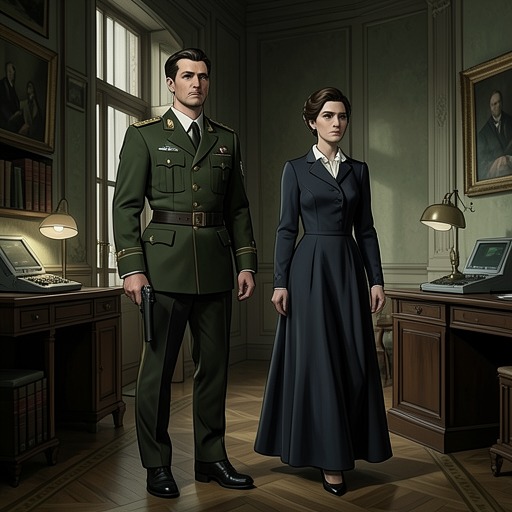
Colonel Saint-Clair de Villauban
The Day of the JackalColonel Saint-Clair de Villauban is an Air Force colonel on Charles de Gaulle’s staff whose fierce loyalty to the President is matched by conspicuous ambition. In the meeting convened over the threat from The Jackal, he advocates decisive action and presents the Presidential Security Corps as the last line of protection. Yet the investigation requires powers and reach beyond his staff’s remit. His exchanges with Roger Frey and Claude Lebel expose the strain between protective duty, institutional limits, and the political risks of being held responsible for failure.
Position and Character
At the Interior Ministry’s briefing, Colonel Saint-Clair de Villauban sits among the senior officials responsible for the response to the assassination threat. He is identified as an Air Force colonel on the Élysée staff, a fanatical Gaullist, and a man equally known in the President’s circle for his ambition. The juxtaposition matters: his commitment to Charles de Gaulle is presented as genuine, but his place in the presidential entourage also gives him a personal stake in how the crisis is managed and who appears capable of managing it.
He is aristocratic in bearing and keenly attentive to rank. When Claude Lebel emerges from the meeting, Saint-Clair stops him in the hall, addresses him as Commissaire, and wishes him success with pointed formality. He then warns that the palace will watch his progress closely and that failure will bring repercussions. Lebel says nothing, but blinks rapidly as Saint-Clair turns away. The exchange makes clear that Saint-Clair regards the investigation not merely as an urgent police task but as a performance subject to judgment from the presidential circle.
Proposals and Institutional Limits
During the conference, Saint-Clair asks whether the suspected assassin could be seized, as Antoine Argoud had been, and made to help produce a likeness of the man believed to be in Paris. The proposal is practical in its immediate aim: investigators have only a poor description, and a better identification could help them search. But the Minister rejects another such abduction, explaining that the earlier operation has already left the government at odds with the German Foreign Ministry. Saint-Clair’s suggestion therefore meets a limit imposed not by lack of urgency but by the diplomatic consequences of covert methods.
He then makes a more direct claim for his own organization. Saint-Clair declares that, if other measures fail, the President’s protection must ultimately rest with the Presidential Security Corps and the President’s personal staff, and assures the Minister that they will do their duty. The declaration is grand, but it draws weary reactions from the experienced officials around the table. Jean Ducret, whose corps works in the President’s immediate vicinity, answers that the inquiry is far wider than his staff can undertake without neglecting its primary duties. The exchange distinguishes close protection from a nationwide investigation: Saint-Clair can invoke the final responsibility of the presidential staff, but that responsibility does not give it the capacity to conduct the whole search.
Political Exposure and Conflict with Lebel
Roger Frey turns Saint-Clair’s appeal into a warning about accountability. He agrees that everyone will do their duty, then observes that whichever department accepts responsibility for breaking up the plot will also bear the consequences if it fails or uses methods that inadvertently make the affair public. The implication settles over the meeting. Saint-Clair’s face tightens and worry becomes visible in his eyes. His confident claim to a central role has been recast as exposure to blame: responsibility may confer authority, but it also creates a target for political disapproval.
The problem is sharpened by the President’s instructions. The threat is to be kept secret; there is to be no publicity or nationwide search, and no sign outside a small circle that anything is amiss. These restrictions leave the officials with a serious danger to address while denying them the open mobilization that might ordinarily accompany it. Saint-Clair’s appetite for decisive action, including the proposed seizure, runs up against a response shaped by secrecy and diplomatic caution. The text does not portray him as controlling those constraints; instead, he has to argue for his service within them and watch another official, Lebel, receive the broad investigative mandate.
Relationship to Lebel and Narrative Role
Lebel is summoned to the meeting, briefed on the threat, and given access to the resources of the organizations represented there. Saint-Clair’s later intervention in the hall shows the consequences of that appointment for the relationship between them. He does not offer Lebel practical assistance there; he emphasizes surveillance and the possibility of repercussions. The encounter establishes a contest in which the investigator’s authority comes from the Minister’s directive, while Saint-Clair speaks from the Élysée staff’s proximity to the President and its interest in the outcome.
Saint-Clair’s contribution is therefore less the conduct of the search than the pressure surrounding it. His proposals reveal a preference for forceful measures, while the meeting exposes the limits on what his own corps can do and the political danger attached to taking responsibility. His loyalty to Charles de Gaulle places him within the effort to protect the President, but his ambition and concern with accountability make him an uneasy participant in a crisis that Lebel is tasked to investigate. The contrast gives the manhunt an institutional dimension: the danger comes from The Jackal, but the response must also negotiate jurisdiction, secrecy, diplomatic consequences, and the fear of being blamed if the protection fails.