Criminal Investigation Brigade
The Day of the JackalThe Criminal Investigation Brigade is the major-crime unit of the French Judicial Police at 36 Quai des Orfèvres in Paris. Its role in the novel grows from investigating a wave of robberies to leading the police response to a threatened assassination: under Maurice Bouvier and Claude Lebel, routine accounting, archive searches, interdepartmental authority, and field reports become parts of one urgent inquiry.
Institutional Position and Early Investigation
The Brigade is led by Commissaire Maurice Bouvier, a highly respected chief whose small, work-strewn office becomes an early command point in the investigation. During the last two weeks of June, the robberies of banks and other sources of cash and jewellery become serious enough to be assigned to his unit. A chart assembled at its headquarters records the stolen sums and the estimated resale value of the gems. By the latter half of July, the total exceeds two million new francs, or four hundred thousand dollars. After estimated expenses and payments to the robbers are deducted, Bouvier still sees a substantial sum that cannot be accounted for. The Brigade’s attention is thus drawn not only to the crimes themselves, but to the unexplained purpose behind their sudden scale.
The organization undergoes a change of leadership in July. On July 18, its deputy chief, Commissaire Hyppolite Dupuy, suffers a severe stroke in his office at Quai des Orfèvres and dies on the way to hospital. Claude Lebel, chief of the Homicide Division, is appointed as his successor and takes up the new duties immediately because of the Brigade’s summer workload. The appointment places an experienced homicide investigator at the centre of a case whose immediate danger is still uncertain.
A Secret Assignment and Expanded Authority
When the Minister of the Interior briefs Lebel, the assignment is presented as a directive rather than a consultation. Lebel is to establish his own office, receive the information he needs, and draw on the resources of the organizations represented at the meeting, without a limit on expenditure. The scale of that authorization makes the Brigade the operational hub of a much larger effort, while the need to keep the matter secret shapes how it can use that authority.
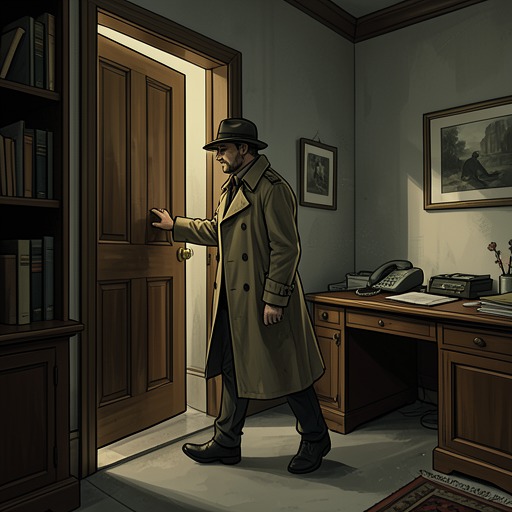
Lebel turns the room into a working office for himself and Lucien Caron. He orders the regular secretary removed from the secret assignment, makes Caron his combined assistant and secretary, and arranges a camp bed, washing and shaving supplies, and a coffee percolator. He also secures ten outside telephone lines and a permanently assigned operator. A circular is prepared to tell the departmental chiefs that Caron can request whatever assistance Lebel himself would require. These arrangements are practical responses to a case expected to demand sustained work and rapid communication, not merely symbols of high-level backing.
From Sparse Clues to a Wider Search
At first the Brigade cannot give foreign police a name or a reliable identification. Lebel and Caron make confidential calls to senior crime investigators abroad, carefully distinguishing the approach from a formal enquiry between police forces. The crucial clue they can offer is a profile: the unknown man would have to be a professional contract assassin with successful political killings behind him. By asking colleagues to consider people on their files, even those who have never operated in their own countries, the Brigade turns international contacts into a way of testing a narrowly defined hypothesis.
The inquiry also depends on records that acquire meaning only when compared. During an overnight check of the archives, investigators find that Alexander James Quentin Duggan entered France from Brussels on the Brabant Express on July 22 and left for Brussels on the Etoile du Nord Express on July 31. A hotel registration near the Place de la Madeleine, covering July 22 through 30, gives a passport number matching information received from London. Rather than raid the hotel, Lebel visits its proprietor quietly and establishes that the man sought was no longer there by August 15. The sequence does not locate the suspect, but it reconstructs part of his movements without alerting other guests or turning an inconclusive lead into a public spectacle.
As the search shifts beyond Paris, Lebel directs Commissaire Valentin to send as many capable men as possible to Ussel and organize a square search centred on the place where a car was found. The requested enquiries range from farmhouses and village shops to cafés, hotels, and woodcutters’ shelters. Investigators are to ask about a tall, blond Englishman who speaks good French, carries three suitcases and a handgrip, and may look as if he has slept rough despite being well dressed and carrying substantial cash. Lebel also insists that the press be kept away, authorizing a misleading car-crash explanation to deflect local curiosity, and instructs the police to surround the suspect rather than approach him if they find him.
Inference, Evidence, and Narrative Role
The Brigade’s reasoning advances through hypotheses that remain open to revision. Lebel interprets evidence of a repainted car as a possible sign that the suspect was warned after the Duggan identity was discovered and moved quickly to escape detection. He cannot establish who passed on the warning; he considers the possibility of an OAS contact somewhere in the chain of operators and officials, and suspects Valmy may be the link. At a later conference, he stresses that the police have been investigating for seventy-two hours but do not know where the suspect is in his own timetable. Because the killer may know that the plot has been exposed without knowing how far the inquiry has progressed, Lebel argues that the police may still catch him unaware once they identify his new name and location.
The Brigade’s work combines that inferential process with accumulated physical and eyewitness evidence. In a later call from Tulle, Lebel asks whether the car and the room at the château have been fingerprinted; the reply reports hundreds of sets, all matching. At the Paris security perimeter, a guard’s account adds another kind of lead: an apparently ill, elderly cripple with an identification card and a Mutile de Guerre card had been allowed through, with an address on Rue de Rennes. Such reports show how a search directed by senior investigators depends on observations made by people at its edges.
The Criminal Investigation Brigade is therefore more than the setting for Lebel’s work. Its collective methods give the manhunt its procedural shape: unexplained sums prompt questions about motive, archives establish movements, international calls define the kind of suspect, and local teams widen the search while protecting its secrecy. The institution’s reach is considerable, but the evidence remains fragmentary and the suspect’s timetable remains his own; the suspense turns on whether the Brigade can connect its records and reports before he acts.