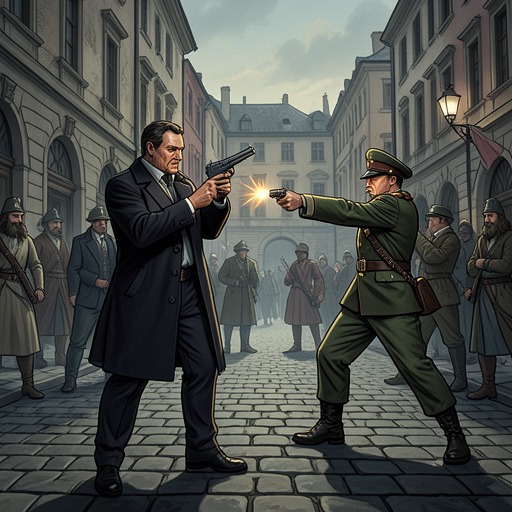
De Gaulle’s secrecy order for the Jackal operation and instruction to maintain public engagements
The Day of the JackalDe Gaulle’s secrecy order for the Jackal operation and instruction to maintain public engagements defined the political limits of the French response to an assassination threat. Charles de Gaulle would neither let the public see him retreat before a foreign assassin nor permit the investigation to become public knowledge; the authorities therefore had to protect him while preserving the appearance of normality. The order shaped the manhunt from its first uncertain assessment through its extensive, concealed security preparations, and made secrecy itself a condition the police had to manage.
The political logic of the order
The threat arose from a record of failed attempts and a recognition that the next attack would not be an ordinary security problem. Marc Rodin’s account described six previous efforts to kill Charles de Gaulle: three exposed during early planning, one betrayed on the eve of the attempt, and two carried out but unsuccessful. The English assassin whom Rodin consulted judged that a professional could kill the President, but that escape would be unusually difficult. Earlier failures had made the general intention known, ensuring that vigilance would not relax into routine. The danger was therefore not simply that an assassin might reach the target; it was that the target’s exposure and the attacker’s preparations had to be considered together.
When Roger Frey presented the threat, Charles de Gaulle framed the issue as one of national dignity. The President objected to being seen as cowering before a foreign hireling and insisted that France could not allow its dignity and grandeur to appear subject to such a threat. His position was not a denial that danger existed. Rather, it made visible retreat politically unacceptable, even while the possibility of an attack demanded more protection. The order’s central tension followed from that distinction: the state could act, but could not publicly behave as though The Jackal had dictated the President’s movements.
Secrecy and the limits on the response
The government’s assessment remained provisional. Maurice Bouvier explained that the report Colonel Rolland had prepared depended on his interpretation of Viktor Kowalski’s statements, and Kowalski had since died. Enquiries in Vienna were still under way, with General Guibaud expected to report back. Under those circumstances, a nationwide hunt for a foreigner known only by a codename seemed premature as well as politically dangerous. Uncertainty did not remove the threat; it constrained how the authorities could present and pursue it.
Charles de Gaulle’s formal instructions prohibited publicity, a nationwide search, and any sign outside a small circle that something was wrong. Frey said the President feared that exposure would give the press an opportunity to ridicule France and invite foreign nations to jeer. More than that, visible precautions could make it appear that the President of France was hiding from a single foreigner. Frey warned that disclosure, or even a public impression of what was happening, would have serious consequences for those handling the affair. The investigation’s secrecy was thus not merely a preference for discretion: it was an explicit presidential requirement backed by the threat of dismissal.
The same policy applied to Charles de Gaulle’s schedule. When Alexandre Sanguinetti argued that public appearances had to stop until the attacker was caught, Frey answered that the President would cancel nothing and that no engagement would move by even an hour or a minute. The public programme had to continue in complete secrecy. At a meeting of departmental chiefs, Frey repeated the rules: everyone present was sworn to silence, no one could discuss the matter outside the room unless another person had been admitted to the secret, and each chief had to give it immediate personal attention. Delegation was permitted only for tasks that did not disclose why they were being done. The rule narrowed the circle of knowledge while requiring a wide range of government resources to be ready for use.
Covert protection and the unchanged public programme
The order did not mean that the authorities took no precautions. It distinguished between measures hidden from the public and changes that would reveal the threat or alter the President’s visible routine. For the Liberation Day ceremonies, organizers planned steel crowd barriers, searches of the enclosed areas down to the sewers, searches of houses and flats, and armed watchers on nearby rooftops. Police were to occupy even the cornices and spires of Notre-Dame, while priests, acolytes, and choirboys taking part in Mass would be searched. Special lapel badges were prepared for police and CRS personnel to make it harder for The Jackal to pose as a security officer.
Protection extended to the President’s car without informing him. Bulletproof windows were secretly installed in the Citroën he would ride in, and the driver was told to move faster than usual in case the attacker tried to take a snap shot. Ducret also arranged for unusually tall officers and officials to form a protective screen around Charles de Gaulle without his noticing. These preparations preserved the outward schedule while changing the conditions under which it could proceed. The President’s insistence that he would not be seen to yield therefore required the security services to conceal not only the investigation but also the extent of the protection surrounding him.
Even this extensive deployment could not guarantee that the attacker would be stopped before reaching the ceremony. Claude Lebel reminded the authorities that The Jackal had a timetable known only to himself. The police had been investigating for seventy-two hours and could not tell where they had entered that schedule. They knew that the assassin had learned the plot was exposed, but had no reason to assume he knew how far the investigation had progressed. Lebel’s hope was that the authorities could identify and locate him under his new name before he understood how much they knew. At the same time, he warned that The Jackal might already be in France, armed and using another face and identity card.
The order under pressure
The secrecy policy created an operational vulnerability as well as a political safeguard. When the investigators traced a transformed car from Gap toward Ussel, Bouvier reasoned that the paint might have been bought in Gap. If so, The Jackal had been warned that the authorities had uncovered his Alexander Duggan identity and had escaped before they could reach him. Bouvier could not identify the source of the warning: information might have passed through switchboard or telex operators, or through other staff who handled orders. He suspected that the same clandestine contact, Valmy, might be involved. The conference could not establish exactly how the information had leaked, but the possibility exposed the cost of moving secret instructions through the very network needed to enforce them.
Lebel’s later deduction sharpened the immediate danger. He had wondered why The Jackal, after leaving Gap, had not immediately adopted another identity and travelled to Paris, but instead spent a week in France. The delay suggested that he had chosen a particular day to strike. Meanwhile, the security plan made the ceremony perimeter formidable, and Lebel could not explain how the assassin might get a weapon through it. His conclusion was not that the precautions were inadequate, but that The Jackal believed he could overcome them and had so far remained at large despite betrayal and pursuit by two police forces. At the barrier, a sentry reported that no one had passed through a gap except an old, sick-looking disabled veteran with identification and a Mutile de Guerre card. The detail gave the danger a human shape: the conspicuous security ring could still be approached through a credible identity.
Significance
The order turned public composure into part of the state’s security strategy. Charles de Gaulle’s unchanged appearances denied The Jackal the visible victory of forcing the President into hiding, but they also left the authorities responsible for protecting him in circumstances where ordinary public warning and schedule changes were forbidden. The resulting system relied on compartmentalized knowledge, discreet preparation, and close observation rather than a publicly declared emergency. Its strengths and costs remained intertwined: secrecy limited the political damage of the threat, while uncertainty about the evidence, possible leaks, and the assassin’s private timetable left the investigators unable to know whether their hidden precautions would be enough.