France’s secret investigation to identify the Jackal
The Day of the JackalFrance’s secret investigation to identify the Jackal turns a fragmentary confession into a national emergency and then into a race to put a name, face, and location to an assassin who may already be inside the country. Its central paradox is that the state can mobilize its security services on an unprecedented scale, yet none can act effectively until detective work identifies the person they are meant to pursue.
From confession to national emergency
Colonel Rolland’s breakthrough comes from correcting the words recorded during Viktor Kowalski’s confused confession. Kowalski had described the foreigner as blond, not good, and the word transcribed as a term for a troublemaker was actually a word meaning killer. Most consequentially, Rolland reinterprets Kowalski’s repeated use of jackal: not as an insult directed at his captors, but as the code name of a blond foreign assassin. The three OAS leaders had met this man at Pension Kleist in the Vienna where Rodin recruited The Jackal, shortly before they went into protected hiding.
That decoding also gives Rolland a reason for the recent wave of bank and jewellery robberies. The money, he concludes, is financing a job for the OAS, and the scale of the payment points to a political assassination rather than an ordinary criminal dispute. He regards the threatened target as Charles de Gaulle and the plot as potentially the most dangerous conception the terrorists could devise against the President’s life.
Rolland handles the warning as a secret of state. He orders an urgent message to the SDECE office in Vienna, overriding the usual interdepartmental protocol, then gathers every copy of Kowalski’s confession and locks them away. His report recounts the operation that brought Kowalski back to Marseille through a deception involving someone supposedly ill in hospital, his capture by SDECE Action Service agents, the injuries he sustained while resisting arrest and attempting suicide, and the confession he made from his hospital bed. Rolland writes that corroboration is still being sought, and carefully presents the assassination as a conditional but grave possibility. He types the final copy himself, seals it with his personal seal, assigns the highest security classification, and destroys his handwritten draft.
Secrecy and the problem of a name
The Interior Minister’s response is not to announce a public hunt but to authorize a concealed inquiry. The investigation must identify the assassin wherever he is, at home or abroad, and stop him without revealing the operation publicly. At a meeting of fourteen senior officials, the Minister stresses absolute secrecy, demands that the matter remain within the room unless someone is formally brought into it, and requires the departmental chiefs to give the case immediate personal attention. Work may be delegated only when the task itself does not disclose the reason for it.
The limits of the available intelligence are as important as the breadth of the mobilization. The OAS agents cannot identify a man whose identity even the OAS does not know. The Action Service cannot target an unknown person; border officials cannot intercept him; the French General Intelligence Directorate cannot search for documents without knowing what name to seek; and the police cannot arrest a suspect they cannot identify. The CRS, too, lacks a person to pursue. Commissaire Maurice Bouvier distils the dilemma: the first task is to give the assassin a name, because a name may lead to a face, a passport, and finally an arrest. That, he argues, is a job for detective work.
Bouvier names his deputy, Claude Lebel, as the best detective for the assignment. The Minister summons him and gives him a directive rather than asking for advice: Lebel is to establish his own office, draw on all necessary information and the resources represented at the meeting, and incur whatever costs the investigation requires. The assignment displaces his ordinary cases. He chooses to keep his existing office, which becomes the headquarters of Operation find-the-Jackal, and asks for Lucien Caron as his assistant.
Building a secret investigative machine
Lebel makes the office itself part of the operation. Caron is to become both assistant and secretary; the regular secretary must be removed from the secret. Lebel orders a camp bed, washing and shaving supplies, and a coffee percolator, anticipating sustained work without leaving the office. He also arranges for ten outside telephone lines and a permanently assigned operator. A circular memorandum is to authorize Caron to request from departmental chiefs anything Lebel could request himself. These practical arrangements turn the broad political order into a working investigative centre while limiting how many people know what it is for.
The inquiry reaches beyond national records almost immediately. Lebel and Caron spend three hours in the basement communications room speaking with senior crime investigators abroad over secure, scrambled high-frequency lines. Lebel cannot yet describe the approach as a formal inquiry between police forces: at that point, investigators do not know whether the intention to commit an offence has become a settled plan or entered its preparatory stage. He presents the request as a routine tip-off and admits that the police have little to go on: no name and only a poor description.
He then supplies the one criterion he believes can narrow the search. The unknown man must be among the world’s leading professional contract assassins, with successful political killings behind him, rather than a gangland gunman. The request asks foreign investigators to check their files for anyone matching that profile, including a person who has never operated in their own country. The pauses on the other ends of the lines register how much the investigators understand about the implied target, even though Lebel cannot state the full danger openly.
Records, movement, and an exposed identity
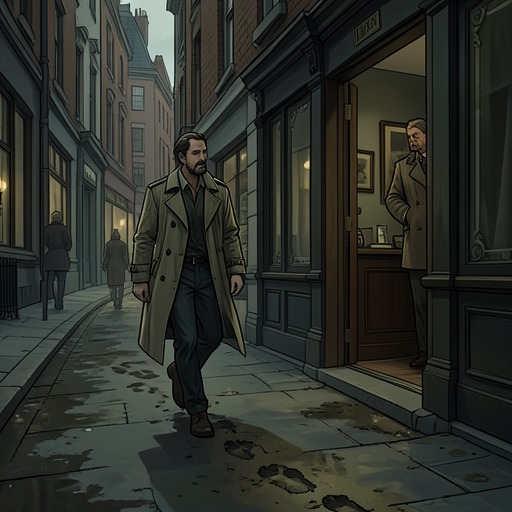
The inquiry turns its general description into a search of travel and lodging records. A repeated examination of the archives uncovers a card for Alexander James Quentin Duggan, who entered the country on the Brabant Express from Brussels on July 22. A separate customs report places Duggan on the Etoile du Nord Express travelling from Paris to Brussels on July 31. Investigators also find a hotel card in Duggan’s name, bearing the same passport number reported by the police in London. It records a stay at a small hotel near the Place de la Madeleine from July 22 through July 30.
Caron favours raiding the hotel, but Lebel chooses a quiet visit in the early hours. He speaks with the proprietor and establishes that Duggan was gone by August 15; the proprietor appreciates that the investigator did not wake the other guests. The episode exemplifies the inquiry’s method: combine administrative traces, compare identifying details, and pursue verification without needlessly advertising the search.
As the investigation proceeds, Lebel warns that the assassin’s timetable is known only to the assassin. After seventy-two hours of inquiry, the police cannot tell where they have entered that timetable. They know the killer is aware that the plot’s existence has been discovered, but cannot assume he knows how far the investigation has advanced. This uncertainty leaves open the possibility of catching him unaware once they identify his new name and establish his location. It also makes the question of whether he has withdrawn, concealed evidence, or continued with the attack newly urgent.
The hunt moves into the field
When the false identity of Duggan is exposed, Lebel reasons that the assassin must have been warned. He infers that paint used to transform a car was probably bought in Gap, and that if the vehicle was already altered during its overnight journey from Gap to Ussel, the change likely followed the discovery of the pseudonym. The inference raises the possibility of a leak, though Lebel cannot determine whether information escaped from the conference room itself or through the operators and officials who passed orders along. He suspects the assassin has a single contact, possibly Valmy, whose message to Rome had been intercepted by the DST. The evidence, in Lebel’s view, indicates both that the plan was exposed and that the assassin chose to proceed anyway.
Lebel orders Commissaire Valentin to send a strong team to Ussel and conduct a square search centred on the place where the car was found. Investigators are to question farmhouses, regular road users, village shops and cafés, hotels, and woodcutters’ huts. The man they seek is described as tall and blond, English by birth but fluent in French, carrying three suitcases and a handgrip, with substantial cash; after sleeping rough, he may look less immaculate than his clothes and means suggest. Valentin is told to keep the press away, using a minor car accident as a cover story if necessary. If the suspect is found, the local team must surround him and hold position rather than approach him. Lebel will come in person.
The clues also force Lebel to reconsider the time available. He admits that he had failed to recognize the significance of the assassin’s delay after leaving Gap: why had he not immediately adopted the identity of Pastor Jensen and taken the express to the capital? Why had he spent a week killing time? Lebel concludes that the delay reflects a chosen date for the attack, not necessarily indecision or escape. A later identification report confirms hundreds of fingerprints on the car and in the room at the chateau, illustrating how a potentially useful trace can be obscured by the volume of contact.
Near the guarded route to the ceremony, a sentry reports that the street has been closed since noon and that only an old man described as crippled has passed through the gap. He carried an identity card and a Mutile de Guerre card giving an address on Rue de Rennes; the guard let him through because he looked ill and exhausted. The detail gives the investigation a final, unnerving counterpoint: an identity paper and an appearance of infirmity have served as permission to cross a security boundary. The record here does not resolve what follows, but it shows the manhunt narrowed to the practical question on which it began—whether the assassin can be recognized before his timetable runs out.