Jacqueline Dumas
The Day of the JackalJacqueline Dumas is an OAS underground worker whose private losses become the motive for her political violence. Her story links the death of her brother in Algeria and the death of her lover during the 1961 army mutiny to a later assignment that requires her to seduce a man for the Organisation. The contrast between her former, loving intimacy with François and her deliberate performance for a new lover gives her July 1963 mission its particular emotional force.
Identity and Background
At twenty-six, Jacqueline works as a beautician in an expensive salon behind the Champs Elysees. She comes from a close, respectable family: her father is a banking-house clerk, her mother a conventional homemaker, and her younger brother Jean-Claude is completing National Service. Before grief remakes her life, she is preoccupied with ordinary concerns such as dates and the pleasures of youth. The family home is in Le Vezinet, a suburban setting whose quiet security will later seem to her irretrievable.
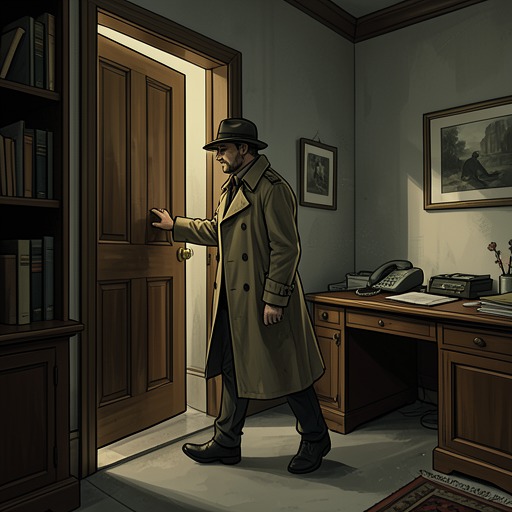
On July 30, she watches the presidential motorcade pass after a policeman stops her crossing the road. She recognizes Charles de Gaulle's profile in the first Citroën and follows the cars with an intensity that distinguishes her from the other onlookers. The scene establishes her political fixation through a public gesture: she has seen the President, and the attention she gives him is far from casual. Later that evening she hurries home to prepare for a date with a man she hates, a private appointment that stands in sharp contrast to the fervour of her look after the motorcade.
Bereavement and Political Conviction
The telegram announcing Jean-Claude's death arrives at breakfast near the end of 1959. He has been killed in Algeria while serving with the First Colonial Paratroops. Jacqueline's response is not a gradual adjustment but a collapse of the everyday world she had known. Salon conversation, popular music, and the familiar security of home lose their hold as she fixates on the death of the brother she remembers as gentle, bookish, and hostile to violence. In her grief, she directs her hatred toward the Algerians she blames for his death.
François, Jean-Claude's platoon commander, brings the family a letter written by the young soldier before he died. The account he gives Jacqueline fills in what the letter does not: the patrol had been searching for guerrillas after a settler family was killed, then encountered a battalion of the ALN, trained forces of the FLN. Jean-Claude was shot through the lungs in the ensuing skirmish. François recounts the retreat through scrub, the repeated requests for air support, and the fighter-bombers that arrived at eight o'clock. Jean-Claude, who had volunteered for a demanding regiment to prove himself, died beside a rock, coughing blood over a corporal's knees. Jacqueline asks François to keep the circumstances from her parents, who have tried to endure their loss by carrying on as usual.
François becomes both her lover and her guide to the politics of the war. Through him, she hears accusations that Charles de Gaulle has betrayed France, and learns of the French Government's negotiations with imprisoned FLN leader Ahmed Ben Bella and the prospect that Algeria will be handed over. She and François come to regard keeping Algeria French as an article of faith. His political account and her grief reinforce one another: her commitment is not formed as an abstract programme, but through the brother she has lost and the soldier she loves.
François, the Mutiny, and the OAS
During François's leaves, Jacqueline builds her life around their meetings. She waits for him through the autumn and winter of 1960, keeping his photograph beside her bed. In the spring of 1961, they walk together through Paris while he is in uniform; she takes her annual holiday to spend time with him. By then she is pregnant, though François never learns this. Their shared expectation that the Army will resist the Government's course gives their relationship a political horizon as well as a private one.
François returns to Algeria in March 1961. On April 21, several French Army units mutiny against the Metropolitan government, and the First Colonial Paras join almost to a man; only a handful of conscripts leave the barracks to meet loyal authorities. Fighting between mutineers and loyal regiments follows within a week. In early May, François is shot in a skirmish with a loyalist Army unit. Jacqueline, expecting no letters from April onward, does not learn of his death until July.
She takes a flat in a poor Paris suburb and attempts suicide by gas. The room's many leaks prevent her death, but she loses the baby. After spending the August holidays with her parents and appearing to recover, she becomes an active underground worker for the OAS in December. Her purpose is explicit: François, and before him Jean-Claude, are to be avenged, whatever the means or cost. She has little ambition beyond this commitment, and resents the limits of her work. She carries messages and, at times, plastic explosive concealed in a loaf in her shopping bag, but believes she could do more.
Her earlier support has included sheltering one of the would-be killers after the Petit-Clamart affair. He stays for three nights at her flat while on the run, then leaves; a month later he is caught but does not disclose that she hid him. Her cell leader nevertheless orders her to stop working for the OAS for several months until attention has eased. She resumes carrying messages in January 1963. This sequence shows her moving from peripheral errands and temporary shelter toward the more consequential task later placed before her.
The Assignment and Its Personal Cost
In July, a man accompanied by her cell leader visits Jacqueline. He has no name, and the leader's deference marks his authority within the Organisation. He asks whether she will undertake a special job; she accepts even after being warned that it may be dangerous and distasteful. Three days later, while sitting in a parked car, she is shown a man emerging from a block of flats and told his position and what she is to do. The evidence establishes the preparation of an operation built around access to that man, though Jacqueline's immediate task is personal and intimate rather than openly violent.
By mid-July, she has begun the approach. In a restaurant, she sits beside him and asks to borrow the salt cellar from his table. She presents herself as shy and modest, letting him lead the conversation. Within a fortnight, the carefully cultivated encounter has become an affair. Jacqueline judges the man's appetite for conquest and plays to it, appearing attentive and chaste while suggesting that greater intimacy may eventually be possible. Her performance is calculated to make him pursue what she withholds.
The operation then moves toward cohabitation, despite the obstacle of the man's wife and two children. On July 29, they leave for the family's country house in the Loire Valley, while he remains in Paris for work. Within minutes of their departure, he calls the salon and insists that he and Jacqueline dine alone at his flat the following night. The domestic separation that enables the meeting is thus part of the assignment's practical circumstances, not a change in Jacqueline's feelings.
Memory and Narrative Role
As she prepares for the evening, Jacqueline has three hours before the appointment and expects two to be enough for her preparations. She showers and dries herself before the full-length mirror, observing her body without the anticipation she once felt when François would touch her. Her belly tightens with revulsion at the night ahead, but she resolves to go through with it whatever form of lovemaking the man wants. The contrast is exact: the same bodily intimacy that once belonged to affection has become an imposed instrument of the mission.
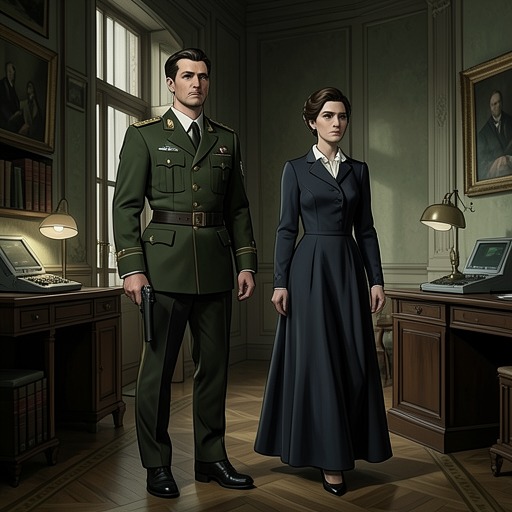
She takes François's photograph from a compartment in the bureau and lies on the bed holding it above her. The photograph preserves his brown hair, buff uniform, paratrooper's wings, and the half-smile she remembers; it also keeps present the person whose loss has helped drive her into the OAS. She recalls their old lovers' exchange and repeats her accustomed answer to the image. The memory does not undo the assignment or restore the earlier relationship. Instead, it measures the distance between the intimacy she once chose and the encounter she now intends to endure. Jacqueline's plot trajectory turns private grief into clandestine service, while the July preparation reveals the cost: her agency is expressed through a mission she accepts, but the emotional life against which she measures it remains bound to the dead.