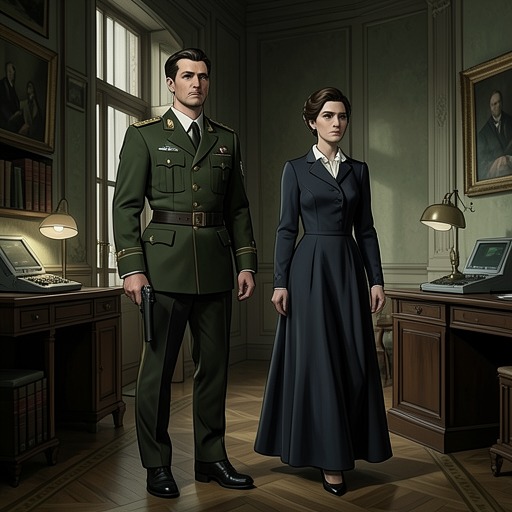
Jean Ducret
The Day of the JackalJean Ducret’s importance lies in the boundary his office both defines and exposes: he is one of France’s foremost experts on protecting a president from assassination, yet he cannot by himself find an assassin who operates beyond the President’s immediate circle. As head of Charles de Gaulle’s personal security, he reads the threat as a security specialist and speaks plainly about what his corps can—and cannot—do.
Identity and Expertise
Jean Ducret is the head of the President’s personal security corps, a position he holds because of his standing as one of France’s leading experts on security, particularly the protection of a single life against assassination. His professional record is tied to six known plots against Charles de Gaulle: by the time Ducret assesses the new threat, those earlier attempts have either failed in execution or been dismantled before they could be carried out.
That experience gives his judgment weight, but it does not make him omnipotent. Ducret’s expertise is concentrated on the immediate protection of the President. The distinction between guarding a person and identifying an unseen attacker becomes central to his role once the authorities confront The Jackal, a foreign professional working alone.
Assessment of The Jackal
At the Interior Ministry briefing, Ducret accepts Colonel Rolland’s analysis that the plot represents an exceptional danger. The usual instruments of French security—the agencies’ files and the network of agents and infiltrators inside the OAS—are, in his assessment, rendered ineffective by an outsider with no local contacts or friends. His conclusion is severe because the threat does not fit the system’s familiar points of access: there is no established circle of associates for the agencies to penetrate and no ordinary network through which to trace the attacker.
Ducret’s analysis also belongs to a wider history of failed attempts. The Jackal’s prospective employer, Marc Rodin, has already heard that previous efforts against Charles de Gaulle failed in part because the attackers were unwilling to risk their own lives. The Englishman advising Rodin explains that a professional assassin faces a different problem: earlier attempts have made the President more alert, reducing the chance that established routines will lapse and making escape after a shot less likely. Ducret’s later assessment gives the French authorities’ institutional view of the same danger: the target is heavily protected, while the person planning the attack remains unidentified and outside their networks.
The Limits of His Office
In the closed meeting of department chiefs, Ducret resists allowing the investigation to be mistaken for an extension of presidential guarding. His corps spends its time in the immediate vicinity of Charles de Gaulle, he explains, and a search extending much farther would exceed what its staff could undertake without neglecting its primary duty. This is not indifference to the danger but a candid statement of jurisdiction and capacity. Other agencies must carry the broader inquiry if his own officers are to keep protecting the President.
Ducret proposes one possible way to obtain the identity of The Jackal: among the people who know it, he says, are the assassin himself and three OAS leaders staying in Rome. Bringing one of those leaders back might supply an answer. The proposal is checked by the President’s formal prohibition on kidnapping, as well as concern about the diplomatic consequences of such an operation in Italy. Ducret can identify a possible source of information, but he cannot make that source available by whatever means might be most expedient.
His manner in these meetings reinforces his professional restraint. When he speaks, his voice is described as flat and final; he does not dress a judgment up as reassurance. He names both the danger and the limit: the security corps can guard the President, but the investigation must range beyond the immediate protection detail. The scene places expertise alongside institutional constraint rather than treating the former as a cure for the latter.
Security Measures and Narrative Role
The protective response grows more severe as Liberation Day approaches. The authorities plan to keep crowds farther from each ceremony, erect steel barriers, search enclosed areas—including sewers—and place armed watchers on nearby rooftops. Buildings are to be searched; police are to occupy even the roof and spires of Notre-Dame de Paris; and clergy, choirboys, police, and security personnel face checks intended to prevent a disguised attacker from slipping through. The President’s car is secretly fitted with bullet-proof windows, and passes are to be replaced at dawn. These measures show the practical scale of the threat Ducret has helped define, although the evidence presents them as a collective plan rather than attributing every measure to him personally.
One safeguard is specifically assigned to Ducret: he drafts a group of especially tall officers and officials to surround Charles de Gaulle without attracting his notice. That detail captures the balancing act of personal security. The President must be protected in public, but the visible appearance of protection itself must be controlled; precautions cannot openly transform the ceremonies into a display of fear.
Ducret is therefore not the investigator who uncovers The Jackal’s identity. His role is to establish why the threat is unlike the earlier plots, to press against the limits of the security corps without neglecting its central duty, and to contribute to the close protection surrounding the President. In a story where the assassin’s advantage comes from being unknown and alone, Ducret embodies the state’s countervailing strength—and its blind spot: formidable protection at the center, but no automatic way to reach the danger beyond it.