Jean-Marie Bastien-Thiry
The Day of the JackalJean-Marie Bastien-Thiry is the officer whose execution frames the novel’s opening account of the threat against Charles de Gaulle. A French Air Force colonel who regarded himself as a patriot, he helped lead the Secret Army Organisation’s effort to kill the President after France yielded Algeria to Algerian nationalists. His death was intended as a conclusion to the attempts on de Gaulle’s life; in the novel’s governing reversal, it becomes the event that helps bring the next attempt nearer.
Identity and Conviction
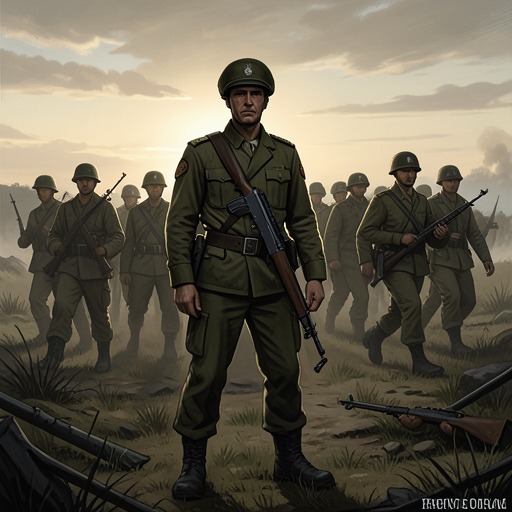
Bastien-Thiry was thirty-five, married with three children, and employed in the Air Ministry. His conventional professional and family life stood in contrast to his political extremism. He believed Charles de Gaulle had betrayed both France and the men who had called him back to power in 1958 by accepting the loss of Algeria. The narrative emphasizes that Bastien-Thiry had suffered no personal loss through Algeria’s departure: his motive, as he understood it, was not private grievance but service to his country.
That self-image made his violence possible without making it merely personal. Many people shared his opposition to de Gaulle’s policy, but the novel distinguishes ordinary political agreement from membership in the Secret Army Organisation, whose members had sworn to kill the President and bring down his government. Bastien-Thiry belonged to that more fanatical group. He saw assassination as patriotic action against a leader he considered a betrayer.
Planning the Petit-Clamart Attempt
Bastien-Thiry did not leave the attack to improvisation. He spent days preparing the site, measuring firing angles, the speed and distance of the vehicles, and the firepower he believed would be needed to stop the presidential convoy. He selected the straight stretch of Avenue de la Libération leading toward the crossroads at Petit-Clamart. The detailed planning makes him both a political zealot and an operational organizer: his conviction was translated into measurements, positions, signals, and escape arrangements.
The ambush was designed in stages. Marksmen were to fire from behind an Estafette van as the President’s car approached, at a shallow angle intended to reduce the adjustment required for their shots. Bastien-Thiry calculated that 150 bullets should pass through the leading car before it reached the van. If the car stopped, a second group was to emerge from a side road and attack the security-police vehicle at close range; after finishing off the presidential party, the attackers would run to three getaway vehicles. These were his estimates and intentions, not evidence that the attack unfolded as planned.
On the evening of August 22, 1962, Bastien-Thiry waited in a cafe in Meudon. By 8:05, the groups were positioned. He took the role of lookout, standing by a bus stop about a hundred yards on the Paris side of the ambush with a newspaper. Waving it was to signal the first group to begin firing. The placement of the signalman, separated from the gunmen but linked to them by a small, deliberate gesture, shows the practical discipline of the plan—and the danger concentrated in the timing of the convoy’s arrival.
Trial and Execution
The Supreme Military Court delivered its verdict on March 4. Bastien-Thiry and two others were sentenced to death; three more men who remained at large, including Georges Watin, received the same sentence. On March 8, Charles de Gaulle listened for three hours to appeals for clemency from the condemned men’s lawyers. He commuted two death sentences to life imprisonment, but Bastien-Thiry’s sentence stood.
When his lawyer told him that the execution was fixed for March 11, Bastien-Thiry continued to smile in disbelief. He insisted that no French firing squad would raise its rifles against him. The execution disproved that confidence. At six-forty in the morning, in the main courtyard of Fort d’Ivry, he stood bound to a stake while a priest murmured beside him and soldiers prepared their rifles. The shots and the coup de grâce were absorbed into the ordinary sounds of a waking city beyond the prison walls. The public quiet around the execution contrasts with the scale of the political violence for which he had been condemned.
Consequences and Narrative Role
The novel presents Bastien-Thiry’s death as an attempted full stop that instead becomes a turning point. The account explicitly describes the execution as intended to end further attempts on the President’s life, then reverses that expectation: by a quirk of fate, it marked a beginning. The change in command explains the reversal. After the Action Service removed Antoine Argoud from the OAS leadership, Argoud’s deputy, the little-known but astute Marc Rodin, assumed responsibility for operations aimed at killing de Gaulle. The removal of one leader had not dismantled the organization; it opened the way for another.
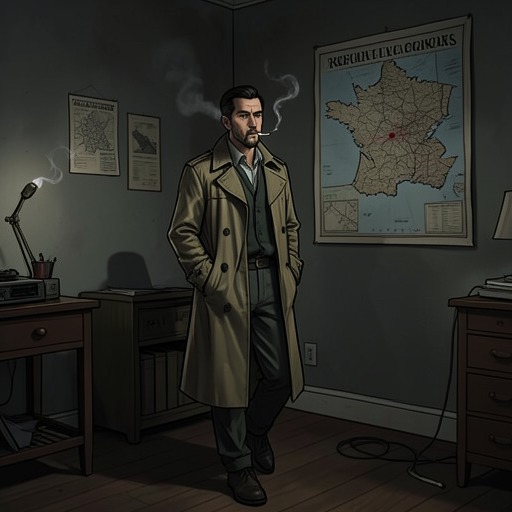
The news of the execution reached Rodin by radio in Austria. He was the new operations chief of the Secret Army Organisation, and the broadcast set off the thoughts and actions that would bring de Gaulle nearer to death than at any earlier point in his career. Bastien-Thiry therefore matters to the plot beyond his own failed attempt and death: his execution helps establish the conditions for the subsequent conspiracy. The opening movement turns the apparent finality of a firing squad into political succession, making the dead officer’s defeat an unsettling source of renewed danger.