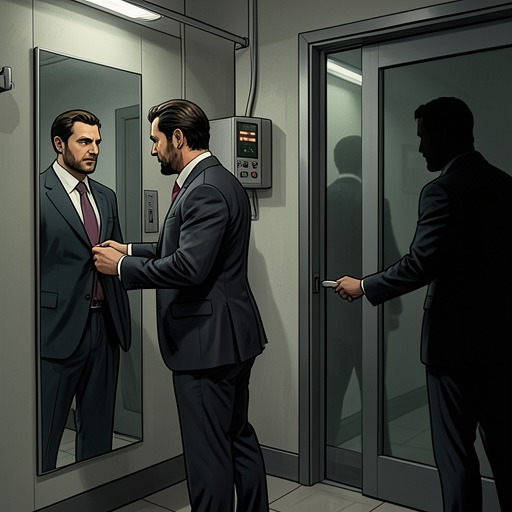
Jules Bernard
The Day of the JackalJules Bernard is a Paris resident whose desire for companionship makes him vulnerable to The Jackal’s disguise. After inviting the apparent young American student into his home, Bernard discovers too late that his guest is the killer sought across the city. His death is both the consequence of a deliberately cultivated intimacy and the means by which The Jackal gains a secluded hiding place during the search.
Identity and Introduction
Bernard appears among the late-night patrons observed by The Jackal shortly after midnight. He is the slim, elegant man at the back of the bar, in late middle age, with a balding head, a long neck, a carefully tailored suit, narrow trousers, lace showing at the cuffs, and a silk foulard knotted at his throat. The Jackal associates his appearance with the arts, fashion, or hair-styling, but the narrative does not establish Bernard’s occupation. His precise presentation, rather than any stated profession, marks him out in the room.
The Jackal is also watching the fat man at another table, who competes with Bernard for his attention. When the rival sends over an invitation to champagne, The Jackal instead crosses the room with his whisky and asks to sit with Bernard, framing the choice as a way to escape the other man’s attentions. Bernard responds with evident delight. The fat man leaves, still resentful, while Bernard and his new companion settle into an intimacy that has been manufactured for them by The Jackal.
An Invitation to Shelter
After one o’clock, Bernard asks where the young American is staying. The Jackal presents himself as a student down on his luck, with nowhere to sleep and no money. Bernard, who lives alone in a quiet, beautifully decorated flat, offers to take him in while he is in Paris. He says that his neighbours have been terribly rude in the past and that he has little to do with them. The offer rests on Bernard’s confidence that he can provide privacy and hospitality; for The Jackal, those same conditions make the flat useful as a refuge.
Before leaving the bar, The Jackal goes into the lavatory and returns with heavy mascara, powder on his cheeks, and lipstick. Bernard is put out by the transformation, though he conceals his reaction while they are still inside. Outside, he objects that the makeup makes his guest resemble the men at the bar and insists that he is already good-looking without it. The Jackal apologizes and says he will wipe it off at home. Bernard is mollified and drives him first to Gare d’Austerlitz to collect his bags. This exchange shows Bernard trying to shape the appearance of the young man he hopes to bring home, while The Jackal adapts his presentation to sustain the welcome.
At a crossroads, a policeman stops their car. The Jackal switches on the interior light as the officer leans toward Bernard’s window. The policeman looks in, then draws back in revulsion; the officer does not inspect their identity papers. The interruption passes, and Bernard takes The Jackal to the flat. The encounter demonstrates how readily the disguise can deflect scrutiny when the people who see it respond to appearance rather than verifying identity.
Hospitality, Hope, and Deception
Bernard and The Jackal reach the flat by two o’clock. The Jackal insists on sleeping on the studio couch in the drawing room, and Bernard overrules his objections to the arrangement; nevertheless, Bernard peeks through the bedroom door while his guest undresses. The narrative presents Bernard as anticipating an erotic pursuit of the muscular student from New York. His invitation is therefore not simply an act of charity: it carries a private hope of seduction, and that hope helps explain why he welcomes a stranger so quickly.
The next morning, Bernard wants to go out for fresh milk. The Jackal keeps him indoors, saying that he prefers tinned milk in his coffee, and the two spend the morning talking. The Jackal also insists on seeing the midday television news. These ordinary domestic details gradually acquire a different weight: Bernard’s quiet home and his willingness to remain there give the fugitive a controlled space in which to monitor events without venturing into the city.
The broadcast reports the search for the killer of Madame la Baronne de la Chalonnière and shows a photograph of a handsome young man with chestnut-brown hair and heavy-rimmed glasses. The announcer identifies the wanted man as an American student named Marty Schulberg and describes his eyes as blue. Bernard turns from the television and looks up at his guest. The face before him is the one on the screen, but the eyes are grey. The mismatch is the small, decisive clue that breaks through The Jackal’s performance. Bernard recognizes that the man he has sheltered is not the person he claimed to be, but recognition comes only when the assassin is within reach.
Death and Narrative Significance
The Jackal strangles Bernard. A few minutes later, Bernard’s body is shut inside the hall coat cupboard, his face distorted and his hair disordered. The abrupt movement from courtship to murder exposes the imbalance at the centre of their encounter: Bernard’s gestures arise from hospitality and desire, while The Jackal has used both as instruments of concealment. The apparent negotiation over makeup, sleeping arrangements, and breakfast has not created mutual intimacy; it has helped keep the fugitive’s identity hidden until the television image makes the deception unsustainable.
The Jackal then takes a magazine from the drawing-room rack and waits in the flat for two days. During that interval, Paris undergoes an extraordinary search: hotels, pensions, bars, restaurants, nightclubs, and cafés are checked, suspected OAS sympathizers’ homes are raided, and large numbers of people are stopped for their papers. Bernard’s secluded flat becomes a hiding place within the city being searched. His death thus has a direct practical consequence for The Jackal’s flight, while the concealed body makes the domestic refuge part of the crime scene that the manhunt has not yet uncovered.
Bernard’s brief role turns on a contrast between being seen and being known. His striking clothes and carefully arranged home attract attention, but his eagerness to believe in the stranded student leaves The Jackal’s identity unexamined. The television broadcast supplies the evidence Bernard needs, in the form of the wrong eye colour, only after he has offered shelter and trust. The episode makes the fugitive’s disguises more than changes of appearance: they exploit other people’s expectations, and Bernard pays for recognizing the person behind them too late.