La Marjolaine
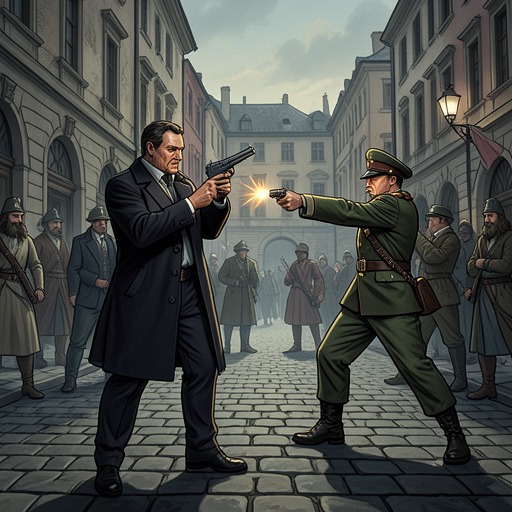
The Day of the JackalLa Marjolaine is the ceremonial tune played during the medal presentation at the Gare Montparnasse on Paris Liberation Day in 1963. As Charles de Gaulle pins a medal on a veteran, The Jackal fires from a nearby building; the bullet misses, but the music continues, holding the ceremony’s public composure against the danger that its participants do not perceive.
A song within the ceremony
The ceremony takes place on August 25, nineteen years after Paris’s liberation from German occupation. De Gaulle has refused to alter his published itinerary: after morning commemorations, he is to present medals to ten veterans of the Resistance at four o’clock in front of the Gare Montparnasse. The event draws a vast crowd, while some 75,000 police and other personnel work to keep order. Most spectators can barely see the President through the protective ranks around him.
The music first heard at the station is not La Marjolaine. The band begins with La Marseillaise; after the anthem ends, the guard receives its command to present arms. De Gaulle then walks forward to the veterans, accompanied by the Minister of Ancient Combatants and an official carrying the medals and ribbons on a velvet cushion. La Marjolaine enters as the band plays softly during the first presentation.
The shot and the music’s continuation
Six floors above the forecourt and about 130 metres away, The Jackal sights on De Gaulle as the President pins the medal to an elderly veteran. At the instant the assassin squeezes the trigger, De Gaulle bends to kiss the man on both cheeks. The movement carries his head clear of the bullet’s path: the shot passes a fraction of an inch behind him and tears harmlessly into the sun-softened tarmac.
The near miss does not interrupt the ceremony. Neither the Minister nor the official hears the shot, and the people fifty metres away hear nothing. De Gaulle straightens and proceeds to the next veteran while La Marjolaine plays on. The Jackal reloads, still intent on continuing the attack; Claude Lebel reaches the sixth floor as the ceremony carries forward below.
Narrative function
The tune marks a precise contrast between two simultaneous actions: a formal act honoring wartime service and an attempt to kill the head of state. Its continuation is not evidence that the danger has passed; rather, it shows how completely the shot is absorbed into the event’s ordinary sounds and movements. The medal, the veteran’s salute, the President’s congratulatory kisses, and the music sustain the public ritual while the assassination attempt remains, for those assembled, unseen and unheard.
The choice of the station square also carries a memory of its own. The Jackal had previously surveyed the site, whose name had been changed from Place de Rennes to Place du 18 Juin 1940. That name commemorates the day De Gaulle, speaking from exile in London, urged the French to continue the struggle after a lost battle. At the ceremony, the song accompanies a public commemoration of resistance; in the same place, De Gaulle’s physical movement unexpectedly defeats the assassin’s aim.