Lebel kills the Jackal in an apartment gunfight
The Day of the JackalClaude Lebel kills the Jackal in an apartment gunfight, ending the pursuit that has followed the assassin to Paris and preventing another attempt on Charles de Gaulle. The final confrontation grows out of a manhunt built on incomplete information, hurried coordination, and the recognition of one decisive detail: an aluminium crutch concealing a rifle.
The Manhunt Narrows
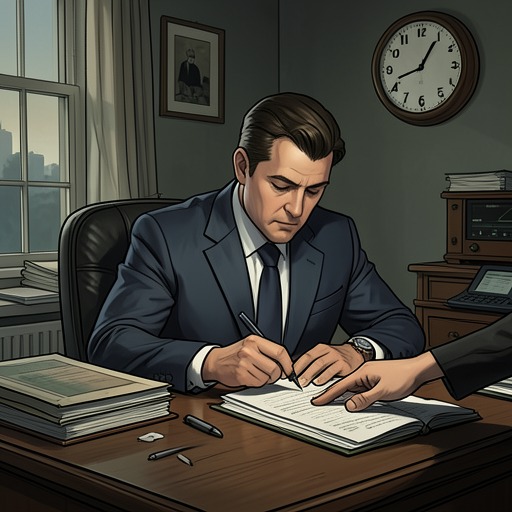
Lebel’s pursuit began with an extraordinary assignment. Briefed by the Minister of the Interior and given access to the resources of the officials assembled around him, he established a secret office and made Bryn Thomas his assistant. He ordered a camp bed, washing equipment, coffee, and ten outside telephone lines—not incidental comforts, but provisions for a round-the-clock investigation whose existence had to remain tightly controlled.
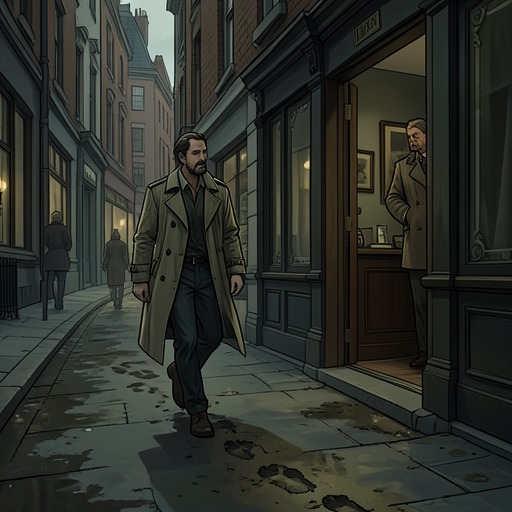
The first international appeals conveyed how little the investigators knew. Lebel could offer his foreign police colleagues only a poor description and the suspicion that the unknown man was a political contract assassin with several successful killings behind him. Later, searches of immigration and hotel records supplied a more specific lead: Alexander James Quentin Duggan had entered France from Brussels on July 22 and returned toward Brussels on July 31. A hotel card linked the same name and passport number to a small hotel near the Place de la Madeleine, where the man had stayed from July 22 through July 30. The records traced a false identity through ordinary administrative paperwork, but did not yet reveal where the fugitive had gone.
When the search shifted to the area around Ussel, Lebel instructed Commissaire Valentin to organize a square search from the place where the car had been found. Police were to question farmers, village shops and cafés, hotels, and isolated woodcutters’ shacks about a well-dressed, tall blond Englishman carrying three suitcases and a handgrip. To keep reporters from discovering the real purpose of the operation, Valentin was told to describe it as a search for a possibly dazed survivor of a car crash. If officers located the man, they were not to approach him: they were to surround him and hold him there until Lebel arrived.
The Ceremony’s Defenses and the Crutch
The authorities prepared for the Liberation Day ceremony at the Gare Montparnasse with precautions designed to leave no obvious route into the crowd. Steel barriers were to be erected hours in advance, with the enclosed ground and sewers searched; nearby houses and flats were to be inspected, and armed watchers placed on rooftops. Police were to occupy even the cornices and spires of Notre-Dame de Paris. Priests, acolytes, choirboys, and police officers were all subject to checks, while special lapel badges were issued to help distinguish genuine security personnel from anyone attempting to impersonate them.
The measures extended to Charles de Gaulle’s car and the movement around him. Bullet-proof windows were secretly fitted into the Citroën DS 19, whose driver was told to travel faster than usual, and Jean Ducret assembled especially tall officers and officials to screen the President without making the protection conspicuous. Yet Lebel did not treat the impressive perimeter as proof that the danger had passed. The fugitive had reached Paris despite betrayal and pursuit, and might be using another face and identity card. Since the security plan could not guarantee that he would be found before emerging, Lebel proposed walking among the ceremonies and watching for him.
At the Gare Montparnasse, that attention to what did not fit became decisive. Lebel heard that an apparent one-legged man had a crutch, then recognized the significance of its aluminium construction: it matched the kind of object that could conceal a weapon. He ran after the CRS officer, turning the disguise’s most conspicuous sign of disability into a practical clue. The clue led Lebel from the public ceremony to the building where the assassin had taken position.
The Gunfight and Its Immediate Aftermath
Lebel reached the sixth floor with a CRS officer carrying a submachine carbine. Two doors faced the front of the building, and he hesitated between them until a soft, distinct sound came from behind one. He pointed to the lock and ordered the officer to shoot it away. The door buckled under the burst, and Valremy entered first, with Lebel close behind.
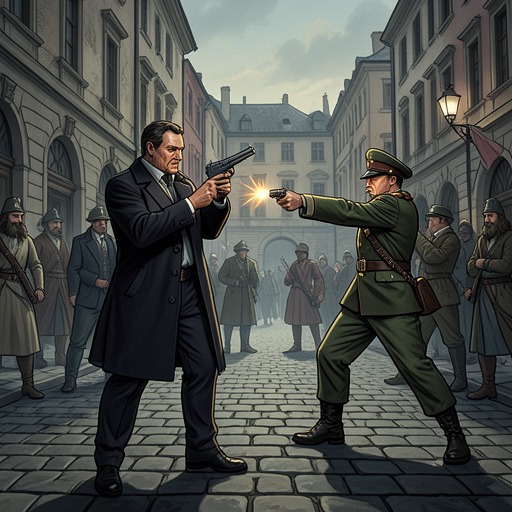
The room exposed the disguise’s trick: the apparent one-legged old man was a strong young man with two legs, no greatcoat, and the rifle already in his hands. He swung up from behind the table and fired from the hip. The explosive bullet struck Valremy in the chest; he fell, and Lebel found himself facing the gunman above the dying officer’s body. The assassin and detective recognized one another, but there was no pause for arrest or interrogation. The Jackal opened the rifle’s breech and worked to reload.
Lebel’s attention dropped from the assassin’s eyes to the fallen CRS officer. The young man’s carbine had slipped from his hands and lay at Lebel’s feet. Lebel seized the MAT 49 and fired as the Jackal snapped the rifle shut. Half a magazine struck the assassin in the chest, throwing him backward into the far corner and bringing down a standard lamp. The gunfire carried into the square, where the band continued playing; afterward, inquiries were diverted with a false explanation that a motorcycle with a faulty silencer had been started nearby.
At six that evening, Superintendent Thomas received word from Paris that the Jackal had been killed and was told to send a senior inspector to the flat to handle the remaining work. The killing closed the pursuit in the same cramped room where Lebel’s recognition and rapid use of the fallen officer’s weapon mattered more than the vast security arrangements outside. The assassin who had entered the ceremony perimeter under a false appearance was identified only when the disguised body and concealed rifle became an immediate armed threat.
Secrecy, Security, and the Final Recognition
The final confrontation resolves a strategic problem established before Lebel’s appointment. The earlier attempts on Charles de Gaulle had failed, but they had also warned the authorities that his life remained under threat. The Jackal’s assessment was that this forewarning would prevent security from slipping into routine: any shot would prompt an immediate response, and officers would be more likely to attack the assassin than panic. In his view, the OAS therefore needed a professional rather than another volunteer willing to risk his own life. The resulting pursuit was not simply a contest between a detective and a fugitive; it unfolded in a security environment the failed plots had already transformed.
The government’s secrecy order added a second constraint. Charles de Gaulle would not tolerate public knowledge of the threat or precautions that might make him appear to be hiding from a foreign assassin. Lebel’s investigation consequently had to mobilize extensive police resources while keeping the operation from becoming public. The ceremony’s defenses could search buildings, roofs, sewers, and the crowd, but they could not by themselves identify a disguised man who had reached Paris despite the manhunt. At the decisive moment, the pursuit depended on Lebel interpreting an ordinary-looking crutch as a possible weapon container. The ending thus turns on the difference between adding safeguards and seeing what those safeguards cannot settle: the assassin is stopped not by the scale of the perimeter, but by a clue recognized within it.