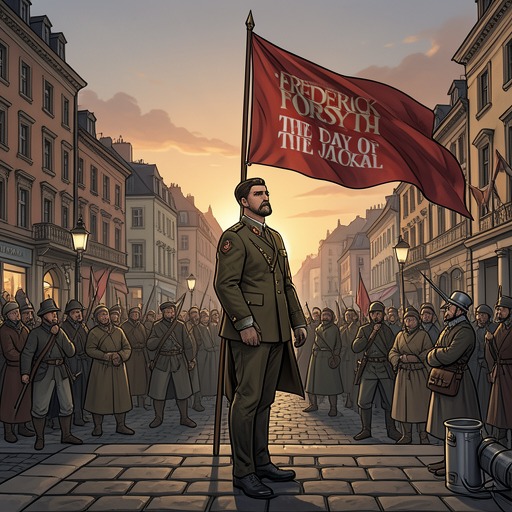
Liberation of Paris
The Day of the JackalThe Liberation of Paris was the 1944 liberation of the city from German occupation, remembered in the novel through its anniversary and its association with Charles de Gaulle. Nineteen years later, that memory gives The Jackal a crucial piece of information: de Gaulle will not spend the anniversary elsewhere, making the commemorations a foreseeable opportunity for an assassination attempt.
The 1944 Liberation and Its Memory
The novel invokes the liberation as a shared point of reference rather than staging the event itself. During a conference about the assassination threat, the minister recognizes August 25 as Liberation Day and recalls that he and many of those present had been with de Gaulle on the day Paris was liberated in 1944. The brief recollection places the current crisis against a defining national event and connects the President personally to its anniversary.
The date also carries a political history that predates the liberation. In 1940, de Gaulle had spoken to the Army over the radio, calling on it to follow him; in 1961, his address again helped defeat a military putsch. The novel thus presents the 1944 anniversary as part of a longer public memory of de Gaulle’s wartime leadership and authority, not simply as a ceremonial date on the calendar.
From Anniversary to Assassination Timetable
The Jackal’s choice of day emerges only when Claude Lebel reconsiders the assassin’s movements. The Jackal had spent a week in France rather than immediately adopting another identity and travelling to Paris. Lebel concludes that this delay is purposeful: the assassin has chosen his day and has been waiting for it.
Once the conference identifies August 25 as Liberation Day, Lebel explains the calculation. De Gaulle would never be away from Paris on the anniversary, which the President regarded as his great day. A national commemoration therefore supplies the assassin with a dependable occasion and turns the President’s public attachment to the date into a vulnerability. The historical event does not itself cause the plot, but its continuing significance makes the target’s movements unusually predictable.
The 1963 Commemoration and Its Irony
On Sunday, August 25, 1963, Paris celebrates its liberation from the Germans nineteen years earlier. The ceremonies draw a vast crowd, while 75,000 officers and officials work to keep order in the summer heat. Most spectators can barely glimpse de Gaulle as he moves through dense ranks of guards and police to officiate. Tall officials also form an accidental human screen around him, and all four of his bodyguards are present.
The contrast is sharp: the anniversary that makes the President’s appearance predictable also brings extraordinary security and puts the city’s crowds under close control. The Liberation of Paris is remembered publicly as a victory and a moment of national unity, yet in the present action its date becomes part of an assassin’s timetable. That collision between civic commemoration and private violence gives the event its decisive significance in the novel.