Lucien Caron
The Day of the JackalLucien Caron is the inspector and close operational aide who helps Claude Lebel organize the investigation of a threatened political assassination. Brought from Homicide into the Brigade Criminelle, he becomes both Lebel’s assistant and the practical link between a small, secret inquiry and the police resources it must mobilize. His work ranges from arranging confidential calls and searching records through the night to translating urgent intelligence and entering a suspected hideout with a cocked submachine gun. Through Caron, the pursuit is shown not simply as Lebel’s individual reasoning but as sustained, tiring institutional labor.
Appointment and Role
Caron is introduced as one of the younger inspectors who had worked with Lebel in Homicide and whom Lebel brought to his new post as assistant chief of the Brigade Criminelle. The detail establishes an existing professional relationship: Lebel selects a colleague familiar with his work rather than an unknown subordinate. The narrative later spells the name as Caron, identifying him as Inspector Lucien Caron of the Sureté Nationale.
When the investigation begins, Caron reports to Lebel after receiving a call from Commissaire Bouvier’s office. He is told that he has the security clearance needed to learn what the assignment concerns, and Lebel gives him material to read before explaining the case. The sequence makes secrecy a condition of his new duties. Caron is not merely asked to help with ordinary office work; his access to the investigation is controlled, and Lebel stresses that no one else is to be admitted to the secret.
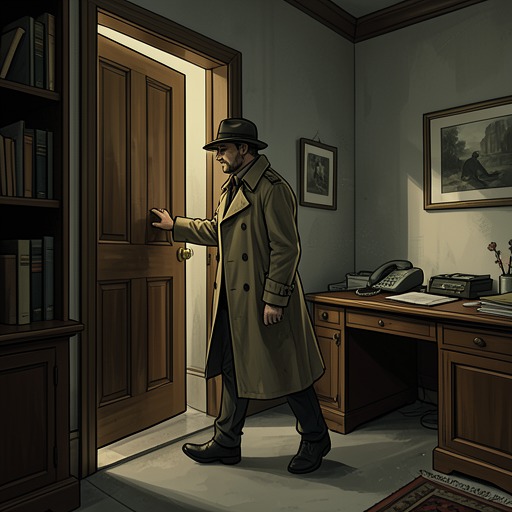
Lebel defines Caron’s position in practical terms: he is to become assistant and secretary in one. The existing secretary is to be transferred or placed on paid leave, while Caron is to arrange a camp bed, linen, pillows, washing and shaving supplies, and a coffee percolator with milk and sugar. These instructions give the operation a makeshift headquarters inside the office. The camp bed and provisions are not incidental comforts: Lebel expects the two men to remain at work for long stretches, and the room must support that effort. The arrangement also places Caron close to the investigation’s changing demands, ready to manage information as it arrives.
Building the Investigation
One of Caron’s first substantial assignments is to organize a sequence of calls through the International Criminal Police Organization’s communications room. He is to approach homicide chiefs individually, confirm that each will be present in his own communications room, and book seven person-to-person calls between seven and ten in the morning at twenty-minute intervals. The calls are to use UHF, with no listening in. Each recipient must be told that Lebel’s information is for that officer’s ears only and may concern not just France but the officer’s own country. Caron must have the ordered schedule ready by six in the morning.
The procedure reflects the uncertainty of the case as well as its urgency. Lebel cannot yet present the matter as a formal inquiry between police forces: he describes it as a routine response to a tip, since investigators do not know whether a crime has been fully formulated or even entered its preparatory stage. At the same time, the question he wants put to foreign police is highly specific. They are to consider whether their files, or their own recollection, contain a top professional contract assassin with successful political killings behind him—not merely a gangland gunman. Caron’s calls carry that narrowly framed request while preserving the inquiry’s confidentiality.
By just before six, Caron is at his desk in shirt-sleeves, tired and strained, with a sheet listing names and timings. The list is a visible result of the night’s scheduling work: a set of separate conversations converted into an ordered plan. His task is not to make the investigative judgment himself, but to ensure that Lebel can put the same question to the right people, in sequence, under controlled conditions. When Caron introduces himself on another call as acting on Lebel’s behalf, he performs that delegated role directly, serving as the investigation’s voice to an outside police contact.
Records, Intelligence, and Fatigue
The search also depends on the patient retrieval of travel and identity records. During an overnight examination of the archives, investigators find a card showing that Alexander James Quentin Duggan entered France on the Brabant Express from Brussels on July 22. A second report, from a customs unit that checked Brussels–Paris trains while they were moving, records Duggan among passengers on the Etoile du Nord Express travelling from Paris to Brussels on July 31. The evidence is significant because it turns a name under investigation into a traceable sequence of border movements. The records have to be found among accumulated files; their value comes from painstaking comparison rather than from a dramatic discovery at a crime scene.
Caron is closely associated with that labor. While Lebel sits at his desk feeling he has never slept and will never sleep again, Caron snores on the camp bed after being up all night masterminding the search through records for Charles Calthrop somewhere in France. Lebel has taken over at dawn, but the division of work leaves Caron’s night effort plainly in view. The camp bed that had been installed to sustain the operation has become a place of brief, exhausted sleep, and the contrast between the two men’s states conveys how the investigation consumes ordinary time without offering certainty in return.
The British call makes Caron’s usefulness especially clear. At five past ten, Superintendent Thomas insists on speaking to Lebel, and Caron crosses the office to wake him on the camp bed. Lebel looks, in Caron’s perspective, as though he has been dead for a week, but gets up and takes the call. Because of the language barrier, Caron then takes back the receiver and translates Thomas’s statements and Lebel’s replies. The exchange makes him more than a scheduler: he is the channel through which information and decisions can pass between the two investigators. When Lebel slams down the receiver, Caron responds by raising an eyebrow; he does not presume to resolve the matter, but remains alert to the next practical instruction. He also asks whether an all-stations alert should be issued, offering a concrete option as the investigation changes pace.
Field Pursuit
Caron’s office work leads into direct participation in the search. When Lebel concludes that the fugitive remains alive, free, and armed, he directs that the search continue and that the missing car be found; the three pieces of luggage make a long escape on foot seem unlikely. Caron is then given responsibility for sending a strong team to Ussel. The search is to begin at the point where the car was found, with that location at the centre of a mapped square. Investigators are to ask at farmhouses, among farmers who regularly drive the road, and at village stores, cafés, hotels, and woodcutters’ shacks. The plan expands outward from a fixed piece of evidence, translating Lebel’s inference into a broad, organized canvass.
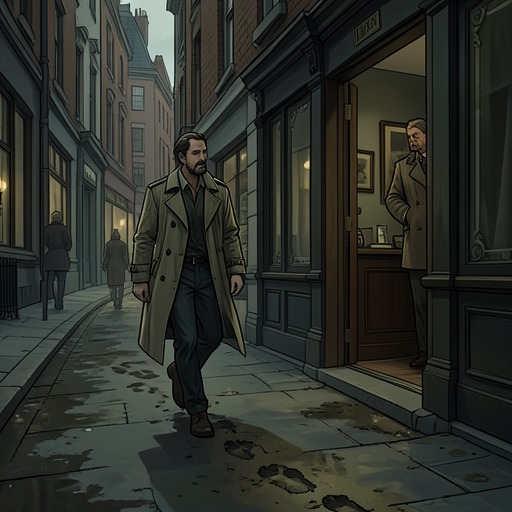
At the Hotel du Cerf, the investigation becomes immediate physical danger. Lebel arrives by police car after landing a mile beyond the township and walks to the entrance with Caron beside him. Under Caron’s mackintosh is a loaded and cocked MAT 49 submachine gun, with his forefinger on the trigger. The hotel has already been isolated for five hours, and the town knows that something is happening; the proprietor is the exception. The ordinary interruption noted in the account is the trout-seller’s failure to arrive with the day’s fresh fish. Against that local detail, Caron’s concealed weapon registers how far a routine search has advanced into an armed operation. His role is now neither clerical nor distant: he accompanies the lead investigator into the place they are checking, prepared for violence.
Partnership and Narrative Function
Caron’s work repeatedly gives form to Lebel’s decisions. He arranges the calls that extend the inquiry beyond France, maintains the records effort, translates the British contact, asks about a wider alert, and carries out the search deployment around Ussel. Later, when Lebel suspects that someone has been warning the fugitive, he proposes wire-tapping and tells Caron to get the Prefecture. Caron is the person who can turn that new suspicion into the next administrative step. The pattern is one of close professional reliance: Lebel sets priorities and draws conclusions, while Caron makes their consequences operational.
That partnership does not remove the investigation’s uncertainties. Lebel recognizes that the assassin knows his own timetable while the police do not know how far along it he is; the investigators can only hope to identify and locate him under his new name before he acts. Later, Lebel acknowledges that the police have made mistakes and suffered bad luck, and that they have twice missed the fugitive by hours. Caron is present within the machinery of those efforts, where careful schedules and exhaustive searches cannot guarantee timely knowledge. The story’s procedural texture rests partly on this contrast: the police can coordinate seven calls, comb archives, map a square search, and isolate a hotel, yet every action still depends on information that may arrive too late.
Caron therefore serves as more than a supporting presence beside the central investigator. His schedule sheets, translations, record searches, phone calls, and armed escort show the collective work required to make a manhunt function. The exhausted inspector on the camp bed and the armed inspector at the hotel entrance are two aspects of the same role: one absorbs the long hours of administration; the other carries the investigation into the field. His contribution is practical rather than spectacular, but it gives Lebel’s inquiry reach, continuity, and the capacity to act.