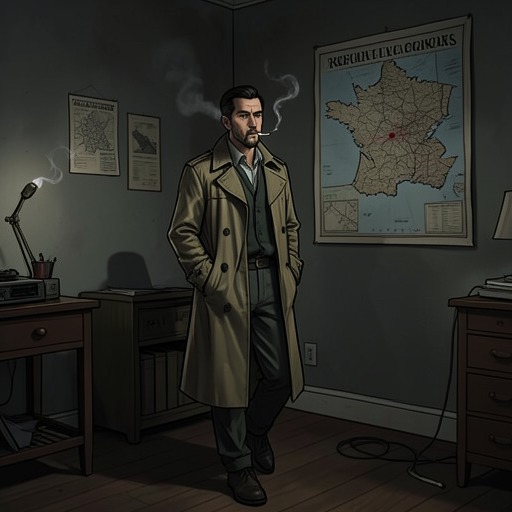
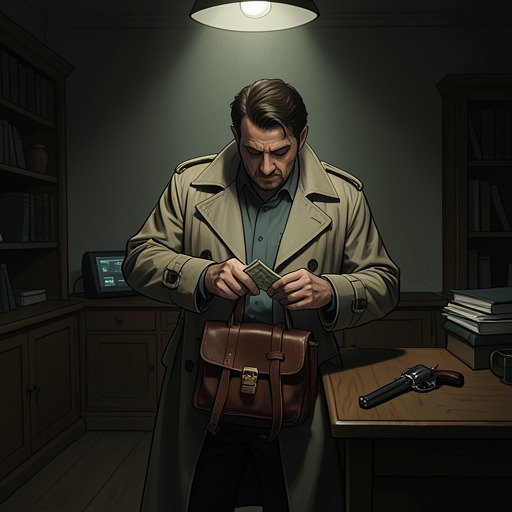
OAS robbery wave of summer 1963
The Day of the JackalThe OAS robbery wave of summer 1963 was a nationwide campaign of armed theft that shook France during the second half of June and all of July. Its immediate significance was twofold: it created a public security crisis on a scale described as unprecedented at the time, and it generated money whose eventual purpose the authorities could not initially identify. Banks, jewellers’ shops, and post offices were attacked from one end of the country to the other, while the frequency and pattern of the crimes made the wave seem less like a succession of isolated thefts than a coordinated emergency.
The Crime Wave and Its Public Impact
Banks were held up with pistols, sawn-off shotguns, and submachine guns on an almost daily basis. Smash-and-grab raids on jewellers’ shops became so frequent that local police could be called away to another case before they had finished taking statements from shaken, sometimes bleeding shopkeepers and assistants. Two bank clerks were shot in separate towns while attempting to resist the robbers. The attacks thus imposed their cost not only through stolen cash and jewels but through a growing threat to people caught at work during ordinary business hours.
The danger lay chiefly in daylight. These were not skilled safecrackers who slipped into banks at night to open vaults; they were masked, armed gangs who could enter during business and threaten to shoot at the slightest provocation. In response to complaints from bankers and jewellers, the government increased nighttime police checks on banks, but that measure did little against raids conducted while the premises were open. By the end of July, the crisis had become serious enough for the CRS anti-riot units to be called in. For the first time, they were armed with submachine guns, and customers entering banks increasingly encountered one or two blue-uniformed guards carrying loaded submachine carbines in the foyer.
The Robbers, the OAS, and the Missing Money
The arrests exposed a deliberately shallow-looking chain of responsibility. Three robbers wounded in separate hold-ups near the end of July were taken prisoner; one was a petty criminal who had used the OAS’s existence as cover for general anarchy, while the others were deserters from former colonial regiments who admitted they belonged to the OAS. Under interrogation, none could explain why the robberies had begun. Each said a patron had assigned a bank or jeweller’s shop as a target, and each had been promised a share of the proceeds. The police concluded that these minor participants had carried out orders without knowing the larger purpose.
The robbery method suited such a divided operation. The men who entered the premises were armed and willing to use force, but they were not skilled safecrackers; they took targets given to them and expected a cut. Their ignorance frustrated the authorities even as it suggested that the crimes were being organized above the level of the arrested men. The OAS was soon recognized as the force behind the wave, and the authorities inferred that it needed a large sum of money in a hurry. They did not yet know what the money was for.
By the latter half of July, the scale of the unexplained proceeds had become measurable. In the last two weeks of June, the case had been assigned to Commissaire Maurice Bouvier, chief of the Brigade Criminelle of the Police Judiciaire. At the police headquarters at 36 Quai des Orfèvres, Bouvier’s office compiled a chart of cash stolen and the approximate resale value of jewels taken. The total had passed two million new francs—about four hundred thousand dollars—by the second half of July. After estimated operating expenses and payments to the hoodlums and deserters were deducted, Bouvier still found a substantial remainder that the known robberies did not account for.
That gap made the crime wave more than a string of violent thefts: it was the visible surface of a financial operation whose purpose remained concealed. The authorities understood that the OAS was raising money, but the prisoners could supply no explanation and the sums did not resolve the question. Only in the first fortnight of August, and by a different route of inquiry, did the authorities discover why the organization had needed funds so urgently. Until then, the unexplained balance stood as a clue to a plan whose principal participants were still beyond the reach of ordinary robbery investigations.
The Financial Campaign’s Hidden Purpose
The account of the robberies changes once the authorities connect the unexplained money to the OAS’s concealed political operation. The wave had looked like a nationwide emergency driven by armed gangs and a hidden balance of proceeds; in the first fortnight of August, a different line of inquiry began to expose the purpose behind the organization’s sudden need for cash. The robberies were not simply an outbreak of opportunistic crime. They belonged to the financial background of the OAS contract that brought The Jackal into a plan to assassinate Charles de Gaulle.
The connection emerged through fragments of intelligence rather than an explanation from the men caught in the raids. Colonel Rolland, working over the damaged record of Viktor Kowalski’s final testimony, reconsidered words first transcribed as French terms for “good” and “annoying.” Listening again, he recognized the description of a “blond” foreigner and a word meaning “a killer.” A garbled name led him to underline the Pension Kleist in Vienna, a possible clue to the meeting place from which the secret had originated. The deciphering made the robbery arrests’ ignorance intelligible: the petty criminals and deserters had been assigned targets and promised shares, while knowledge of the larger operation remained elsewhere.
The OAS leadership’s precautions reinforced the picture of a conspiracy operating behind its visible violence. A report to General Guibaud placed Marc Rodin, René Montclair, and André Casson together on the top floor of a Rome hotel, with bodyguards occupying the floor below. Eight former Foreign Legion members guarded them, and the three leaders did not venture out. The initial assessment was that they were protecting themselves from the kind of kidnapping that had overtaken Antoine Argoud. Their guarded retreat did not itself explain the stolen money, but it showed how much the organization feared the exposure of what its leaders knew.
The decisive confirmation came in a monitored telephone call. At 7:30 one morning, a call from a post office near the Gare du Nord reached the Rome hotel. An operator put it through before recognizing that the number was under surveillance, then listened and alerted the authorities. The message from Valmy to Poitiers reported that The Jackal had been exposed and that Kowalski, after being captured, had disclosed the secret before dying. The intercepted words turned the robbery wave’s missing balance into part of a larger chain of evidence: the OAS had raised money urgently, but its political purpose had been concealed behind layers of intermediaries, fragmentary testimony, and coded contact.
The shift in the investigation was consequential. The authorities no longer faced only a rash of armed thefts, nor could they rely on the arrested robbers to explain the organization’s intentions. The proceeds had pointed toward an urgent OAS need; Kowalski’s testimony and the intercepted message revealed the assassination plot that gave that need its significance. The robbery wave thus functions as both a public crisis in its own right and the financial shadow of a secret campaign against de Gaulle.
From a Crime Wave to a National Manhunt
The robbery investigation ultimately widened into a political-security operation because the men caught at the crime scenes could identify their immediate orders but not the purpose behind them. Once the authorities connected the unexplained funds to a concealed assassination plan, Claude Lebel was summoned to a briefing with the Minister of the Interior and senior officials. The assignment was a directive, not a request: Lebel would have his own office, access to the necessary information, and the resources of the agencies represented at the meeting. The shift in scale reflected the limits of the original inquiry. Local arrests and a ledger of stolen cash could describe the violence, but they could not identify the distant organizers or the intended use of the money.
Lebel’s first measures were designed to keep the inquiry both secret and mobile. He made his assistant, Lucien Caron, his sole secretary, arranged a camp bed and coffee for the office, and demanded ten outside telephone lines with an operator permanently available. When he contacted police abroad, he carefully described the search as a preliminary tip-off: the authorities did not yet know whether the unknown man had settled on a specific crime or begun preparations. The identifying qualification was more revealing than the description itself. France was looking not for an ordinary gangland gunman but for a professional political assassin with successful killings behind him. In this way the robbery wave became the opening public symptom of a much less visible contest: the money had been collected by expendable local crews, while the investigation had to move across agencies and borders to find the person for whom it had been raised.