Rue de Rennes
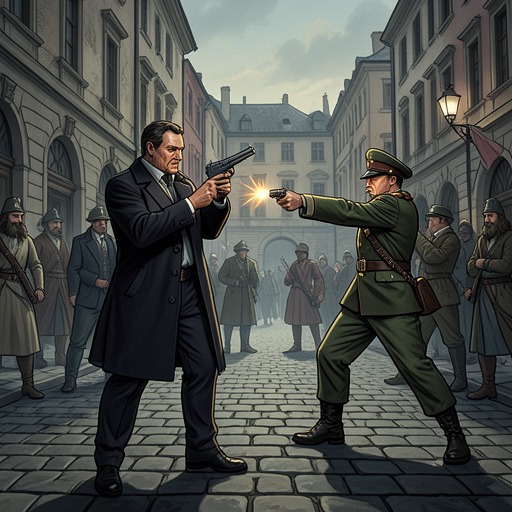
The Day of the JackalRue de Rennes becomes the decisive approach to the forecourt of the Gare Montparnasse in The Jackal’s plan to assassinate Charles de Gaulle. Opening onto the Place du 18 Juin 1940, the street offers the assassin a view of the station forecourt and a choice of buildings from which to fire. Its ordinary features—apartment windows, a concierge’s doorway, and a gap in a crowd barrier—become parts of a carefully assessed route and firing position. On Paris Liberation Day, the street is also where police inquiries converge on the disguised gunman, only for him to reach his chosen position before they can stop him.
Setting and approach
At the end of his survey of the square, The Jackal faces down Rue de Rennes toward the Place du 18 Juin 1940. The forecourt of the Gare Montparnasse lies beyond the square, and from the top floor of a corner building on the street’s western side the distance to the planned firing point is about 130 metres. The street is thus not merely adjacent to the target: it gives him a practical line of sight into the ceremony’s space.
The Jackal compares the buildings around the square according to their angles and distances. On Rue de Rennes, the first few houses offer possible views into the forecourt, while farther along the firing angle narrows too much. Similar possibilities exist on the Boulevard de Montparnasse, but the station itself is not a usable alternative: its upper windows would be occupied by security personnel. These constraints make the street’s corner buildings unusually valuable, while sharply limiting which rooms can serve his purpose.
Reconnaissance and chosen position
The Jackal spends hours watching the buildings from public places. He takes coffee at the Café Duchesse Anne, studies the opposite facades, then has lunch across the square before inspecting apartment entrances more closely. On the following day he returns with a newspaper, using a pavement bench beneath the trees as cover while he examines the upper floors. His method is patient observation: the street remains in full public view, but his attention is fixed on windows, rooftops, and the relation between a room and the distant forecourt.
He considers both the roofline and the floors below it. The attics and mansard windows may attract security watchers, perhaps positioned among the chimney stacks, so a room on the top floor beneath the attics could offer concealment if its occupant sat far enough back from the window. That concealment comes at a cost: moving deeper into the room narrows the sideways angle of fire. He therefore rejects the third house along Rue de Rennes on either side and reduces the viable choice to four buildings around the square.
The afternoon sun settles the question. Expecting to fire in mid-afternoon, The Jackal checks the light at four o’clock on July 29. The upper windows on the western side receive only a slanting ray, while the eastern facades remain strongly illuminated. He chooses the western side, where the light is less likely to expose him. The decision is the result of observation rather than guesswork: distance, angle, concealment, and sunlight all shape the position.
Access through the apartment block
The next day, The Jackal watches the concierge, Madame Berthe, from a nearby bench. Her routine gives him a way to assess the building without attracting attention. He sees her greet residents, chat with a waiter, and bring milk to a cat she calls her little Minet. Shortly before four, she puts away her knitting and walks to the bakery. The Jackal enters the block while she is away, taking the stairs rather than the lift.
At the sixth floor he checks the rear fire escape and the inner courtyard, then climbs the final half-flight toward the attics. Two front flats have the windows he has been watching from the street: one belongs to Mlle Beranger and the other to M. et Mme. Charrier. Their locks are too strong to force quietly, and he concludes that he will need keys, which Madame Berthe is likely to keep in her lodge. He leaves within five minutes, having assessed the access problem without entering either flat. Rue de Rennes has supplied him with a potential firing position, but the building’s domestic routines and security still have to be overcome.
The street on Paris Liberation Day
On the day of the ceremony, police seal the area around the Place du 18 Juin 1940 and search buildings from basement to attic. Rue de Rennes is blocked about 200 metres from the square; crowds gather behind barriers while CRS officers patrol the emptied street. The barrier line makes the street a controlled approach, but also creates a specific point for investigators to check. Claude Lebel moves through side streets, shows his police pass to take a shortcut, and questions officers along the route as the band tunes in the forecourt and Charles de Gaulle’s motorcade enters the square.
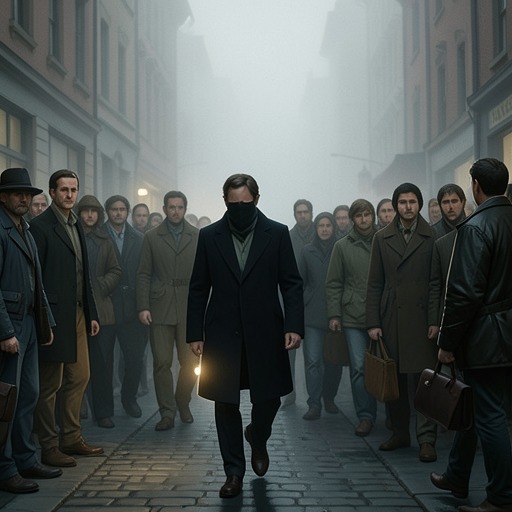
A young officer at the barrier beside number 132 reports that one person has passed through a gap: an apparently sick, elderly cripple who showed an identity card and a war-disabled veteran’s card, with an address given as 154 Rue de Rennes. The disguise turns the street’s checkpoint into an opening rather than an obstacle. Once Claude Lebel connects the sighting to the supposed resident’s address, the route points toward the building and the top floor. The Jackal has crossed the barrier as a figure whom the officer felt obliged to admit, while the official cordon and the crowds below direct attention toward the presidential arrival.
Firing line and significance
From six floors up, about 130 metres away, The Jackal steadies his rifle on Charles de Gaulle as the President pins a medal on a veteran. He fires when the raised salute appears to expose the President’s temple. At that instant, however, de Gaulle bends to kiss the recipient on both cheeks. The bullet passes a fraction of an inch behind his moving head and strikes the softened tarmac of the forecourt, where it breaks up harmlessly. Rue de Rennes has given The Jackal a carefully calculated line of fire, but the target’s unanticipated movement defeats the shot.
The street’s role is built from a contrast between visibility and concealment. The Jackal studies it openly from cafes and benches, enters an apartment block during a brief gap in the concierge’s routine, then crosses a barrier under a false identity. Meanwhile, the police search the same buildings and question the people controlling access. Rue de Rennes is at once a public thoroughfare, a sequence of practical obstacles, and the final distance between a planned assassination and its failure.