Somerset House
The Day of the JackalSomerset House becomes a crucial London outpost in the investigation of The Jackal, where a laborious search through death certificates turns a passport identity into a concrete lead. The records do not identify the assassin directly; instead, they reveal that Alexander James Quentin Duggan, the man whose name appears on a passport, had died at two and a half years old. That contradiction gives the investigators a firm fact amid a search otherwise hampered by uncertainty about the fugitive’s name and appearance.
Setting and institutional role
Somerset House houses the section responsible for Britain’s death certificates, a record collection encompassing millions of deceased citizens. During the search, its files become part of a practical test of passport identities: investigators check whether the people named in recently issued passports are actually dead. The work depends on staff clerks and paper files rather than a quick, automated lookup, turning the grand scale of the archive into an accumulation of individual checks.
The location’s importance lies in this specific function within a wider international investigation. The French police are searching their own records and pursuing leads inside France; at Somerset House, Thomas’s team examines British identity and death records. Information uncovered in one country can then be compared with border and hotel records in another, making the location a working point in a cross-border chain of verification rather than simply a backdrop for the hunt.
The Duggan discovery
At a quarter past ten, Superintendent Thomas receives a call from Somerset House. The senior inspector supervising the search reports the passport details for Alexander James Quentin Duggan: he was supposedly born on April 3, 1929, in Sambourne Fishley; he applied for a passport on July 14, 1963; it was issued the following day and mailed on July 17 to the address on his application. The inspector suspects that address may be an accommodation address, but the decisive clue comes from the death records.
Duggan had been killed in a road accident in his home village on November 8, 1931. He could not have applied for a passport in 1963. The discovery exposes the name as a false identity and gives the investigators a way to distinguish a fabricated passport persona from a living applicant. Thomas immediately asks how many recent passport applications remain unchecked; about three hundred are still to be examined. The clue is therefore powerful but arrives within an unfinished, painstaking process.
The labour of verification
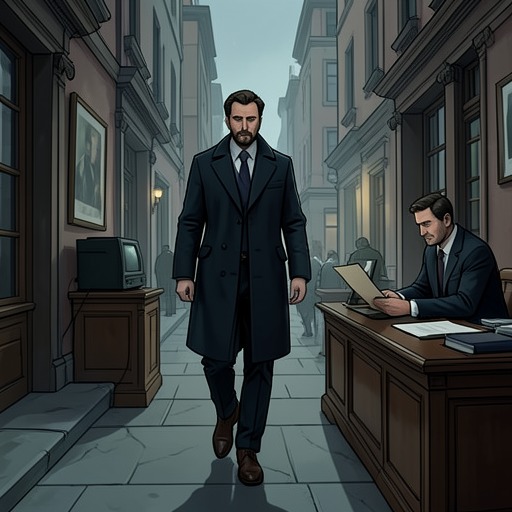
The call comes while Thomas is at his office, looking out over a quiet street. At Somerset House, six detective sergeants and two inspectors work through piles of paperwork, repeatedly accompanying staff clerks along rows of files to check another name. The senior inspector sounds tired, yet hopeful that a useful result might bring an end to the grind of checking records for passport holders who are not dead. The scene gives the discovery its institutional cost: it emerges not from a single dramatic search, but from sustained clerical labour and the coordination of police officers with archive staff.
A clue carried across borders
The false Duggan identity is tested against records held in France. A search of the Pantheon archives finds an entry showing that Alexander James Quentin Duggan entered France from Brussels on July 22 and another showing him travelling from Paris to Brussels on July 31. A Paris hotel card, filled out in Duggan’s name and carrying the same passport number reported from London, places him at a small hotel near the Place de la Madeleine from July 22 through July 30. These French records do not belong to Somerset House, but their agreement with the British passport information shows how the London discovery feeds into a broader reconstruction of the fugitive’s movements.
The novel thus makes Somerset House part of the manhunt’s procedural machinery: an archive becomes useful when a name is checked against a record capable of disproving it. The Jackal’s anonymity is challenged not by a witness who recognizes him, but by the mismatch between a passport and a dead child’s history. The revelation narrows the investigators’ uncertainty while also showing the limits of the method: hundreds of applications remain to be checked, and the discovery exposes the false identity without, by itself, locating its user.