The Jackal–OAS contract
The Day of the JackalThe Jackal–OAS contract is the secret arrangement by which the OAS hires The Jackal to assassinate Charles de Gaulle. It begins as a response to a compromised organization: established OAS operatives are known to the French authorities, while the hired outsider insists on controlling his own plan, timing, and communications. The contract’s central tension is therefore present from the outset: the OAS needs a killer it cannot safely supervise, and the killer accepts the assignment on terms that leave him increasingly beyond its control.
Why the OAS hires an outsider
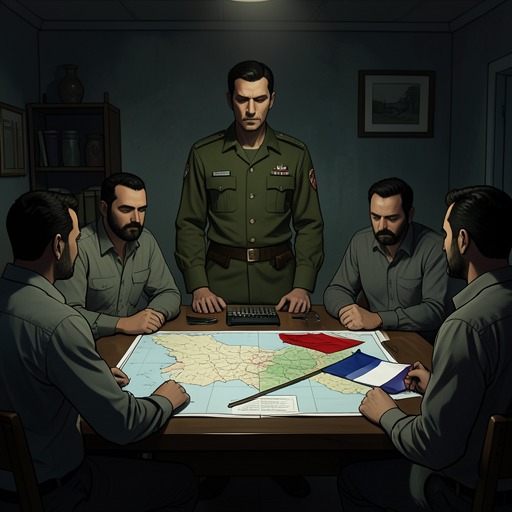
Marc Rodin presents the hiring plan to René Montclair and André Casson after concluding that the OAS’s known candidates cannot operate freely in France. They would be hunted by conventional police and exposed to informants among the undercover agents. An outsider, Rodin argues, might bypass a security network that already knows the organization’s available assassins. Montclair and Casson first react with astonishment, then agree in principle.
Rodin makes secrecy part of the plan’s design. He warns that even within the OAS there are infiltrators in responsible positions, and that some National Resistance Council politicians might be unwilling or unfit to know the full scope of the operation. Only he, Montclair, and Casson are told of the proposal; Rodin says he developed it the day after Jean-Marie Bastien-Thiry’s execution and made the enquiries himself. Montclair’s role as treasurer and paymaster is to meet the fee, while Casson is to arrange assistance from a small, trusted group inside France.
The assassin’s terms
When Rodin asks whether the Englishman will assassinate de Gaulle, The Jackal agrees, but makes clear that the price will be high. He describes the assignment as a career-ending risk: capture or discovery is likely enough that the payment must provide for the rest of his life and for protection against Gaullist revenge. The fee is thus not incidental compensation; it reflects the danger and the expectation that this will be his last operation.
The Jackal makes security conditions explicit before proceeding. He asks how many people know that the OAS is considering an outsider, and, on learning that only the three men present know, requires that the circle remain unchanged. Records of meetings, files, and dossiers are to be destroyed. Because Antoine Argoud had been seized in February, The Jackal says he will consider himself free to call off the assignment if any of the three principals is captured; he also expects them to remain somewhere safe and under heavy guard.
He reserves both planning and execution to himself. He will disclose no operational details, even to his employers, and will disappear rather than maintain ordinary contact. Rodin’s group has his London telephone number and address, but he intends to leave both before moving; the men may contact him there only in an emergency. Payment is to go through a bank in Switzerland, with the first $250,000 deposited before he moves, unless he is fully ready sooner. He will not be hurried or subjected to interference. The OAS offers information from highly placed men in France, but this offer does not displace his insistence on operational independence.
Payment, exposure, and the choice to continue
The money becomes a point of pressure once the assassination plan is exposed. After Viktor Kowalski’s death, The Jackal is on his own: neither Rodin nor the other OAS men know his identity or whereabouts. He weighs returning against continuing. Returning would bring a dispute over the quarter-million dollars in his Zurich account; he believes the OAS would track him, torture him for the signed release needed to recover the money, and kill him if he refused to hand over most of it. Continuing, by contrast, means facing the heightened security surrounding de Gaulle and spending much of the money he has.
The Jackal chooses to continue. His decision shows how the contract’s payment arrangement and his personal freedom pull in opposite directions: the money makes withdrawal dangerous, while the exposed plot makes the assassination more difficult. He remains confident that his plan can overcome the security screen, even as the danger increases and the opportunity to turn back narrows.
The police trace the contract’s consequences
The contract gives the French investigation a distinctive problem: the authorities know that someone may be preparing an assassination but initially have neither a name nor a reliable description. Claude Lebel makes confidential approaches to foreign police forces, presenting the request as a preliminary tip rather than an official inter-police enquiry. He asks whether their records or experience suggest a professional political assassin with successful killings, distinguishing such a figure from an ordinary gangland gunman. The request’s unusual qualification reflects the OAS’s choice of an outsider: the investigators are searching for a specialist who may never have operated under his own name in their countries.
Lebel’s later reasoning links the assassin’s professional standing to his ability to evade official records. He argues that someone experienced enough to be among the world’s best contract killers, yet absent from police dossiers, must have worked under false names and appearances. The comparison between photographs shows how Charles Calthrop could become Alexander Duggan by appearing taller in high-heeled shoes, losing several kilos, changing his eye colour with contact lenses, and dyeing his hair. The disguise is not a side issue to the contract; it helps explain why hiring an unknown outsider initially seemed to offer the OAS a way around the compromised network.
As the manhunt develops, Lebel concludes that The Jackal has been repeatedly tipped off. Information about the exposed assassination plan and the discovery of the Duggan identity reaches him, while the exact route of each leak remains uncertain. Lebel suspects the contact known as Valmy in connection with one message, and later reports that the first two occasions on which the assassin was warned followed briefings to the authorities’ meeting. When the authorities arrest Valmy, Lebel’s inability to impersonate him on the telephone prompts The Jackal to leave his hiding place and assume another identity. These revelations show the contract’s secrecy failing on both sides: the OAS’s internal vulnerabilities have been matched by leaks from the investigation.
A contract still in motion
Lebel reasons that the assassin has not retreated merely because his identity as Alexander Duggan has been exposed. When enquiries suggest he bought paint in Gap to transform his car before fleeing toward Ussel, Lebel infers that someone warned him about the discovery of the Duggan identity. Yet the route points not out of France but toward its centre. Lebel tells the authorities that The Jackal has not abandoned the target; he has continued toward the head of state despite knowing that the authorities are alert to the plot.
The assassin’s timing remains his own, as promised in the original terms. Lebel observes that the authorities do not know where they have intervened in the killer’s timetable, and later concludes that the week The Jackal spent killing time in France was deliberate: he had chosen a day to strike. At the ceremony perimeter, a guard reports allowing an apparently ill, older cripple through a gap after checking an identity card and a disability card; the address given is 154 Rue de Rennes. The disguise and passage through the barrier bring the contract to the edge of its intended act. Its defining feature has endured throughout: the OAS supplied the commission and money, but The Jackal retained the plan, the timetable, and the final approach to Charles de Gaulle.