The Jackal’s failed shot at de Gaulle during the Liberation Day ceremony
The Day of the JackalThe Jackal’s failed shot at de Gaulle during the Liberation Day ceremony is the decisive break between a seemingly controlled assassination plan and the chaotic gunfight that follows. With Charles de Gaulle exposed in the station forecourt, The Jackal fired from six floors above; a traditional congratulatory gesture shifted the President’s head at precisely the wrong moment for the assassin, and the bullet missed.
The ceremony and the firing position
The ceremony unfolded before a formal military guard. The western side of the forecourt was lined with the red plumes and burnished helmets of the Garde Republicaine, while its bandsmen stood slightly forward. Protocol officials and palace staff gathered around a car beside the station facade, and the band began La Marseillaise. The public ritual supplied The Jackal with a predictable target and a crowd that did not know it was in danger.
From his elevated position, The Jackal raised his rifle and selected the veteran nearest him, a short, stocky man standing very erect and about to receive the first medal. The veteran’s head appeared clearly in profile through the sight. De Gaulle, taller by about a foot and wearing a khaki kepi with two gold stars, would soon stand opposite him. The Jackal’s choice of target and the ceremony’s sequence gave him a narrow, carefully observed opportunity: the veteran’s award would bring the President into the assassin’s line of fire.
After the anthem, the Commander of the Guard ordered a salute. The crowd divided around the car, and de Gaulle emerged alone from its centre, walking towards the veterans. Only the minister who would introduce them and an official carrying a velvet cushion with ten medals and coloured ribbons continued forward with him. The distinction between the carefully arranged ceremony and the President’s solitary approach sharpened the danger: for the brief moment of the presentation, the assassin had a clear view across the forecourt.
The shot and its failure
The President paused before the first veteran while the minister identified him and explained the act of valour for which he was being decorated, performed nineteen years earlier. De Gaulle inclined his head, took the medal from the official holding the velvet cushion, and pinned it to the elderly man’s chest as the band played La Marjolaine. He then stepped back for the salute. From six floors above and 130 metres away, The Jackal held his rifle steady; through the telescopic sight he could see the brow under the kepi, the President’s eyes and nose, and the raised hand descending from the salute. The crosswires rested on the exposed temple. He squeezed the trigger.
The shot missed because, at the instant the bullet left the barrel, de Gaulle bent forward to kiss the veteran on both cheeks in the traditional congratulatory gesture. The bullet passed a fraction of an inch behind his moving head and struck the softened tarmac, where it broke apart harmlessly. Whether de Gaulle heard the bullet’s whipcrack is left unknown; he gave no sign, and the minister and nearby official heard nothing. The music continued, and the President straightened and moved on to the next veteran, leaving the ceremony apparently undisturbed.
Behind the rifle, The Jackal swore softly, then steadied himself. He had never before missed a stationary target at 150 yards, but the shot had not ended his opportunity: he opened the rifle’s breech, let the spent cartridge fall onto the carpet, took a second round from the table, and loaded it. The failed shot turns the ceremony’s carefully ordered sequence into an immediate second attempt, while its cause is neither a change in the target nor a flaw in the weapon, but the brief human gesture that moved de Gaulle out of the bullet’s path.
The missed shot becomes a gunfight
The second round did not restore the carefully controlled conditions of the first attempt. Claude Lebel reached the sixth floor panting, with a CRS officer behind him, and hesitated between two doors facing the front of the building. A low, distinct report came from behind one; Lebel pointed to the lock and ordered the officer to shoot it off. The door buckled under the burst, and Pierre Valremy entered first, with Lebel close behind.
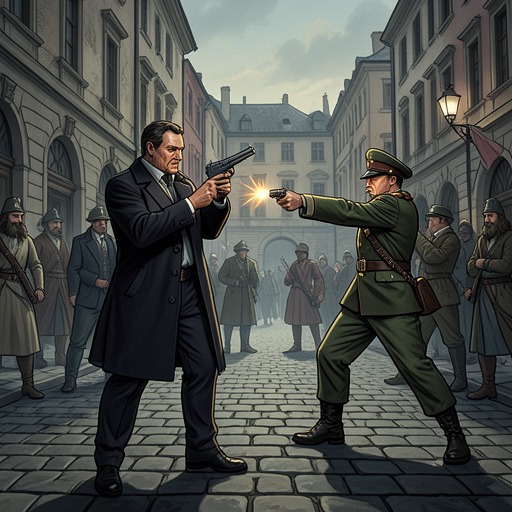
The room revealed the Jackal’s disguise in pieces: Valremy recognized the grey tufts of hair, but the greatcoat was gone, and the legs and forearms belonged to a strong young man. The Jackal rose from behind the table and fired from the hip in one smooth movement. His bullet struck Valremy in the chest and exploded. The failed shot at de Gaulle had left the President alive and the public ceremony apparently intact; moments later, the pursuit had reached the assassin’s room, where the violence that missed its intended target killed the first man through the door.
Significance of the near miss
The episode makes precision answer to a movement no plan can fully command. The Jackal’s aim depends on holding a person still inside a carefully staged public ritual; the ritual’s formal sequence creates the opportunity, but its customary human gesture defeats the shot. The failure remains invisible to the assembled crowd, so the same ceremony can continue while the assassination attempt has already changed the story’s direction. What appears, from the public side, as uninterrupted order becomes the hinge between a concealed threat and an immediate confrontation.