The Jackal’s operation is blown
The Day of the JackalThe Jackal’s operation is blown when the dying Viktor Kowalski’s confession gives French authorities a warning of the plot and prompts an expanding manhunt. The disclosure does not immediately identify The Jackal or reveal when he intends to strike. Instead, it begins a contest between an assassin who believes his false identities can keep him ahead of the search and investigators trying to turn scattered records and deductions into a location.
How the Plot Is Exposed
The first decisive information comes through a message from Valmy to Poitiers: The Jackal is blown, Kowalski has been taken, and he spoke before dying. The news is consequential but incomplete. It tells the OAS network that Kowalski has confessed, not precisely what he revealed or how much the authorities can prove.
Rodin reconstructs one crucial route by which the code name may have escaped. Kowalski could not have known the assassin’s real name, which only Rodin, Montclair, and Casson knew. But as Rodin and The Jackal had parted, Rodin had addressed him as Mr Jackal within Kowalski’s hearing. The greeting, casual at the time, could now help investigators associate a code name with the blond man seen at the hotel. Rodin concludes that the operation cannot be recovered: authorities may have the meeting, the hotel, a description, and a name for the suspected killer.
The disclosure also changes Rodin’s own conduct. He believes that tighter protection around Charles de Gaulle will close off the assassin’s opportunities, and that The Jackal must be urgently told to stop. Still acting as a commander responsible for a mission, Rodin summons the bodyguard who has been collecting mail and making calls since Kowalski’s departure, and briefs him at length. The warning is meant to prevent an impossible operation from continuing; it does not give Rodin direct control over what The Jackal will do next.
The Manhunt Takes Shape
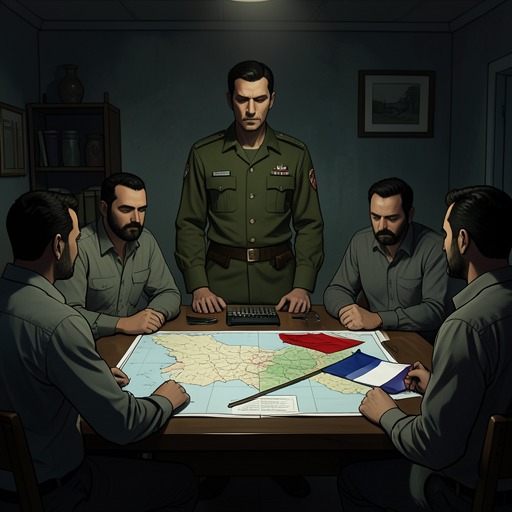
The French response begins with an extraordinary briefing. After reading Colonel Rolland’s report, Claude Lebel is told by the Minister of the Interior that the assignment is a directive, not a consultation. Lebel will have his own office, access to necessary information, the resources of the organizations represented at the meeting, and no limit on expenditure. The scale of the order reflects the danger, but the information available to investigators is still meagre.
Lebel and Lucien Caron turn that institutional authority into an operating base: Caron is made Lebel’s sole assistant, while the office receives dedicated outside telephone lines and priority access to other departments. Lebel then contacts senior police figures abroad. He initially presents the request as an unofficial tip-off rather than a formal international inquiry, because the authorities do not yet know whether the intended crime has moved into preparation. What he can tell them is that the unknown man would have to be a top professional political assassin, with successful killings behind him. The target is left unstated, but Lebel expects his counterparts to understand the implication.
The central uncertainty is not only who the assassin is, but where he stands in his own timetable. After seventy-two hours of investigation, Lebel tells the conference that the killer knows a plot has been exposed in principle but cannot know how far the police have progressed. If investigators identify and locate him under a new name, they may still catch him unaware. This distinction prevents exposure from being mistaken for capture: the authorities know there is a threat, while the attacker retains control of the timing and may already be in France.
The Jackal’s Calculation
Valmy advises The Jackal to quit, but admits that he has no direct authority from Rodin to cancel the operation. The Jackal sees the warning as proof of OAS security failures, yet also recognizes what the police do not know: he is travelling under an assumed name supported by a legitimate passport, with three further sets of false papers, including two foreign passports, and matching disguises. The search for Charles Calthrop therefore need not lead to him as Alexander Duggan, the identity he can document.
That advantage does not make the danger imaginary. The Jackal understands that he will be attacking a guarded target whose security has been alerted. He weighs continuing against returning: going back would risk a dispute with Rodin’s men over the quarter of a million dollars in his Zurich account, while remaining ahead of them would consume much of his money. Continuing means facing greater danger as the chosen day approaches. He decides that his plan can still overcome the security screen and proceeds independently, no longer relying on Rodin or his associates to direct him.
Evidence, Inference, and the Limits of Exposure
Police records provide a more concrete lead when searches under Alexander Duggan’s name uncover an entry into France on the Brabant Express from Brussels on July 22 and a later listing on the Etoile du Nord Express travelling from Paris to Brussels on July 31. A hotel card, carrying the passport number supplied from London, places Duggan at a small hotel near the Place de la Madeleine from July 22 through July 30. Lebel checks quietly with the proprietor and establishes that Duggan was gone by August 15. The records establish a past route and a usable identity, not the fugitive’s present whereabouts.
Later, Lebel reasons from the discovery of The Jackal’s car and its apparent transformation. If the vehicle had already been repainted during its overnight journey from Gap toward Ussel, he must have bought paint in Gap. That purchase would suggest advance warning: someone had told him that the Duggan identity had been uncovered and that the police might soon find the car. Lebel cannot prove that the warning came from within the conference operation; orders pass through switchboard operators, telex operators, and junior staff. He considers Valmy, whose message to Rome had been intercepted, a possible single contact, but presents this as suspicion rather than established fact.
The search for the fugitive is consequently built from provisional explanations. Lebel orders a broad search centred on the place where the car was found, with inquiries at farms, village shops and cafés, hotels, and woodcutters’ shelters. Local officers are told to keep the press away with a cover story about a road accident and to surround the man if found rather than approach him. The measures show how the exposed plot has changed ordinary policing: a vague description and a suspected disguise now govern a coordinated, geographically focused operation.
Yet the final gap remains between knowing that an assassin is at work and recognizing him in front of the guards. At the Paris security cordon, a sentry reports that the only person admitted through a gap in the closed street was an apparently sick, old cripple carrying an identity card and a Mutile de Guerre card, with an address on Rue de Rennes. The report captures the manhunt’s central paradox: the conspiracy is known, the search is active, and the assassin can still pass as someone whom procedure and appearance give no immediate reason to stop.