World War II
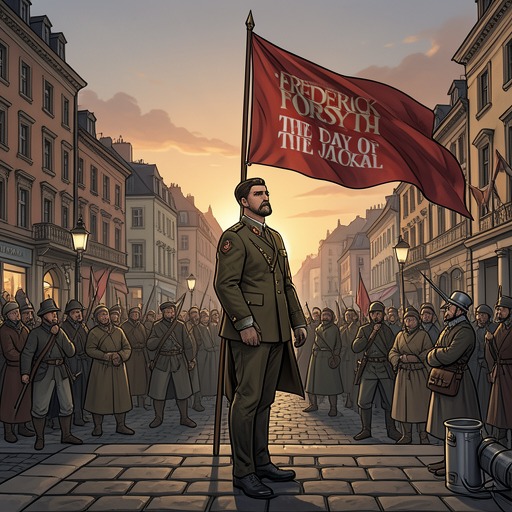
The Day of the JackalWorld War II is a formative historical backdrop in the novel, not a single narrated campaign. German occupation and resistance emerge through the sharply different wartime experiences of M. Goossens, Marc Rodin, and Antoine Argoud; for Rodin in particular, the voice of Charles de Gaulle in 1940 returns decades later as a measure of military loyalty and political rupture.
Occupation and Resistance
During the occupation, M. Goossens continued working at the arms factory in Liège that the Germans had taken over, while secretly assisting the Resistance. His wartime record included participation in a network of safe houses for downed Allied airmen and leadership of a sabotage ring inside the factory. Weapons produced there were made inaccurate or arranged to fail after their fiftieth shell, killing German crews. These actions remained unknown until his defence lawyers uncovered them after the war; Goossens had not disclosed them earlier because post-liberation honours and medals would have embarrassed him. His history makes the factory a double-sided setting: outwardly part of the German war effort, it also concealed practical resistance from within.
Flight and Wartime Service
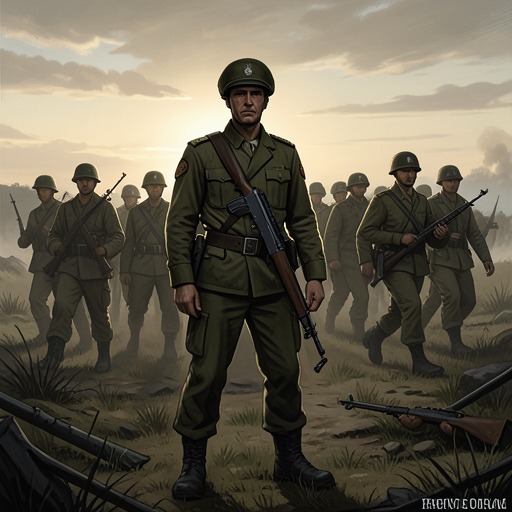
For Marc Rodin, the German advance through France brought flight and a new military identity. The son of a cobbler, he escaped to England by fishing boat as the Germans overran the country and enlisted as a private under the Cross of Lorraine. He rose through the ranks in combat, serving in North Africa under Koenig and later fighting in Normandy with Leclerc. During the fight for Paris, a field commission gave him officer’s rank—advancement earned in battle rather than through the formal education that had opened other officers’ paths.
Antoine Argoud’s wartime background placed him on a different route to authority. As a lieutenant under De Gaulle in the Free French, he fought for France’s liberation from the Nazis. The novel later presents him as a highly capable OAS operations chief, so his earlier service sits in pointed contrast with his subsequent opposition to De Gaulle’s government. Both Rodin and Argoud carried military credentials from the struggle against Nazi occupation into the later conflict, but those credentials did not produce a shared political allegiance.
A Voice Recalled in Algeria
Rodin’s memory of the war becomes politically consequential during the 1961 putsch in Algeria. Before the crisis, De Gaulle’s return to power and his use of the phrase Algérie Française had led Rodin to expect full support for the French Army and for French rule in Algeria. When that expectation collapsed, Rodin joined the putsch and remained with 120 officers, non-commissioned officers, and enlisted men after the mutiny was broken. The account connects that break directly to a wartime memory: when conscripts across Algeria turned on radios to hear De Gaulle, Rodin heard the same voice he had listened to in June 1940, delivering a message that the narrative describes as almost the same.
The radios had initially seemed to the officers a harmless comfort for troops stationed in Algeria. In the decisive broadcast, however, they carried De Gaulle’s appeal to the soldiers to choose their loyalty and follow him. The recollection of 1940 therefore does not simply establish Rodin’s past; it gives the 1961 crisis an echo of an earlier call to allegiance. The same political voice that had been associated with resistance and liberation now helped defeat a military revolt, turning a remembered wartime bond into a source of division.
The War’s Afterlife
The novel uses World War II as a source of histories that continue to shape later action. Goossens’s resistance work explains the concealed wartime service that later mitigated his sentence; Rodin’s escape and battlefield promotion inform his sense of what soldiers have earned; and Argoud’s Free French service complicates his later role in the OAS. These are distinct legacies rather than a single consensus about the war.
That afterlife is most visible in the contrast between military experience and political change. Rodin’s service in North Africa, Normandy, and the fight for Paris had made advancement possible through combat, but it did not prevent his later conviction that politicians had betrayed the Army in Algeria. The return of De Gaulle’s voice across the decades sharpens the irony: a wartime appeal associated with national survival becomes, in the later crisis, the instrument that breaks Rodin’s rebellion. World War II thus supplies the novel with personal histories and a remembered political language whose meaning changes with the conflict around it.