Bunny Junior
The Death of Bunny MunroBunny Junior is Bunny’s nine-year-old son and Libby’s bereaved child. During the novel’s journey with his father, he tries to make sense of a household and a life transformed by his mother’s death. He observes more than the adults around him realize: he notices Bunny’s confusion, keeps his own fears largely to himself, and stores facts from books with painstaking attention. His quietness is not detachment. It is the means by which he manages grief, illness, and a road trip whose purpose and direction he cannot control. By the ending, the child who has spent much of the story following his father becomes the one who can stay beside him and help him face what is coming.
Identity and Background
Bunny Junior first emerges into a home marked by disorder. The living room holds a stack of pizza boxes and unopened bottles of Coca-Cola, while Bunny finds his clothes scattered around. The boy offers little explanation, telling his father that he does not know what has happened. The scene establishes how much of the adult crisis lies beyond his understanding, even as he is physically present in its aftermath.
In the period after Libby’s death, police and ambulance workers have been at the house, and Bunny Junior is relieved when they leave. Their questions about whether he is all right and their whispered conversations bring his mother back to mind; remembering her makes him feel as if the ground beneath him has given way. He wants instead to watch television without being watched or questioned. His response conveys grief as an exhausting intrusion, not a feeling he can readily explain to adults.
He also has blepharitis, which leaves his eyelids puffy, sore, and red. His steroid eye drops have run out, and he thinks he ought to tell Bunny so that more can be bought. Later, the discomfort becomes urgent enough for him to remove his glasses and say that the light hurts and he fears he may be going blind. His eye condition gives his vulnerability a practical, recurring form: even when he tries to attend to his father or his surroundings, he has to contend with painful vision and the uncertainty of whether his sight is worsening.
Learning, Memory, and Libby
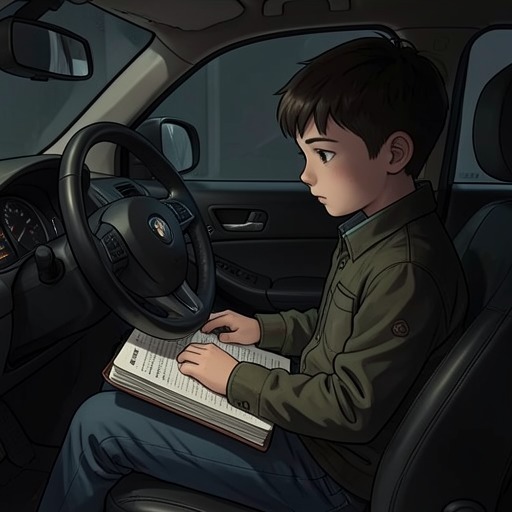
Bunny Junior approaches knowledge as something he can deliberately gather and keep. Lying on the floor of his bedroom with Bunny Junior’s Encyclopaedia, he remains in one position because the discomfort helps him stay awake and alert, and he believes it keeps his memory keen. He is working through the letter M, reading about Merlin and following the book’s cross-references. His attention moves from the Arthurian figure to an unfamiliar word and then onward, showing a mind that learns by pursuing one question into another. The book’s jacket, the color of a citronella mosquito candle, is part of its particular presence for him, but its deeper importance is personal: Libby bought it because she loved him, and he holds on to that reason as well as to its contents.
The encyclopaedia also becomes a way of interpreting the world beyond the page. While waiting in the Punto on Meeching Road in Newhaven, Bunny Junior thinks about quasars, among the most luminous objects in the universe. In that moment he believes Libby will eventually find him. He senses her presence and recalls the smell of her hand cream, then experiences a touch on his brow and a kiss-like gesture. A voice, which he cannot tell is his or hers, connects him to the image of the quasar. The passage presents his longing through the language he has been learning: scientific fact and imagined reunion meet in a private experience of consolation. His knowledge does not remove his bereavement; it gives him a vocabulary in which to hold it.
His grief surfaces more abruptly when he speaks to a girl beside the Punto. He has never really spoken to a girl before and likes her, but instead of finding an easy opening he tells her that his mother died. He immediately feels embarrassed and draws back into his seat. The moment shows how close the loss remains to the surface: even an ordinary attempt at contact can turn into an unguarded disclosure. His attention to the girl’s crimson glitter nail polish and blue eye shadow follows, as if noticing details can help him recover from having said so much.
The Road and His Father’s Lessons
Bunny announces that he and his son are hitting the road. Bunny Junior responds with visible excitement, despite his worn, hole-marked T-shirt and flip-flops. Bunny insists that he must look presentable, presenting appearance as the first rule of salesmanship. The contrast is characteristic of their journey: Bunny frames their time together as a business expedition, while Bunny Junior receives it as an adventure and a chance to be with his father.
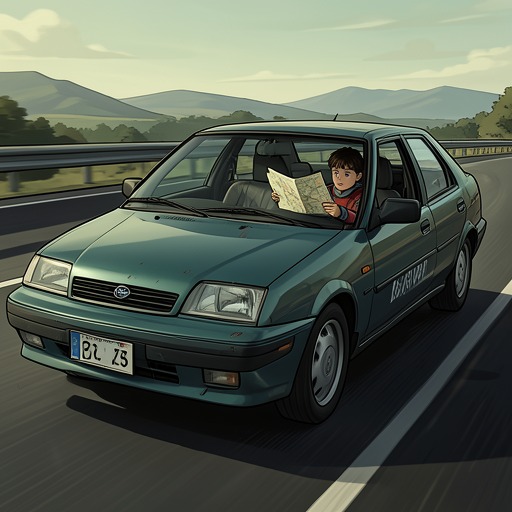
As they travel, Bunny tries to teach him how to sell. Driving slowly through the Wellborne Estate in Portslade, he checks the customer list Geoffrey has given him and searches the buildings for the right flat. He begins a lesson with the image of shaking a great oak or elm tree, asking what would happen, while Bunny Junior listens closely and admits that he does not know. The boy retains the explanation without pretending to understand it at once. His patience and attention are distinct from Bunny’s performance of confidence: Bunny speaks as if experience can be turned into a lesson, while the child quietly stores what he hears for a later time.
That teaching sits within a more difficult choice Bunny puts to him. He asks whether Bunny Junior would rather stay with his father and learn the business or return to school, casting school as a place among children he disparages and sales as a route to becoming someone. Bunny Junior’s immediate response is not to choose between those futures but to ask for his glasses and eye drops because the light hurts and he fears losing his sight. Bunny insists that he answer. The exchange reveals the imbalance between them: Bunny makes his own plans for the boy’s future sound like a test of loyalty, while the child is trying to get his present physical need recognized. Bunny Junior is affectionate and attentive, but his willingness to travel does not mean he is free of his own worries.
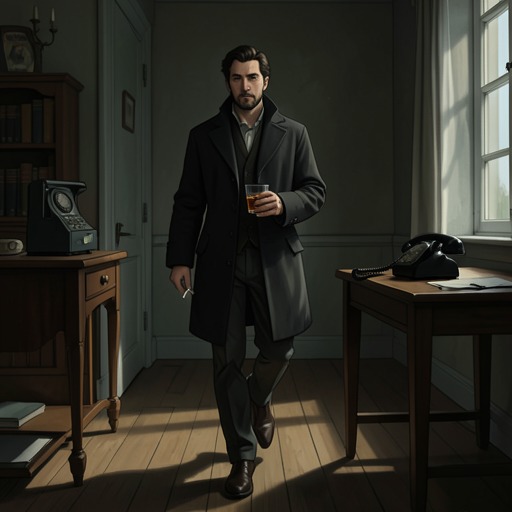
The salesmanship Bunny teaches him also has a family history. In the presence of Bunny Munro Senior, the older man claims that he tried to teach Bunny the business and showed him beautiful things, then condemns the work Bunny ended up doing. Bunny Junior hears this accusation. The scene places the father’s lessons to his son beside an earlier, failed transmission from grandfather to father. Bunny is now trying to make Bunny Junior his companion and pupil, but the older generation’s account makes clear that business instruction has already been a source of disappointment and conflict in the family.
A Child Reading the Adults
Bunny Junior notices changes in Bunny that the father cannot conceal from him. After returning to the living room, Bunny looks gray and moves as if unsure of where he is; the boy sees him enter in a daze. At another point, Bunny’s remark about his own father provokes a sudden, serious threat toward Poodle. Poodle is too incapacitated to hear it, but Bunny Junior’s story repeatedly places him among adult moods and arguments that he can register without being able to resolve.
The boy’s own manner is markedly restrained. When River reaches down and messes his hair, he tries to put it back as it was. When he tells the girl his mother has died, he retreats in embarrassment. At the pool, too, he reads Bunny’s face before answering whether he wants another ride. These small acts of adjustment and observation suggest a child continually gauging other people: how close to come, what to disclose, and when not to press further. His composure should not be mistaken for a lack of feeling; it is paired with grief, fear for his sight, and a strong wish for his father’s attention.
During a vision of Libby, Bunny Junior asks what they will do about Bunny. Libby tells him that his father cannot help him and is truly lost. The boy answers that he is the navigator. The exchange gives words to a reversal already developing in the journey: Bunny is nominally the adult leading the trip, yet his son is beginning to understand that he may have to find his own way through the crisis. The image of the navigator is not proof that the child can repair his father; it marks his effort to take responsibility when the person he depends on seems unable to provide direction.
Change and Ending
At the holiday camp, Bunny Junior waits beside the pool in a circle of streetlamp light, his flip-flops carefully set aside and his feet trailing in the water. He and Bunny greet each other, and Bunny runs his hand through the boy’s hair. They move to the brightly colored electric children’s train, which Bunny remembers from his own childhood. He points out the large yellow key and asks his son to turn it. Bunny Junior hesitates, feeling a flutter around his heart, but then turns the key and starts the train.
For a circuit of the pool, father and son share a rare, uncomplicated happiness. Bunny puts his arm around the boy; Bunny Junior laughs, and they ring the train’s silver bell together. The reflected lights and the train moving around the water give their ride a temporary world apart from the sales trip and its demands. When Bunny asks if he wants to go again, Bunny Junior reads his father’s face and declines. The choice is quiet but consequential: he understands enough to recognize that the ride cannot simply be repeated, and he does not mistake its moment of joy for a return to ordinary life.
Bunny then says that he needs to lie down. Bunny Junior cannot hear him clearly amid the noise around them, but he sees his father fall beside the pool. He strokes Bunny’s brow as Bunny closes his eyes and briefly clutches his shirt, then kisses him. After Bunny dies, the boy lays his head on his father’s chest and holds him, kissing him once more. The rain, the sirens, and the wreckage nearby frame the loss, while Bunny Junior’s damaged encyclopaedia lies on the road: the book associated with Libby and the boy’s habit of preserving knowledge has itself been caught in the catastrophe. In the final scene, Bunny Junior is no longer merely the child being led through the journey. He is the son who stays with his father, recognizes his death, and gives him the tenderness that he has been seeking throughout their time together.