Bunny Junior's grief and fading memories of Libby
The Death of Bunny MunroBunny Junior’s grief and fading memories of Libby Munro form a continuing struggle between absence and attachment. His mother’s death leaves him distressed by the people who come to the house and by the reminders they bring, while the passage of time becomes a second threat: he fears that forgetting her will make their relationship disappear. Recollection and visions offer moments of renewed connection, but they do not settle his loss; they show how actively he tries to keep his mother present.
Grief in the House
In the immediate aftermath, Bunny Junior sits in front of the television with a large bottle of Coca-Cola between his knees. Police officers and ambulance workers have been in the house, and he is relieved when they leave. Their whispering in the hallway and repeated questions about whether he is all right make him feel observed rather than comforted. Their presence keeps turning his attention to his mother, and thinking of her brings an overwhelming sense of loss. His wish to watch television in peace is not a sign that he is untouched by what has happened; it is a small refuge from other people’s attention and from grief that he cannot simply set aside.
His own physical discomfort continues alongside that bereavement. Bunny Junior has blepharitis, his eyes are sore and red, and he has run out of his steroid eye drops. He thinks he should tell Bunny so his father can buy more, but the need remains unspoken in this moment. The detail places ordinary care—a child needing medicine—within a home disrupted by death. Bunny Junior’s needs persist even while the adults and emergency workers focus on the crisis, and his attention moves between bodily discomfort, television, and the overwhelming presence of his absent mother.
When Bunny Junior says that he thinks his mother left something for them, the statement makes their loss tangible through what she may have left behind. The thought brings on a powerful emotional response, expressed in the violent movement of his feet until his slippers fly off. Bunny looks at him, then nods and turns his attention back to the television. The exchange briefly makes the mother’s continuing place in the family visible, but it does not develop into a conversation between father and son. Bunny Junior speaks toward a shared loss; his father’s response is limited to acknowledgement.
Remembering Against Time
Later, alone in bed, Bunny Junior watches the glow of the planets above him and thinks about Pluto’s composition and scale. The orderly facts he can summon contrast with the uncertainty of remembering his mother. He listens to his wristwatch and realizes that, with each tick, her image seems to fade. Time is therefore not merely passing around his grief: he experiences it as actively diminishing the person he wants to remember. He closes his eyes and searches his own memory, hoping that recalling her can prevent her from disappearing altogether.
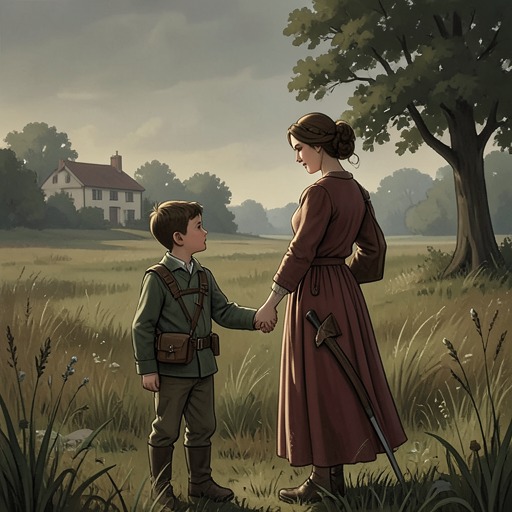
The memories he gathers span different stages of childhood. He recalls Libby collecting him from school in a pink velour tracksuit, tending to his bloody nose, and applauding when he rode his bicycle without holding the handlebars. He remembers the encyclopaedia she gave him because she loved him, and a much earlier image of clinging to her leg as she moved across the kitchen. He also imagines himself as a newborn, wrapped in a blanket with her hand on his forehead and his father nearby, while recognizing uncertainty about whether this last image is truly a memory. The sequence builds a relationship out of acts of attention and care, but its furthest reaches are less secure than its later scenes.
His effort to preserve the past is visual as well as emotional. Bunny Junior arranges memories in his mind like exhibits in the Booth Museum, where stuffed birds stand behind glass, or like frozen wax figures. The comparison reveals both the care of his project and its limitation: he tries to hold experience still, but a preserved scene cannot restore the living person. In the memory of Libby pushing him on a swing at St Ann’s Well Gardens, he can picture himself laughing and rising into the air, yet cannot clearly picture who is pushing. His mother becomes an incomplete figure where the action should have a person. He is left suspended in a remembered moment whose joy remains vivid but whose source is disappearing.
Visions and Continuing Attachment
Bunny Junior’s attempts at recollection sometimes seem to bring his mother back into the present. One night, after searching his memories, he senses her presence in the room and interprets changes in the light as accompanying her return. The scene does not establish whether Libby is literally present; it presents the experience through the boy’s perception. What matters to his grief is that the act of remembering and the feeling of her presence become closely joined. For a time, memory does not merely describe the absent mother: it seems to make contact possible.
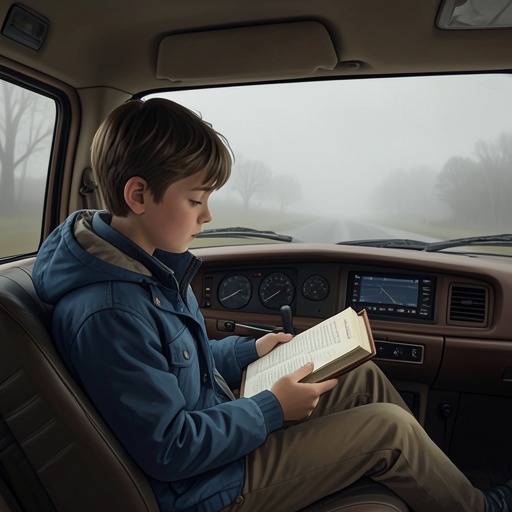
That expectation recurs when Bunny Junior sits in the Punto on Meeching Road in Newhaven. Thinking about quasars, which he understands as among the most luminous objects in the universe, he believes that if he stays where he is, his mother will eventually find him. He then senses her nearby. The contrast between distant astronomical knowledge and his immediate hope is telling: he can explain a remote object through facts, while his certainty about his mother is emotional and relational. The vision gives his longing a direction, turning waiting into an act of faith that she may come to him.
Later, he sees Libby sitting on a low wall opposite the car and beckoning him over. He leaves the Punto, goes to her, and sits beside her. The encounter is narrated as a vision, not as an externally confirmed event. Bunny Junior asks whether this is what she wanted to tell him, but the evidence does not provide her answer. The unanswered question preserves an important uncertainty: he experiences the meeting as communication, yet its meaning is not explained or resolved. His continuing bond with his mother is real as an element of his experience, whether or not the vision is understood as supernatural.
The Shape and Limits of Loss
Bunny Junior’s grief changes form across these scenes, moving from a desire to be left alone, to fear that memory is failing, to deliberate acts of recall and imagined encounters. These are not simple stages in which one response replaces another. He can seek the distraction of television and still be overwhelmed when reminded of Libby; he can assemble detailed memories and still find that her face and actions are becoming difficult to summon. The persistence of that contradiction gives the grief its force.
The novel also places Bunny Junior’s experience beside Bunny’s later encounter with Libby in a crowd. Bunny sees his wife and asks her to forgive him; she tells him that she never haunted him. This exchange belongs to the father’s reckoning, not to Bunny Junior’s visions, and the two should not be conflated. Together, however, the scenes distinguish different forms of attachment to the same absent woman: Bunny Junior tries to preserve his mother through memories and hopes of reunion, while Bunny confronts his own guilt through an encounter he has understood as haunting. Bunny Junior’s grief remains unresolved, centered on the fear that the person he loves may fade from memory even as he continues to seek her presence.