Bunny Junior’s bereavement and visions of Libby
The Death of Bunny MunroBunny Junior’s bereavement is marked by a painful contradiction: he can store facts with extraordinary precision, yet his mother’s face is disappearing from memory. His visions of Libby do not simply restore what has been lost. They shift between incomplete recollection, mistaken recognition, and intimate encounters that help him articulate his grief and, at last, his resolve to endure.
Memory and the fear of forgetting
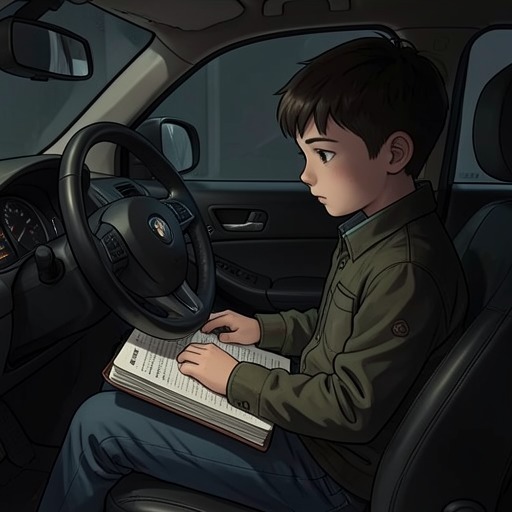
In the Punto, Bunny Junior worries that he can no longer summon Libby’s image clearly. His encyclopaedic memory can retrieve dates and facts, but it cannot secure the face of the person he most wants to remember. The contrast makes his loss concrete: knowing when construction began on the Eiffel Tower does not help him remember what his mother looked like. The failure feels personal, and he feels bad about it.
He tries to arrange memories of their shared life as exhibits, frozen and preserved like the stuffed birds in the Booth Museum. In one remembered scene, Libby pushed him on a swing at St Ann’s Well Gardens. He can still picture his own exhilarated body high in the air, legs kicking and face alive with laughter, but the person doing the pushing has become a dissolving, incomplete ghost. The image leaves him suspended in the swing’s upward movement, without the remembered mother who should bring him safely back down. His effort to preserve the past thus sharpens the fear that it is already vanishing.
That fear is also bodily. In a later reflection, Bunny Junior remembers Libby coming into his room, holding him, stroking his forehead, and crying. He recalls her hand as the softest, sweetest, warmest he has ever felt. As he watches starlings trace the angles of her face in the sky, he longs to feel that hand again, without knowing what he would do if he could. The remembered touch remains vivid even while the face grows indistinct; the loss is not a single blankness but an uneven fading of different kinds of memory.
Mistaken recognition
At the seaside, Bunny Junior buys chips and sees a blonde woman in an orange dress, her hair tied in a ponytail, walking away through the crowd. He takes her for his mother and runs after her, distressed by the recurring experience of Libby disappearing. The people around him seem distorted and strange as he searches, but then he spots the woman again at an outdoor café and approaches with a sudden surge of love.
The woman greets him warmly and asks whether he is all right, but the encounter does not match the mother he has carried in memory. Her features seem slightly altered; when Bunny Junior embraces her, her stomach feels hard rather than soft, and her breasts feel small and hard. He nevertheless clings to her, overcome by sad love and unable to let go when her voice acquires a note of agitation or embarrassment. She struggles free. The moment exposes the gap between the urgent emotional truth of his recognition and the stranger’s actual presence: Bunny Junior’s longing is real, but the woman is not Libby. His mother’s image can draw him toward another person, yet physical contact cannot make the remembered relationship present again.
The encounter in the fog
Later, after Bunny Junior has torn up the client list, eaten its strips, and watched mist gather around the Punto, he closes his eyes and allows himself to be swallowed by the fog. When he opens them, Libby is sitting on a low cream brick wall opposite the car, wearing her orange nightdress and beckoning him over. Mist curls around her face and trails from her hands. The boy steps out and joins her; unlike the stranger at the café, this mother feels soft and familiar, and her presence brings warmth.
Bunny Junior apologizes to her. Libby holds him and answers that she is sorry too, saying she was not strong enough and that he has always been the strong one. The exchange gives form to a sorrow he has largely carried through longing and images: he can speak directly to his mother, and the vision responds. It is an emotionally consoling encounter, though its appearance in the mist leaves open whether it is supernatural, imagined, or an expression of grief. The narrative does not need to settle that question for the scene to matter to the boy.
Loss, guidance, and persistence
Bunny Junior asks what will happen to his father. In the vision, Libby tells him that his father cannot help him and is truly lost. The boy answers, “I am the navigator.” The phrase makes his encyclopaedic competence into a promise of orientation at a moment when he is still a child facing both maternal absence and an unreliable parent. It does not mean that the grief has ended; it gives him a role through which he can respond to what is coming.
He asks whether Libby is alive, explaining that she feels alive and that he can hear her heart beating. She tells him plainly that she died. He then checks whether this was what she came to tell him, but she has another message: she wants him to persevere, whatever happens. Bunny Junior understands this as a warning that something bad is going to happen and that he must be strong. The vision therefore offers comfort without undoing death. Its tenderness coexists with an instruction to face a future in which his mother cannot physically protect him.
The novel also places Bunny Junior’s grief beside Bunny’s very different experience of Libby’s continued presence. During his public apology, Bunny sees her in the crowd and asks her to forgive him; she dismisses his fear of being haunted, saying, “I never haunted you.” That exchange belongs to Bunny’s encounter, not Bunny Junior’s, but it clarifies the contrast: the boy’s visions seek closeness and guidance, while his father’s are entangled with guilt and a sense of being pursued. Across both, Libby remains part of the living family’s emotional world, but the meaning of her appearance changes with the person who sees her.
Narrative significance
Bunny Junior’s bereavement unfolds through repetitions with altered outcomes: a mother’s face dissolves in memory, a stranger is mistaken for her and pulls away, and a mist vision restores the warmth of an embrace while confirming that Libby is dead. The recurring desire for her touch connects the scenes, while each encounter tests a different boundary between remembering and seeing. His grief is not represented as a simple process of forgetting or recovery. Instead, the narrative shows him trying to keep a relationship with his mother amid the knowledge that his recollections are fading and that no vision can return her to ordinary life.
The contrast between Bunny Junior’s factual memory and his uncertain maternal memories gives this loss particular force. He can retrieve an encyclopaedia’s worth of information, but he cannot command the image of Libby to remain. What survives most powerfully is not an exact portrait but the sensory and emotional knowledge of her hand, her embrace, and the love attached to them. The visions give that continuing bond a changing form, and the final appeal to persevere turns it toward the child’s future without pretending the loss has been repaired.