Bunny Munro Senior
The Death of Bunny MunroBunny Munro Senior appears as an ailing father whose need for professional care is unmistakable, but whose relations with Bunny Munro remain governed by anger and old injury. In their encounter, he directs his bitterness not only at his son but also at Bunny Junior, making the boy the focus of a painful hope that the family’s damage might not be repeated.
Identity and Condition
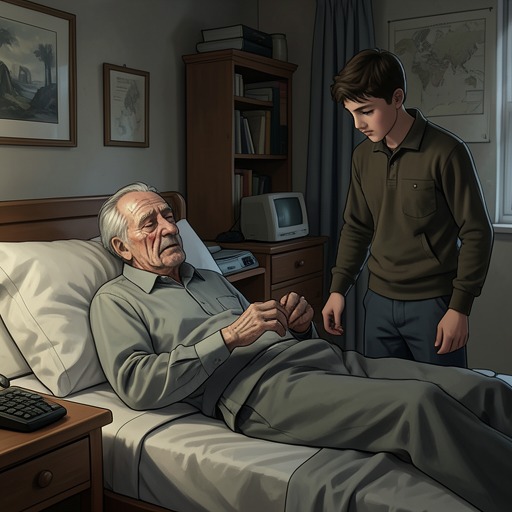
Bunny Munro Senior is Bunny Munro’s father and Bunny Junior’s grandfather. The scene makes his physical decline impossible to overlook: he is small and bent, his face grey, his breathing broken by hacking coughs, and his dentures and stained handkerchief contribute to the impression of severe illness. He wears a brown Argyll jumper patterned with snowflakes and a polar bear, a nicotine-coloured shirt, and worn corduroy slippers; faded blue tattoos remain visible at his sleeves and open collar. His trousers are unzipped, and he carries a heavy cleated walking stick. The details do not soften his presence into a merely pathetic one: his bodily vulnerability exists alongside a forceful capacity to insult, command, and reject.
The smell of stale urine and medicinal ointment follows him to the doorway, placing intimate signs of bodily dependence in the space between father and son. He hacks and struggles before opening the door, and later his face turns purple with the effort of coughing. Yet the account offers no diagnosis beyond his terminal condition. Miss Lumley, who has keys and has apparently been performing an unpleasant duty, dryly tells Bunny Munro that the arrangement is broken and has been so for months. She quits and explains that his father is dying and needs continuous professional care. Her announcement establishes the practical urgency of his condition before Bunny Munro sees the old man for himself.
Estrangement and Conflict with Bunny Munro
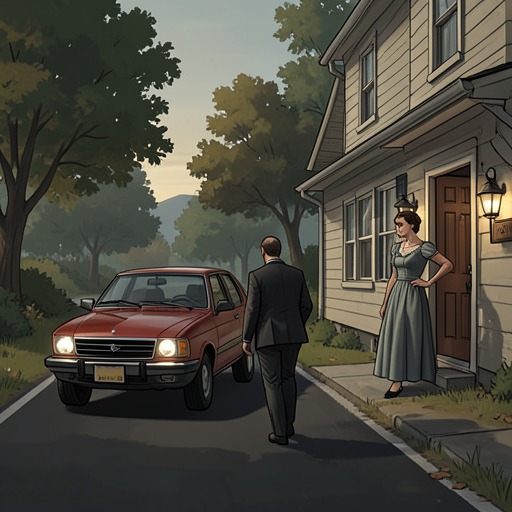
The first exchange at the door sets the terms of the reunion. From inside, Bunny Munro Senior roars at Miss Lumley to go away; when Bunny Munro identifies himself, his father opens the door only to tell him to leave and slam it in his face. The action converts a visit into a rejection before they can speak. Later, Bunny Munro returns to the room, but the hostility persists: his father calls him beyond recall and a lost cause, while insisting that the child might still be saved. The contrast is severe, and it makes Bunny Junior an implicit measure of what the older man believes his son has failed to become.
The father’s resentment becomes explicit when he turns to Bunny Junior. He beckons the boy closer, gestures toward Bunny Munro, and confides that he hopes the child will break his father’s heart as Bunny Munro broke his. This is not a reconciliation disguised as family warmth: the grandfather recruits a child into the grievance between two adults. Bunny Munro answers by asking his father to leave the boy alone and to give him a cigarette. His absent-minded clicking of a lighter and futile search through his pockets leave him visibly uncomfortable, while his request meets another refusal. Bunny Munro Senior tells him to buy his own and hawks into his handkerchief.
Bunny Junior and the Clockwork Bird
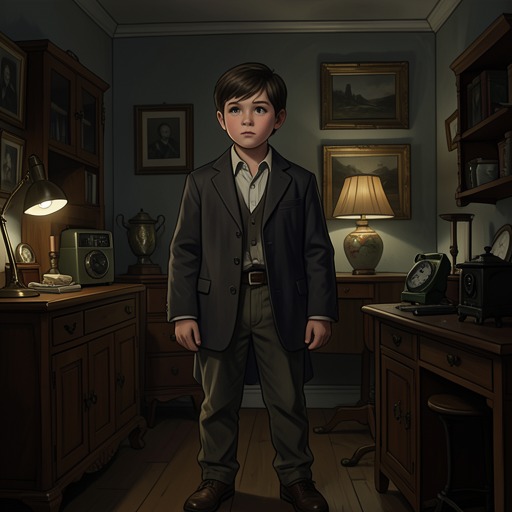
Bunny Junior’s place in the room is marked by the Clockwork Bird. While his grandfather addresses the adults’ conflict, the boy watches the small bird sing and dance on its perch; later he returns to its cage and turns the key again. The mechanical toy gives him a separate focus amid the hostility, an activity he can repeat while the adults exchange accusations. Bunny Munro Senior first orders him away from the bird and toward his grandfather, then beckons him close enough to deliver the wish that he hurt Bunny Munro as deeply as Bunny Munro has hurt him.
That moment combines an invitation to intimacy with a damaging demand. The boy approaches in small, cautious steps, and the grandfather leans toward him conspiratorially. The caution in the child’s movement contrasts with the old man’s insistence on drawing him into the family rupture. Bunny Munro’s intervention is limited to muttering for his father to leave the child alone; it does not settle the conflict. When Bunny Junior turns back to the cage, the bird’s repeated, keyed movement provides a quiet counterpoint to the human exchange: the child can return to watching and winding it, while the adults remain caught in their unresolved history.
Memory and Final Exchange
After condemning Bunny Munro, Bunny Munro Senior pauses through a coughing fit. His face purples with the effort; then his eyes glaze as he seems absorbed in memory and loss. His voice becomes sly and soft as he recalls being on Tom Tiddler’s ground, picking up gold and silver. The shift is striking: the same man who has just spoken with contempt briefly turns toward a remembered scene, though the passage does not explain the memory or resolve what it means to him. It offers a momentary change in register, not a repair of the relationship.
At the end, Bunny Munro Senior calls his son back. He holds out the fouled handkerchief, tears running from his eyes, and tells Bunny Munro that he is dying. Bunny Munro’s eyes fill with tears, and he begins to step back into the room. His father reaches out with the walking stick and, in a final enfeebled lunge, pushes the door shut. The disclosure and the rejection arrive together: Bunny Munro is allowed to hear the truth of his father’s approaching death, but not to cross the threshold in response. Bunny Munro Senior’s last action leaves their encounter suspended between a plea for recognition and the old habit of shutting his son out.