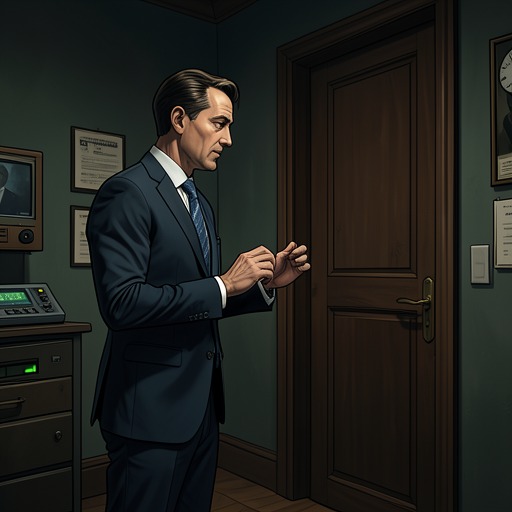
Bunny Munro's in-law relationship with Doris Pennington
The Death of Bunny MunroBunny Munro’s relationship with Doris Pennington, his mother-in-law, turns the aftermath of Libby’s death into a confrontation over blame and care. Their family tie does not produce reconciliation: Doris has long despised Bunny, and when he asks her to look after Bunny Junior, she rejects the request by making clear that the boy reminds her of his father. The exchange exposes both Bunny’s inability to manage alone and the depth of the harm Doris believes he inflicted on Libby.
A history of hostility
Doris’s contempt predates Libby’s death by almost nine years. Its history reaches back to the first time Libby left Bunny and returned to her mother. The return followed Bunny’s infidelity, and the episode established the breach through which Doris would continue to see him. The account presents her hostility not as a reaction invented at the funeral, but as a judgment with a long personal history.
That history also shapes Bunny’s first attempt to contact her after Libby dies. He phones Doris to give her the tragic news, but the call is described through his stunned, almost mechanical state and his sense that silence has replaced conversation. After the line has gone dead, he remains convinced that he can hear distant rhythms of Libby’s voice in the phone and believes she may be trying to tell him something. This is Bunny’s perception, not evidence of Doris’s response; the call instead places him in grief before the two relatives meet face to face.
The funeral and the evidence of loss
At Libby’s simple service at St Nicolas Church in Portslade, Bunny and Bunny Junior stand together in new black suits. Bunny finds the suits in an otherwise empty closet and discovers in one jacket a receipt showing that Libby bought them at Top Shop in Churchill Square two days before her suicide. That preparation gives the funeral a painful, unresolved significance for Bunny: even a practical detail becomes part of his effort to understand what happened, though the evidence does not provide an answer.
Other discoveries deepen the sense of a private history that the funeral cannot settle. A neighbour had seen Libby burning pieces of paper shortly before her death; Bunny learns that the papers were love letters he had written before they married. At the service, Father Miles praises Libby as lively, loved, selfless, and generous, while omitting her medical condition and the circumstances of her death except for a brief reference to her having joined the angels prematurely. The contrast between public eulogy and the troubling details Bunny is finding helps explain why grief in this family is accompanied by unanswered questions rather than shared consolation.
The request for help
Bunny approaches Doris while she is with her husband, Mr Pennington, who is in a wheelchair. He has planned to ask her to care for Bunny Junior, but recognizes as he begins that the plan may be a mistake. Doris immediately makes her contempt explicit and invokes Libby’s death as the reason she cannot regard Bunny neutrally. She accuses him of breaking her daughter’s heart and attributes Libby’s suffering to his treatment of her and his affairs. These are Doris’s accusations, not an independent account that settles every cause of Libby’s death; the scene establishes how firmly Doris holds Bunny responsible.
Bunny persists because the request concerns his son. He apologizes and says that he wants Doris to look after her grandson for a while, then acknowledges that he cannot do it and does not know how. His admission marks a break from the confidence he might otherwise project: here he describes himself as incapable of managing the responsibility. The request is both practical and relational. He turns to the family member whose hostility makes her least likely to help, while his words reveal how urgently he needs support in caring for Bunny Junior.
Rejection and the limits of kinship
Doris responds with genuine sympathy for Bunny Junior, recognizing that his father is all he has. But sympathy for the child does not overcome her association of him with Bunny. She says that when she looks at her grandson, she sees Bunny. Her response makes the family bond itself difficult: Bunny Junior is Doris’s grandson, yet his resemblance, as she perceives it, connects him to the man she blames for Libby’s pain. She does not agree to take him in, leaving Bunny without the help he sought.
The exchange ends with anger rather than negotiation. After Doris insults him, Bunny answers with a sarcastic address to her as a grandmother and then speaks contemptuously to Mr Pennington, who raises a finger in protest. Mr Pennington calls Bunny a disgrace. Bunny’s retort does not repair the breach; it shifts the encounter from his plea for assistance into a reciprocal exchange of reproach. The scene therefore shows not only Doris’s refusal but Bunny’s own retreat into defiance when confronted with blame.
Narrative significance
The relationship gives concrete form to the divided aftermath of Libby’s death. Bunny’s bereavement is accompanied by a persistent sense of her presence, while Doris’s grief takes the form of accusation and an unwillingness to entrust her grandson to him. Neither response resolves the questions surrounding Libby’s final days. Instead, Bunny’s request forces the relatives to confront how differently they understand his responsibility and what care for Bunny Junior would require.
Doris’s refusal also makes Bunny’s dependence on his son more immediate. He has admitted that he is not capable of caring for the boy without help, but the family connection he appeals to cannot supply that help. In this encounter, kinship offers no automatic refuge: the grandmother’s concern for Bunny Junior exists alongside her rejection of Bunny, and the child becomes the point at which those feelings meet. The relationship remains defined by an old marital breach, a death that intensifies blame, and a request that exposes the practical consequences of their estrangement.