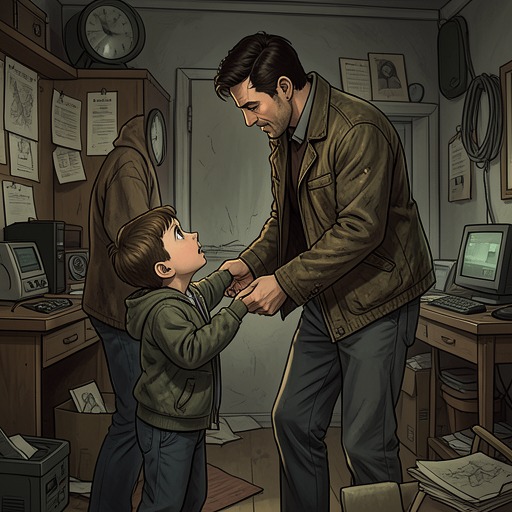
Bunny Munro—Bunny Junior relationship
The Death of Bunny MunroBunny Munro and Bunny Junior’s relationship is shaped by a reversal: Bunny claims the authority to teach and protect his son, but Bunny Junior often sees more clearly how little control his father has. Their journey brings affection and shared jokes into close contact with neglect, fear, and unmet needs. The boy’s loyalty does not erase Bunny’s failures; instead, it makes the gap between a father’s role and his conduct impossible to ignore.
A father who performs authority
Bunny presents fatherhood as an extension of his own salesmanship. On the road, he turns ordinary encounters into lessons, speaking as if confidence and patience can make him a reliable guide. When Bunny Junior answers a question correctly with the name of Ulaanbaatar, Bunny erupts with pride, calls his son a genius, and pulls him into an exuberant headlock. The gesture is playful and affectionate, but it also shows how readily Bunny’s idea of connection becomes a performance of boisterous masculine confidence.
The same performance shapes Bunny’s instruction. As he drives slowly through the Wellborne estate in Portslade, searching Geoffrey’s customer list for the right flat, he asks Bunny Junior to imagine shaking a great oak or elm tree. The boy admits that he does not know what would happen, but listens closely and expects that he may understand the lesson later. The scene gives their relationship a patient, intimate possibility: Bunny wants to pass something on, and Bunny Junior receives even a lesson whose point is not yet clear. Yet Bunny’s teaching is inseparable from the work that occupies him. His authority is asserted from behind the wheel and through the language of business, rather than established by consistent attention to what his son needs.
After a prolonged stop, Bunny Junior remarks that his father was inside for a long time. Bunny accepts the observation, then recasts the delay as an opportunity to teach patience, calling it the first principle of salesmanship. The exchange reveals their different positions. The child registers the actual duration and its effect; the father turns it into a maxim that keeps the journey and his self-image moving forward. Bunny can make a lesson out of almost anything, but that ingenuity does not guarantee that he is attending to his son’s experience.
Work, school, and the boy’s unmet needs
Bunny makes the road a test of allegiance as well as a workplace. When Bunny Junior is asked why he is not at school, he says his father told him he did not have to go that day. Inwardly, he is exhausted by the adults around him and furious that he cannot find his father; almost immediately, he feels guilty for thinking this. His anger is therefore not a rejection of Bunny. It is a response to being left to navigate adult situations without the dependable presence he needs, followed by the familiar pull of love and loyalty.
Bunny later puts the choice between school and staying with him in stark terms. He asks whether his son would rather be with his father or with other children, and whether he wants to learn the business or risk failing in life. The question makes companionship sound like a choice the boy must make, while casting Bunny’s own trade as a route to competence and a future. But Bunny Junior is squinting behind his glasses; his swollen eyes itch and dazzle, and he asks for eye drops because he fears he may be going blind. His immediate physical concern sits beside Bunny’s demand for an answer. The contrast makes the imbalance plain: Bunny wants his son’s commitment to the journey, while the boy is asking for care that Bunny’s argument does not address.
Love, fear, and dependence
Bunny Junior’s attachment is not based on an illusion that his father is a capable guide. When Bunny speaks of making money and compares the pair to predators feeding together, the boy recognizes terror in his father’s eyes. He imagines a passenger discovering that the pilot is drunk and that nobody is steering. The image gives form to a relationship in which the child can love his father and still understand that the adult has lost direction. Bunny, in turn, glimpses the panic of a world he cannot control. The boy’s recognition is frightening precisely because it does not cancel his dependence on Bunny.
That dependence is accompanied by a remarkably unqualified affection. Bunny Junior hopes that nothing terrible will happen to his father and acknowledges that Bunny is not good at fatherhood by the standards he has seen elsewhere. He remembers practical forms of care, such as obtaining ointment to protect a child’s sight, as well as ordinary play in public gardens. Bunny has not reliably provided that model. Still, Bunny Junior says he would not exchange him for another father, and takes pleasure in his capacity to be funny. His love includes the visible shortcomings rather than depending on a belief that they are absent.
The boy’s attachment also becomes active comfort. When Bunny reassures him, Bunny Junior climbs onto his lap, puts his arms around his neck, rests his head against his chest, and cries. Bunny lays a cautious hand on the boy’s back and repeats that everything is all right. The moment reverses their usual positions: the child seeks closeness, but the father’s guarded touch and reassurance are the response he can offer. Their bond is conveyed through the small physical acts of holding and being held, not through a resolution of the problems that brought them there.
Inherited models and changing responsibility
The failures in Bunny’s fatherhood are set against the damaged inheritance he received from Bunny Munro Senior. Bunny reacts sharply when Poodle insults his father, threatening to slap him; the defense suggests that the older man remains emotionally important to him even when their history is painful. Later, Bunny Munro Senior claims that he tried to teach Bunny the business and showed him wonderful things, only to condemn the work Bunny ended up doing. His account makes business a language of paternal transmission, but also exposes its limits: instruction and trade have not produced a secure or uncomplicated father-son bond. Bunny’s own efforts to teach Bunny Junior repeat that inheritance, though the boy’s attention to his father’s confusion shows that the old pattern cannot simply be passed on unchanged.
After the head-on collision with a concrete mixer truck and the lightning strike, Bunny speaks publicly about his life and the fact that Bunny Junior was nearly killed. He says he has begun to think less about why he survived and more about how to live differently. His stated intentions include caring for his dying father, moving through life with greater dignity, and, above all, looking after Bunny Junior. This is a change in the way he defines his responsibility: the boy is no longer merely a companion on the sales trip or an apprentice to be persuaded into the family business, but someone Bunny must actively care for. The declaration is a commitment, not proof that the damage has already been repaired.
Mutual concern at the close
Near the end, Bunny turns to Bunny Junior and asks whether he will be all right. The boy answers that he will, then asks whether Bunny himself will be all right. The exchange condenses the relationship’s central reversal: Bunny remains the father, but his son has learned to worry about the adult’s survival and steadiness. Bunny says he is ready, puts on his jacket, and asks how he looks. The boy’s concern does not make him responsible for his father, nor does the scene establish that Bunny’s new resolve will be easy to sustain. It does show a bond in which care moves in both directions, even after Bunny’s failures have made the child doubt who is steering.
The relationship is consequently neither simple reconciliation nor simple abandonment. Bunny Junior sees his father’s inadequacy without ceasing to love him; Bunny’s late promise to care for his son answers, at least in intention, the needs the boy has repeatedly carried. Their affection remains real, but it is not a substitute for dependable parenting. The tension between Bunny’s exuberant claims to authority and Bunny Junior’s clearer apprehension of danger is what gives their bond its emotional force.