Bunny Munro’s grief-driven psychological breakdown
The Death of Bunny MunroBunny Munro’s grief-driven psychological breakdown is the story’s movement from private disarray toward public confession. The death of Libby remains present not simply as a loss but as an accusation Bunny cannot escape: he senses her watching him, sees signs of her in ordinary surroundings, and struggles to distinguish his perceptions from events outside himself. His crisis grows alongside his continued exploitation of others, until a later testimony makes his grief and accountability inseparable.
Grief and the Perceived Haunting
The breakdown is made tangible during Bunny’s visit to Mrs Brooks. He has just completed a large beauty-products order and takes a remote satisfaction in having pleased her, even though the products are unlikely to be used. Yet his restlessness, which he had attributed to a hangover, becomes fear. The starlings outside and a sudden change in the room’s atmosphere accompany his conviction that Libby is present. He imagines her in her wedding-night Orange dressing gown, seated beside the Bösendorfer Piano, and interprets the image as a reproach. What might otherwise be a routine sales call becomes a scene in which his work, self-justification, and bereavement can no longer be kept separate.
His response is not calm recognition but mounting rage. He resents Libby for seeming to pursue and condemn him, while also turning his anger on Mrs Brooks, Bunny Junior, his dying father, women more generally, and the birds outside. The breadth of the outburst shows how little control he has over where his distress lands. He curses his own appetites, but cannot redirect his attention; even his effort to escape the thoughts fails. Mrs Brooks’s appeal for people to love one another, followed by her observation that he seems sad, gives the encounter a counterpoint: another person recognizes his suffering where he experiences only accusation and pressure.
Disorientation and the Fractured Self
Bunny’s breakdown also alters how he experiences himself. Looking in the rear-view mirror, he sees a face that seems unfamiliar and disjointed from his remembered identity. The change is not presented as a stable new self-understanding; it is a moment of estrangement, as if the person he has become cannot be reconciled with the one he thinks he used to be. His attempt to reassure Georgia over the phone that he is speaking from the heart sits uneasily beside this uncertainty and his continuing reliance on seduction as a way of thinking about the world.
On the rain-soaked streets, that uncertainty takes on the form of a threatened landscape. Bunny notices that the water at his feet has become one pool, then imagines a wave striking the Punto and a fallen power line advancing like a living danger. He recognizes that he might be seeing an illusion, but recognition does not dispel the fear. He drives toward Georgia’s address while darkness closes around the car and his attention returns to sexual fantasy. The sequence binds practical action to distorted perception: Bunny can still consult the sales list and navigate, yet his account of what surrounds him is increasingly unstable.
Repetition, Memory, and Exhaustion
At Mary Armstrong’s home, Bunny’s sales routine and sexualized pursuit continue even as his condition deteriorates. In the darkened house he finds signs of neglect and realizes he has left his sample case in the car; his hands are injured, and he hears an unexplained sound. He announces to himself that he has a good feeling about the visit, but instead collapses into a weariness that interrupts his habitual forward motion. The pause exposes a pattern in which the language of opportunity and conquest persists even when he can no longer sustain the role it is meant to serve.
His thoughts return to an earlier night when Libby discovered his betrayal. He remembers her seeing him with another woman and then, after he returned home, changing in ways he did not understand: she stopped confronting him, moved through the house listlessly, and resumed sex with him. Bunny’s recollection treats that change as bewildering rather than as a moment whose significance he grasped. In the present, he reaches a black door bearing a poster of Avril Lavigne, traces the image, and introduces himself as a representative of Eternity Enterprises. The scene sets the polished identity he sells against his sobbing and exhaustion; the sales introduction survives, but its usual confidence has fallen away.
A Contrast in Bereavement
Bunny Junior’s experience of Libby provides a distinct contrast to his father’s perceived haunting. The boy tries to preserve memories of his mother as though arranging exhibits, but finds her image fading: he can picture himself on a swing at St Ann’s Well Gardens and cannot clearly recall who is pushing him. Later, while waiting in the Punto, he imagines Libby comforting him. In the fog, he sees her in her Orange dressing gown and sits beside her. These moments belong to Bunny Junior’s grief, not to proof that Bunny’s own perceptions are reliable. Their different forms matter: the child’s imagined contact offers closeness, while Bunny experiences Libby’s appearance as judgment and a reminder of his responsibility.
The contrast also clarifies what Bunny’s breakdown threatens. His son is trying to hold on to a mother whose features are slipping from memory, while Bunny’s guilt makes Libby’s absence feel insistently present. Bunny Junior’s act of destroying the client list further marks a break in the father’s commercial routine, though the two experiences remain distinct: the boy acts on the list, while Bunny’s crisis is expressed through memory, perception, and confession.
Confession and Unresolved Reunion
After a head-on collision with a DUDMAN concrete mixer truck and a lightning strike, Bunny tells an audience that his nine-year-old son was nearly killed. He presents his survival as a question he cannot answer, and recounts the history he has tried to evade: the people he exploited, the contempt with which he treated the world, his fear of love, and his accountability in Libby’s suicide. He describes seeing the misery he caused pass before him and tells the crowd that he had been possessed by the Devil. These are claims made during his testimony, not an independent explanation that removes responsibility. His admission that he sold misery door to door revises the meaning of his salesmanship: the routine of selling beauty products becomes part of a larger history of harm.
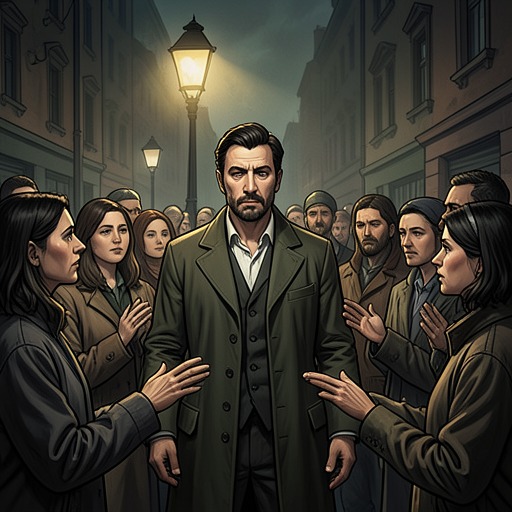
The crowd’s response becomes a public counterpart to his private reckoning. People he has wronged approach and forgive him, and Bunny sees Libby among them. He asks her to forgive him and explains that he missed her; she denies having haunted him, then says she will see him shortly before disappearing into the crowd. The encounter does not settle whether Bunny has truly met Libby or whether the scene continues his visions. Its ambiguity leaves the breakdown neither neatly cured nor reduced to a single supernatural explanation. What changes is Bunny’s account of himself: he names his actions, connects them to Libby’s death, and asks for forgiveness rather than treating his appetite and salesmanship as proof of mastery.