Bunny Munro's father-son relationship with Bunny Junior
The Death of Bunny MunroBunny Munro’s father-son relationship with Bunny Junior is a bond of affection and dependence repeatedly strained by Bunny’s inability to care reliably for his son. After Libby Munro’s death, the boy is left to manage his own distress and physical needs while Bunny remains absorbed in drink, television, salesmanship, and his own unsettled grief. The relationship changes when Bunny takes Bunny Junior on the road: the father offers lessons and companionship, but the boy is often the more observant and emotionally steady presence. Their attachment ultimately becomes a means of confronting loss, even as it cannot undo the care Bunny has failed to give.
Unequal Care and Dependence
The imbalance is visible in the disordered home. When Bunny returns, Bunny Junior emerges from the darkness and reports that his mother has locked herself in her room and will not come out. Bunny recognizes that his clothes have been torn and that the state of the flat may be a message about his own responsibility, but that awareness is immediately crowded out by his anger that sex with his wife is unlikely. The boy’s attempt to explain what is happening receives less attention than Bunny’s own wants. From the beginning, the scene places the child’s need for a responsive parent against the father’s self-absorption.
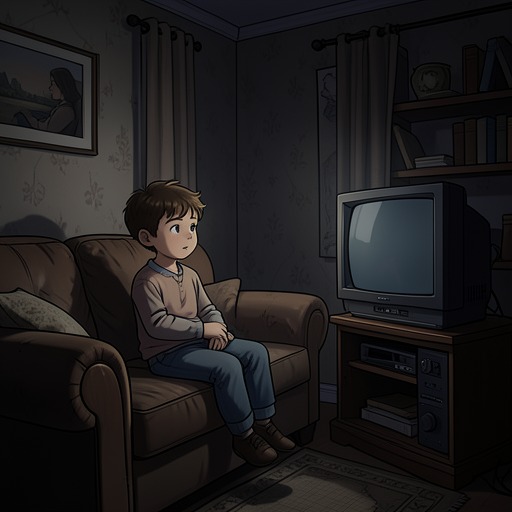
After Libby’s death, Bunny Junior is left among the practical and emotional consequences that adults have been attending to. He sits in front of the television with a large bottle of Coca-Cola between his knees, his eyes sore and red from blepharitis and his steroid eye drops used up. Police officers and ambulance workers have been asking whether he is all right; he finds their whispered conversations and questions exhausting, and they repeatedly bring his mother to mind. He knows he should tell his father about the missing drops, but the immediate scene offers little confidence that Bunny will notice without being prompted. Later, Bunny Junior’s painful, irritated eyes are still visible when he says that they hurt, while Bunny gestures vaguely and returns his attention to television. The boy’s needs are plain, but care does not reliably follow from their being spoken.
The child also tries to read what his father cannot explain. One evening he says that he should go to bed, notes that he is usually in bed much earlier, and rubs his sore eyes. Bunny’s distracted reply does not clearly guide him; Bunny Junior has to decide for himself that he will leave. Before doing so, he sees his father absorbed in a televised contest between masked gladiators. The small domestic exchange makes the relationship’s imbalance concrete: Bunny Junior seeks acknowledgment, while Bunny is physically present but mentally elsewhere.
A Father Who Admits His Limits
Bunny’s request to Mrs Pennington to look after Bunny Junior marks a rare direct recognition that he cannot manage fatherhood alone. He approaches her with a plan devised while sitting on the sofa, but realizes that the idea was mistaken and that his judgment has failed him. He asks her to care for her grandson for a while and admits that he is not capable and does not know how to do it. Mrs Pennington answers that Bunny Junior has only his father. Her words sharpen the dilemma: Bunny’s admission is honest, but the boy’s dependence cannot simply be transferred away.
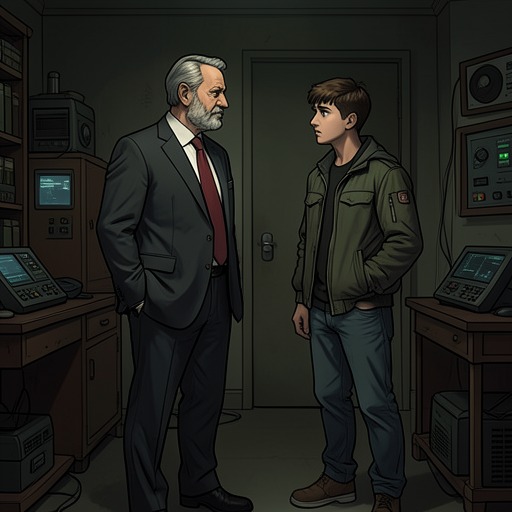
The father’s own history complicates that admission. When Poodle disparages Bunny’s father, Bunny reacts with an unusually forceful warning. He does not seem to be offering Bunny Junior an explanation of the past, but the moment reveals that Bunny’s relationship with his own father remains emotionally charged. Later, Bunny Junior witnesses the older man’s anger and hears him complain that he tried to teach Bunny the business, only for Bunny to end up selling toilet brushes. The grandfather’s accusation turns paternal inheritance into a conflict over what a father can teach and what a son makes of it. Bunny’s fierce defense of his father sits uneasily beside his inability to meet his own son’s needs.
The Sales Journey as School and Performance
When Bunny decides that he and Bunny Junior are hitting the road, the boy responds with visible delight. Bunny immediately turns the departure into a lesson: his son cannot go looking like a hobo because the first rule of salesmanship is to be presentable. The road gives the pair a shared activity and gives Bunny a role he understands. He can instruct, joke, drive, and present himself as a successful salesman, even though these performances do not by themselves amount to dependable care.
Bunny Junior watches his father work the road with admiration. He notices Bunny’s ease in traffic, humor, ability to win over strangers, smile, clothes, and sample case, and tells him that he is fantastic. Bunny answers with a boast about what he could sell, then turns toward another sales lesson, using an oak or elm tree as his example. As the Punto moves slowly through the Wellborne estate in Portslade, Bunny studies Geoffrey’s client list and searches the buildings for the right flat. The boy listens closely, stores what he is told, and accepts that he may understand the lesson only later. Their journey therefore joins instruction to display: Bunny gives his son practical and theatrical versions of the salesman’s craft, while Bunny Junior observes not just the method but the personality built around it.
At one point, Bunny’s refusal of Poodle’s gift produces a brief change in how he experiences himself. He feels that he is in command of his life and says quietly that he is in control of his appetites. Bunny Junior echoes him, saying that he is too. The exchange creates a moment of apparent solidarity, but the boy’s repetition should not be mistaken for proof that the underlying problems have been resolved. Their closeness is real; so is the gap between Bunny’s declaration of control and the care his son continues to need.
Shared Grief and the Boy’s Changing Role
Bunny Junior’s private struggle is not only about his father’s attention. He is afraid that his memories of Libby are fading. He can recall details such as the construction of the Eiffel Tower, yet increasingly cannot picture his mother’s face. He tries to preserve their time together like exhibits in the Booth Museum, including the memory of Libby pushing him on a swing at St Ann’s Well Gardens. In that remembered scene, he can still see himself rising into the air, but the person pushing him has become a dissolving, incomplete figure. The effort to keep his mother present shows how much of the boy’s emotional life is taking place beyond what Bunny notices.
The boy’s knowledge and imagination offer one way of giving form to what he cannot control. While reading Bunny Junior’s Encyclopaedia, he follows an entry about Merlin to the word for an incubus, then tries to understand the idea through another entry. The book, bought by his mother because she loved him, is both a source of facts and a reminder of her care. Later, in the Punto near Newhaven, a passage about quasars and their luminosity runs alongside Bunny Junior’s sense of Libby’s presence and the remembered phrase calling him the most luminous object in the universe. These episodes keep his bond with his mother active even as her image becomes harder for him to hold.
In the mist, Bunny Junior sees Libby in her orange nightdress and goes to sit beside her. He tells her he is sorry; in the encounter, he is held and comforted. He calls himself the navigator, a phrase that suggests the role he has begun to take in relation to his father as well: the boy who remembers, attends, and tries to find direction amid adult confusion. The vision is presented through Bunny Junior’s experience, not as an ordinary exchange witnessed by Bunny, and it gives the child a form of consolation that the living relationship has not consistently supplied.
Reckoning and the Limits of Reconciliation
The later scenes bring father and son into a more explicit conflict over what their life together should be. Bunny asks Bunny Junior to take off his glasses and presses him to choose between being with his father and going to school. He frames the question as a choice between learning the business and falling behind in life. Bunny Junior, however, answers with the immediate fact of his discomfort: the light hurts his swollen eyes, he fears he may be going blind, and he needs eye drops. Bunny insists on an answer to his own question. The exchange recalls the earlier pattern in which the boy’s needs are stated clearly but do not receive the response they call for.
Near the end, the relationship is refracted through Bunny Junior’s encounter with Libby and Bunny’s public plea for forgiveness. The boy asks his mother whether she has come to tell him something, while Bunny, among those embracing and forgiving him, sees Libby and asks her to forgive him for having gone a little crazy because he missed her. When Bunny says that Libby has been haunting him, she denies that she ever haunted him. The distinction matters to the father-son bond: Bunny’s experience of grief has become a force he struggles to interpret, while Bunny Junior’s visions of his mother are a continuing connection through which he seeks comfort and meaning.
The relationship’s movement is therefore not a simple passage from failure to repair. Bunny can be loving, funny, and capable of brief tenderness, and Bunny Junior can admire him; at the same time, the boy repeatedly has to supply patience, attention, and self-reliance that should have come from his father. Their road journey gives them shared language and moments of delight, while their grief exposes how differently each carries the same absence. By the time Bunny seeks forgiveness, Bunny Junior’s presence and perceptiveness have become central to the emotional shape of their bond, but the evidence of reconciliation does not erase its unresolved asymmetry.