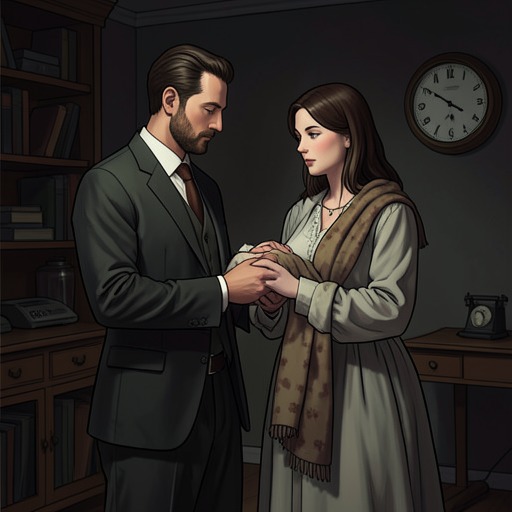
Bunny and Libby’s marriage
The Death of Bunny MunroBunny and Libby’s marriage is rendered less through its daily history than through what remains after Libby’s death: a son trying not to lose his mother’s image, and a husband who misses her and seeks her forgiveness. Their relationship persists as memory, imagined presence, and an unfinished appeal; even when Libby appears to answer Bunny, the encounter does not settle whether she has returned or whether grief is shaping what he sees.
A Marriage Recalled Through Absence
For Bunny Junior, the loss of his mother is sharpened by the fear that he can no longer picture her. Although he can recall facts such as the year construction of the Eiffel Tower began, he finds Libby’s face increasingly difficult to summon. He tries to preserve scenes of their life together as if they were exhibits in the Booth Museum: fixed, arranged memories that can be revisited. In one, he sees himself laughing as Libby pushes him on a swing in St Ann’s Well Gardens, but the person pushing him has become a dissolving, incomplete figure. The memory preserves the child’s movement and joy while the mother who caused them fades from view.
That contrast makes the marriage’s continuing importance visible through their son. Bunny Junior’s encyclopedic memory can retain information in precise mental compartments, yet it cannot guarantee the survival of a face or the presence of a parent. His effort to make memories permanent is a response to the relationship’s most painful change: Libby is absent, and even recollection seems unable to keep her fully present.
Libby’s Presence in Bunny Junior’s Grief
Bunny Junior’s experience of his mother also takes the form of visions. In the Punto on Meeching Road in Newhaven, he believes that if he waits, Libby will find him. As he thinks this, he senses her hand cream and a touch tracing his face, ending at his lips in an approximation of a kiss. A voice, which he cannot tell is his or hers, tells him, “You … are … the … most … luminous … object … in … the … universe.” The passage connects his knowledge of quasars—the most luminous objects in the universe—with a remembered or imagined maternal tenderness. The words offer comfort, but their uncertain source keeps the encounter suspended between inner voice and apparition.
Later, mist gathers around the car, and Bunny Junior sees Libby sitting on a low wall in her orange nightdress, beckoning him. He leaves the Punto, sits beside her, and feels warmth. His apology, “I’m so sorry, Mummy,” receives an embrace; he rests his head against her body and recognizes her as his mother. When he says, “I am the navigator,” she kisses his hair and tells him he has a good heart. Their exchange gives the child a moment of intimate contact, but it does not erase the earlier fear that his memories of her are disappearing. The scene offers presence as a fragile experience, not a recovery of ordinary family life.
Bunny’s Appeal for Forgiveness
Bunny’s relationship with Libby comes into sharpest focus when he sees her through the crowd and moves towards her. In tears, he pleads, “Forgive me, Libby. Oh, Libby, forgive me.” His request is personal and direct: amid the crowd’s embrace and forgiveness, it is Libby’s pardon that he seeks. She answers, “There is plenty of time for that.” Bunny explains that he went a bit crazy because he missed her so much. The exchange links his remorse to bereavement without detailing or excusing the actions for which he asks forgiveness.
The scene makes longing the language through which Bunny tries to account for himself. “I just miss you so much,” he says. His account is not a claim that the marriage can simply be restored: Libby tells him she has to go and that Bunny Junior will be all right now. Her mention of their son places their bond within the family they shared, while also directing attention away from Bunny’s need to hold her there.
Haunting, Denial, and an Unfinished Bond
Bunny asks whether Libby is going to stop haunting him. The question reveals how he has understood her appearances—as something that follows or troubles him—while his admission that he misses her suggests that the feared haunting is inseparable from his desire for contact. Libby responds with a furrowed brow: “What do you mean?” Then she says, “I never haunted you,” flickering through the scene before laughing and disappearing beneath the crowd’s umbrellas. Her denial unsettles Bunny’s interpretation without explaining what the encounter is. The narrative leaves open whether he sees Libby, imagines her, or experiences grief in a form he cannot distinguish from her presence.
The marriage therefore ends not with a settled reconciliation but with a brief exchange that holds apology, longing, care for their son, and separation together. Bunny receives no explicit account of what she forgives, and Libby’s reassurance does not reverse her absence. Instead, she disappears after telling him she will see him in a minute, leaving the promise as parting language rather than a clear explanation. In the novel’s final sequence, the bond remains emotionally vivid precisely because its terms cannot be made certain: Bunny wants forgiveness and contact, while Libby’s appearance offers tenderness but no conventional return to married life.