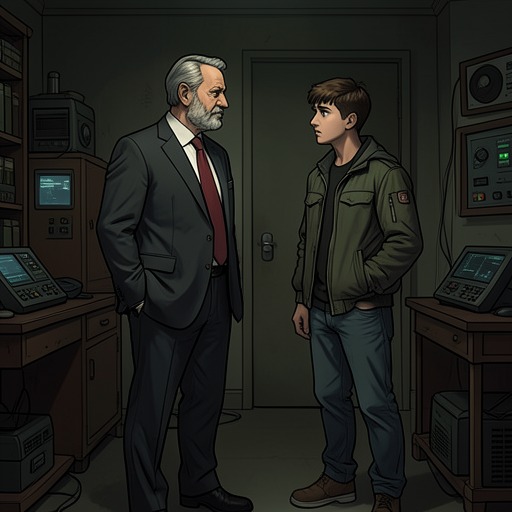
Bunny takes Bunny Junior on a coastal sales trip
The Death of Bunny MunroBunny takes Bunny Junior on a coastal sales trip to sell beauty products, turning a customer list into a moving classroom for his son. He presents patience, confidence, and commercial appetite as lessons in how to live, but the boy’s close attention reveals the distance between Bunny’s performance of authority and his growing inability to direct their journey. The trip becomes both a working expedition and a test of what the son can learn from a father whose example is unstable.
Purpose and Preparation
The journey is organized around the customer list Geoffrey has given Bunny. In Portslade, Bunny drives the Punto very slowly through the Wellborne Estate, matching the numbers on the list to flats in the shadow of the towers. The work is concrete and repetitive: find the correct address, approach a potential customer, and keep moving. Bunny treats this itinerary as the basis of a broader education, while Bunny Junior follows along, listening and trying to understand what his father’s business means.
The trip’s sales purpose also shapes Bunny’s account of why they are on the road. He tells Bunny Junior that a customer in Rottingdean is loyal and can be approached again, and that she likes the body cream. The list therefore represents more than a route: it is a promise of continuing work and, in Bunny’s mind, a means of keeping the pair moving. Bunny Junior, however, later wonders what will happen when the names are used up—whether they will go home, receive another list, or continue indefinitely. The difference between his father’s confident forward motion and his own uncertainty runs through the journey.
Bunny’s Lessons in Salesmanship
Bunny turns the drive into instruction. After Bunny Junior observes that his father has been away for a long time, Bunny explains that patience is the first and fundamental law of salesmanship. His advice follows a prolonged visit, making patience both a practical requirement of the work and a lesson the boy can measure against his own experience of waiting. Bunny speaks as though the delay confirms his expertise, even as his son registers how much time has passed.
Elsewhere, Bunny offers a more expansive image of endurance: he asks his son to imagine shaking a great oak or elm, with its thick trunk, deep roots, and spreading branches. Bunny Junior says that he does not know what would happen, but listens intently and retains the lesson, expecting that he may understand it later. The exchange gives their journey a paternal dimension distinct from the immediate business. Bunny is trying to transmit a way of seeing and acting; the boy is receptive, though the meaning of the lesson remains open to him.
Bunny also responds to his son’s knowledge with exuberant approval. When Bunny Junior identifies Ulaanbaatar, Bunny laughs, embraces him in a headlock, and praises his intelligence before turning the key and pulling onto the road. The exchange briefly makes travel feel like shared adventure: the father celebrates the boy, and the boy accompanies him. Bunny’s boastful excitement at being back on the road, however, sits beside Bunny Junior’s observation that the visit took a very long time. Their different impressions of the same journey keep affection and unease in view at once.
The Son’s View of the Journey
Bunny Junior’s perspective complicates Bunny’s account of the trip as an apprenticeship. At the Queensbury Hotel, while trying to read about Mata Hari in his encyclopaedia, the boy is too worried about his father to concentrate. He recalls Bunny jumping up from breakfast to use his phone, returning to his food, spilling coffee, disappearing into the bathroom, and following the waitress while talking rapidly. Bunny Junior cannot make sense of what his father is saying. The scene contrasts the ordered task of studying a book with the unsettled rhythm of Bunny’s conduct.
The boy remembers that Bunny had put on a new shirt with brown and orange diagonal stripes and a tie showing a floppy-eared rabbit emerging from a magician’s hat, but had not shaved and had untidy hair. These details place Bunny’s presentation alongside the signs that he is not composed: he has made an effort to dress for the day, yet his appearance and behavior do not settle into a convincing image of control. Bunny Junior is not accustomed to worrying about his father. His concern shifts from the worry he usually felt about his mother to uncertainty about the adult now responsible for him.
At the Empress Hotel, that uncertainty deepens. Bunny Junior watches Bunny’s gaze dart around the dining room, sees him check behind himself and under the table, and notices him wince and hold his ribs. The boy experiences time as distorted: his father’s smallest movements can seem to take an age, while other activity appears sped up. Although Bunny Junior feels that they have been on the road for an enormous length of time, he realizes it is only their third day. The mismatch between subjective duration and the short span of the trip gives his observations a sense of mounting strain without changing the basic fact that they have only just set out.
Authority, Inheritance, and Reversal
Bunny’s lessons become more coercive when he asks Bunny Junior to choose between staying with his father and returning to school. He frames the choice as a test of ambition and asks whether the boy wants to learn the business. Bunny Junior answers not by endorsing either future but by asking to put his glasses back on: his eyes hurt, and he fears that he may be going blind and needs eye drops. Bunny insists that he answer the question. The moment exposes the imbalance in the supposed apprenticeship: Bunny presents the choice as an opportunity, while the boy’s immediate concern is a physical problem that his father does not address in that exchange.
The trip also carries the pressure of Bunny’s own inheritance. When Poodle makes a disparaging remark about Bunny’s father, Bunny threatens to slap him. Poodle, holding a nearly empty bottle of Scotch, does not hear the warning; he slumps back onto the sofa and mutters. Later, Bunny’s father angrily recalls trying to teach Bunny the business and ends by contrasting that instruction with Bunny’s present work selling toilet brushes. Together, the two episodes show Bunny caught between rejecting an insult to his father and being judged by that father as a failed successor. His insistence that Bunny Junior learn the trade is thus bound up with a business tradition whose transmission has already broken down.
The decisive reversal comes when Bunny Junior sees his father’s fear and recognizes that Bunny does not know what he is doing or where he is going. The boy imagines himself as a passenger who has entered the cockpit only to find the pilot drunk and no one flying the plane. Yet he straightens the little pink daisy in his father’s lapel. The gesture does not restore Bunny’s authority or make the journey safe; it shows the son offering care at the instant he understands how little guidance his father can provide. The coastal sales trip therefore turns its central promise inside out: Bunny sets out to teach his boy how to navigate business and life, but Bunny Junior becomes the one who recognizes that their navigator is lost.