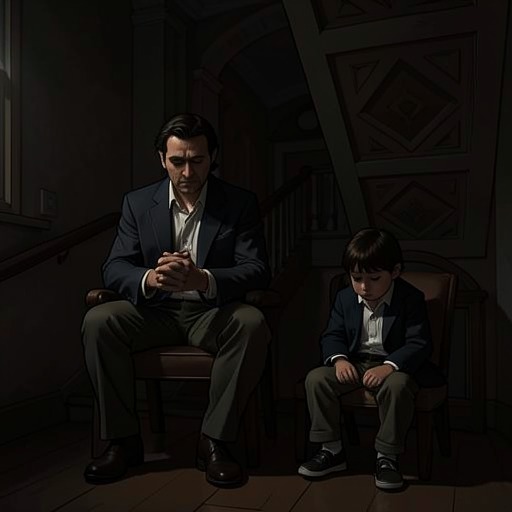
Bunny's perceived haunting by Libby
The Death of Bunny MunroBunny Munro’s perceived haunting by Libby Munro gives his grief a visible, unstable form: she appears in the orange nightdress he associates with her, watching or approaching him, while he struggles to decide whether her presence is a ghost, a demand, or an expression of how completely he misses her. These encounters do not establish that Libby has returned from the dead. Their uncertainty is central to the state: Bunny experiences her as an accusing witness, but their final exchange turns that apparent haunting into a conversation about loss and forgiveness.
Doubt and the First Apparition
During a meeting with social workers, Bunny asks whether they believe in ghosts and wonders aloud what it would mean if someone were unsure that his wife had completely died. His physical unease—the bead of perspiration beneath his Adam’s apple and the tissue balled in his fist—makes the question more than an abstract curiosity. He raises it in the aftermath of Libby’s death, but the scene offers no official explanation or reassurance. Instead, the question remains suspended between bereavement and belief.
The uncertainty takes a vivid shape during Bunny’s sexual encounter with River. By the window, in the folds of rose-coloured chenille curtains, he sees what appears to be Libby in her orange nightdress, waving at him. The sight interrupts the encounter: Bunny makes a wounded sound, struggles against River, and shuts his eyes. When he opens them, Libby has vanished. He tells River that his wife was there and watching. River responds practically, suggesting that he speak to someone she knows in Kemp Town. Her reply treats the sight as something Bunny might need help with, but it does not resolve whether he saw a ghost or experienced a grief-shaped vision.
A Presence Shared, but Not Identical
Bunny Junior also sees a woman in an orange nightdress, though his encounter occurs separately from his father’s. Left in the Punto while Bunny is away, he notices a woman standing with her back turned near the stairwell, partly lost in shadow. She moves farther into the darkness and disappears. The boy cannot decide whether she has disappeared, dematerialised, or atomised; the uncertainty belongs to his perception as much as to the image. The resemblance to Bunny’s sighting links father and son through the same figure and clothing without proving that either has encountered Libby’s spirit.
For Bunny Junior, the vision occurs alongside a more gradual disappearance: his mother’s image is fading from memory. He can recall dates, facts, and scenes with remarkable precision, including the day Libby pushed him on a swing at St Ann’s Well Gardens, but the remembered scene no longer supplies her clearly. He tries to preserve their shared experiences like exhibits in the Booth Museum. In the swing memory he can still see himself laughing high in the air, yet the person pushing him has become an incomplete, dissolving figure. His fear of losing the image helps explain why an apparition might matter to him, but his remembered mother and the shadowy woman remain distinct kinds of presence.
The Dead Side and the Search for Libby
Bunny’s sense of being addressed by the dead becomes more explicit after a sales encounter at the estate. Standing on the gangway and looking over the balcony, he tentatively realises that some kind of demand is being made of him from what he understands as the dead side, although he cannot identify what is being asked. He descends toward the Punto. The moment gives his unease a direction: the dead are not merely behind him as a loss but seem, in his interpretation, to require something from him. The narrative leaves the demand unnamed rather than supplying a supernatural explanation.
The dead side also takes shape through Bunny Junior’s experience in Newhaven. Alone in the Punto on Meeching Road, the boy believes his mother will eventually find him. He senses a change in the air and the smell of her hand cream, then feels a hand trace his face and press his lips in an approximation of a kiss. A voice, which he cannot tell is his or hers, identifies him as the most luminous object in the universe. The sensory details make this encounter intimate, but the uncertainty about the voice preserves the possibility that the scene is an inward experience rather than an externally verified visitation.
Later, mist surrounds the Punto and Bunny Junior sees Libby sitting on a low cream-brick wall, smiling and beckoning. He leaves the car, joins her, apologises, and rests his head against her. In this vision she feels unmistakably like his mother. When he asks whether this was what she wanted to tell him, the conversation indicates that the encounter has not yet delivered its message. The scene gives the boy a moment of closeness to the mother whose image he fears losing; it does not settle what, if anything, Libby has come to communicate.
Denial, Forgiveness, and Ambiguity
Bunny’s most direct encounter with Libby comes during his public plea for forgiveness. As people in the crowd embrace and forgive him, he sees her in the orange nightdress and moves towards her, asking her to forgive him. He says that he went a little crazy because he missed her so much. His language connects the apparent haunting to guilt and bereavement: the encounter gives him a chance to address the person he has lost and the harm he associates with his own disordered grief.
When Bunny asks whether she has been haunting him, Libby says that she never haunted him. She flickers and strobes around the space, then tells him she will see him in a minute before disappearing beneath the crowd’s umbrellas. Her denial complicates every earlier appearance. It cannot prove that Bunny imagined them, since the scene itself remains visionary and unsettled; nor does it confirm that Libby has been following or judging him. Instead, the exchange separates Bunny’s feeling of being watched from Libby’s account of herself. His experience of her as a haunting may express how grief makes the dead persist in the survivor’s attention, while her final departure leaves that bond intact but beyond his control.
The appearances therefore differ in what they offer. The curtain-side Libby seems to witness Bunny at his most compromised; the shadow at the stairwell and the mist-bound mother register Bunny Junior’s fear of losing contact with her; the final vision lets Bunny speak remorse directly to his wife. Across these scenes, orange clothing, remembered touch, and uncertain voices make absence perceptible without turning it into settled fact. Libby’s perceived presence is less a solved supernatural mystery than a recurring form through which father and son encounter the continuing force of their loss.