Bunny’s confrontation with his dying father
The Death of Bunny MunroBunny’s confrontation with his dying father exposes a family inheritance that has passed on more easily as anger and expectation than as affection. Bunny arrives at Flat 17 with Bunny Junior, trying to approach his father as a son and to bring his own child into the family’s history. The visit instead brings their old conflict into the open: the father claims he tried to teach Bunny the business, while Bunny’s life as a seller of toilet brushes stands, to the old man, as proof of failure. The encounter ends with violence against Bunny Junior, Bunny’s reflexive apology, and the father’s admission that he is dying—followed immediately by another act of separation.
Background and Approach
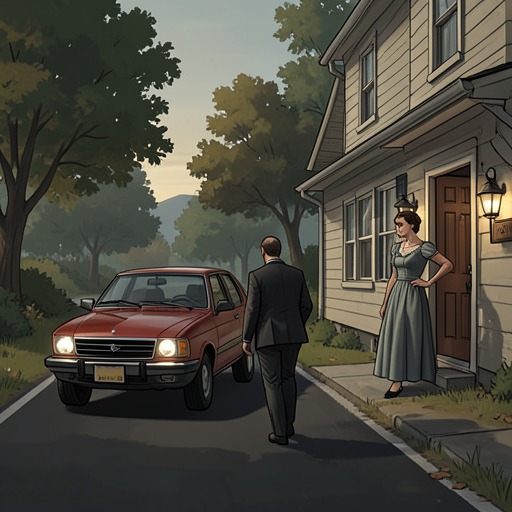
Before the visit, Bunny has already framed fatherhood as a form of instruction. Driving through the Wellborne estate in Portslade, he asks Bunny Junior to imagine shaking a great oak or elm, whose deep roots and heavy trunk hold it firm. The boy listens and admits he does not yet understand the point. The image gives Bunny’s teaching a language of rootedness and endurance, but the scene with Bunny’s own father reveals how little security that inheritance has offered him.
Bunny also presses Bunny Junior to choose between going back to school and learning the sales business alongside his father. He presents the trade as a route to competence and a future, contrasting it with the prospect of going through life poorly equipped. That appeal makes the visit to Flat 17 more than a family call: Bunny is bringing his son to meet the man whose business he wants, at least in part, to pass on. The old man’s response will expose the gap between Bunny’s confidence as a salesman and his father’s contempt for what he has made of that skill.
Bunny approaches the door with the outward care of someone trying to make a good impression. He tucks in his shirt, fixes his hair and tie, drains his Scotch, and knocks three times before stepping back. His father answers by shouting for him to leave, then slams the door in his face. Bunny calls through the closed door and is eventually admitted, but the initial welcome establishes the terms of the encounter: access is granted grudgingly, and closeness remains under the father’s control.
The Father’s Illness and Their Dispute
Inside, Bunny proposes making tea and asks whether his father is all right. The question meets a bitter answer: the old man says that at eighty he has developed lung cancer and rejects the idea that he is doing well. Bunny asks if there is anything he can do, but concern does not dissolve the hostility. The father coughs, complains, and returns to threatening language about a woman he does not want in his home. Bunny’s attempts at ordinary care—tea, questions, offers of help—cannot create a settled conversation between them.
The dispute turns explicitly to work and inheritance. Bunny’s father says that he tried to teach him the business and showed him what he regarded as beautiful things a boy should see. He then points to Bunny’s work selling toilet brushes as the disappointing outcome. The insult is not simply about a product: it makes the father’s judgment of Bunny’s life inseparable from the failed transmission of a trade. Yet Bunny’s earlier efforts to teach Bunny Junior suggest that the lesson has not disappeared altogether. It has become a source of pressure and a model Bunny is trying to repeat, even though his own relationship with his father shows its limits.
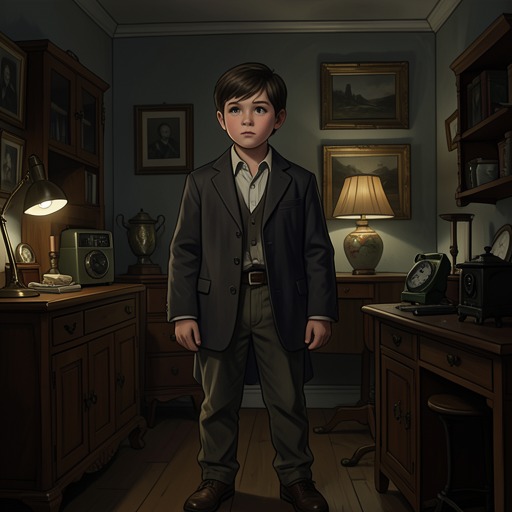
Bunny Junior steps into the conflict when the old man’s attack on his father continues. The mechanical bird winds down and falls silent before the boy defends Bunny by invoking his father’s selling ability. The gesture briefly reverses the family hierarchy: the child speaks up for his father in front of the grandfather whose approval Bunny has not secured. The line also echoes the salesman’s boast that he can sell almost anything, but here it comes from Bunny Junior, as an expression of loyalty rather than a sales pitch. The grandfather reacts as though the boy has mocked him, and the fragile pause turns dangerous.
The Outburst and the Admission
Bunny tries to intervene, but alcohol leaves him unsteady; he trips over a footstool and falls. His father lunges at Bunny Junior and strikes him with his walking stick. The action redirects the conflict from the two older men onto the child who has spoken in Bunny’s defense. Bunny then sees his father’s familiar expression and posture, and the years between them seem to collapse into a pattern he recognizes. Rather than answer the old man’s fury with a counterattack, Bunny cringes, covers his head, and whispers an apology.
That response gives the confrontation a second meaning. Bunny has arrived as an adult and a father, accompanied by a son who has openly defended him, but in front of his own father he falls back into the position of a frightened child seeking to avoid further anger. The scene does not establish that the two men reach an understanding. After Bunny apologizes, his father sits down, addresses him, and orders Bunny Junior to get him out of there. The encounter has moved from rejection, to an argument about what Bunny was taught, to an assault on the boy, without resolving the older grievance.
At the door, the father calls Bunny back and says plainly that he is dying. Bunny’s eyes fill with tears, and he turns as if to step back into the room. His father reaches out with the walking stick and pushes the door shut. The disclosure therefore arrives not as an opening into reconciliation but at the instant the old man closes off further contact. Bunny learns that the conflict is taking place under the pressure of an approaching death, yet he is left outside, unable to answer that knowledge with the return to the room he begins to make.
Inheritance and Separation
The scene sets Bunny’s ideas about fatherhood against his own experience as a son. With Bunny Junior, he speaks of trees, teaches the sales business, and asks the boy to choose whether to learn from him. At Flat 17, Bunny encounters a father who describes teaching as a past effort that entitles him to judge the result. The boy’s defense of Bunny offers a contrasting model of inheritance: a child can receive a parent’s lesson and use it to affirm the parent, not merely to repeat the older generation’s condemnation.
The ending refuses an easy reconciliation. The father’s cancer and admission of impending death make their remaining time newly finite, but the final gesture is still the closed door. Bunny leaves with the news and with the old conflict unresolved. As a turning point, the encounter makes the family trade carry two opposing meanings: it is the connection Bunny tries to pass to Bunny Junior, and the measure by which his father declares him a disappointment. The boy’s intervention momentarily interrupts that judgment, but it cannot undo the estrangement between father and son.