Bunny’s death
The Death of Bunny MunroBunny’s death closes the journey at the swimming pool, where a brief, tender exchange with Bunny Junior gives way to the aftermath of Bunny’s fatal condition. The scene turns the father’s last moments into an act of care: he lets his son take the controls of the Electric children’s train, then draws him close beside the water. Bunny dies there as the storm gathers and help rushes in, while Bunny Junior remains at his side.
From public apology to the pool
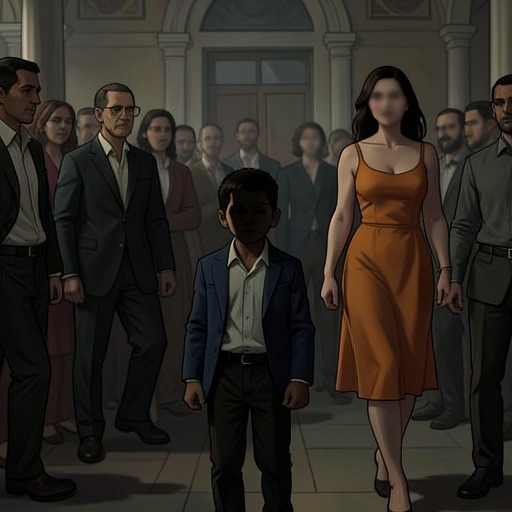
Before the poolside farewell, Bunny moves through a crowd that has responded to his public apology with tears, embraces, and forgiveness. He sees Libby among them and asks her forgiveness, explaining that he missed her. When he speaks of feeling haunted, Libby tells him that she never haunted him, then disappears into the crowd. Their exchange gives the death scene a charged context: Bunny has voiced his grief and regret, but the narrative does not present his encounter with Libby as a simple resolution of either.
Bunny then sees Bunny Junior waiting at the pool’s edge, within a circle of lamplight, with his flip-flops carefully set beside him and his feet in the water. The boy greets his father, who rests a hand on his head and invites him to look at something. Bunny Junior observes that the sky resembles a vast pool filled with dark ink and stars, then follows Bunny to the brightly coloured Electric children’s train. The image joins the real pool to the sky in the boy’s perception, while the approaching police and ambulance sirens establish that the private reunion is taking place amid an emergency.
The train ride
Bunny remembers the train from his own childhood and climbs into its front carriage, inviting Bunny Junior to join him. He points out the control panel and its large yellow key. When Bunny tells his son that this time he will drive, the boy turns the key and starts the train moving around the pool. Bunny puts an arm around him; the two ring the train’s silver bell, and Bunny Junior laughs. For the length of one circuit, the dying father gives his son the active role of navigator rather than leaving him only to witness what is happening.
The ride is brief. When the train slows to a stop, Bunny asks if Bunny Junior wants to go again, and the boy declines. Bunny climbs out and calls him back to the pool, saying that the train is too loud. This choice shifts the scene from movement and laughter to stillness. Together they return to the water: Bunny removes his shoes and socks and dangles his feet in the rain-marked pool, while Bunny Junior sits beside him. Bunny puts an arm around his son, draws him close, and kisses his hair. Their shared ride does not reverse the situation; instead, it becomes a final pocket of play within it.
Bunny’s final moments
Bunny’s condition is visible to his son. Bunny Junior notices the pale scarring at his father’s throat and understands that something is wrong; the water is pooling around them. Bunny says that he needs to lie down, but the noise of the storm prevents the boy from hearing him. In slow motion, Bunny falls back beside the pool, his feet still in the water. Bunny Junior reaches over to stroke his brow. When Bunny says he will close his eyes for a while, the boy kisses him and urges him not to. Bunny briefly opens his eyes again and sees Penny Charade, the girl he met at Butlins when he was young, sitting on the opposite side of the pool. He then says that he found the world a hard place to be good in, closes his eyes, and becomes still.
The scene does not make Bunny’s last admission into an excuse or a full account of his conduct. Instead, it places his sense of moral difficulty beside the tenderness he has just shown his son. Bunny Junior calls to his father and kisses him once more. Rain and thunder fill the setting as the crowd weeps beneath umbrellas and the café awning on Western Road. The storm’s scale contrasts with the smallness of the boy’s actions: he stays close, puts his arms around his father, and gives him a final kiss.
Aftermath and significance
The wreckage makes the emergency’s circumstances plain. Bunny Junior sees the maroon concrete mixer truck overturned and the Punto damaged, with smoke and steam around it; his blackened encyclopaedia lies on the road. He feels his grazed hands and knees and hears the last soft beat of Bunny’s heart. These details connect the poolside death to the crash without shifting the scene away from the child’s perspective. The boy wipes rain and blood from his father’s face as emergency workers approach through the storm, accompanied by the weeping crowd.
A policewoman kneels and offers Bunny Junior help, but he gently moves her hand aside and stands. His refusal does not undo his vulnerability or the loss; it marks his last action in the supplied scene as his own response rather than an acceptance of an adult’s intervention. The ending therefore holds two forms of protection in tension: the emergency services converge around the boy, while his attention remains with his father. Bunny’s death ends the father–son journey in physical separation, but the train ride and the boy’s vigil preserve their final hours as an intimate shared memory.