Empress Ballroom
The Death of Bunny MunroThe Empress Ballroom becomes the setting for Bunny Munro’s public reckoning, turning a performance venue into the place where his private history is exposed to the women he has wronged. The journey from its service entrance to the stage gives the scene its shape: anxious anticipation in the corridors gives way to applause, recognition, anger, and finally Bunny’s testimony.
Setting and Approach
Bunny reaches the ballroom after stopping outside to gather resolve. He leaves the path, goes around the side of the Main Hall, and enters through the stage door. The route places him behind the public face of the venue before he can appear before its audience. Inside, the carpeted stairs and short connecting hall lead him toward the gathering crowd; the architecture makes his progress a sequence of thresholds rather than a direct arrival.
The passage also filters the venue through Bunny’s apprehension. The patterned wallpaper seems to form a gallery of accusing faces, and he reads the crowd’s murmur as carrying both expectation and mistrust. He recognizes that this sense of malice may be imagined or anticipated, but it still affects him. The ballroom is thus presented not just as a physical destination but as the space in which he expects to be judged.
Backstage and Auditorium
Bunny enters a cramped backstage area and hides in the wings. From behind a red velvet, star-spangled curtain, he looks into an auditorium filled to capacity with the women he had seen approaching along the main path. The ballroom’s purple-and-gold satin ceiling and ornamental balconies establish the scale and formality of the room; from his concealed position, those features surround a gathering whose presence makes his private plan public.
A three-piece band in pale green jackets plays an instrumental version of a familiar but indistinct soft-rock song. The music and the prepared stage give the gathering the shape of an organized entertainment event, while Bunny remains backstage, fearful of what his appearance will mean. His eventual entry is announced by the master of ceremonies, and the crowd’s applause initially seems to relieve his dread. The stage offers him a brief appearance of welcome, but it does not guarantee that the audience will accept him.
The Crowd and Recognition
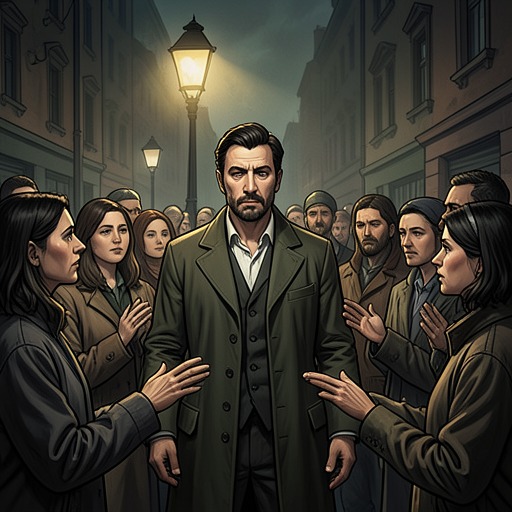
As the mirrorball turns, Bunny identifies several people in the audience. Georgia stands in the front row in an evening dress, swaying contentedly; Zoë and Amanda stand beside her in matching trouser suits and appear happy. Charlotte Parnovar is also present. Bunny notices that her face now seems softer and that the cyst he associates with her is gone. These observations establish that the audience is made up of individuals with histories connecting them to him, rather than an anonymous crowd.
He also sees Pamela Stokes with Mylene Huq, standing together and smiling. Mrs Brooks is seated in a wheelchair, wearing dark glasses and lipstick, and clapping as she rocks; a young carer stands behind her with a hand on her shoulder. The scene gives Bunny an opportunity to see some of the women in circumstances distinct from his memories of them. Their presence makes the ballroom a meeting place for people affected by his past, although the evidence does not establish that every person there has come for the same reason.
The initial welcome collapses when River, whom Bunny knows from the Grenville Hotel breakfast room, steps forward and identifies him. The applause falls away and the room’s mood turns to confusion and outrage. This reversal changes the stage from a platform for a planned appearance into a place where Bunny must face recognition before he can control how his story is told. The public setting makes that change immediate: the response comes from the assembled audience, not from a private conversation.
The Stage as a Place of Testimony
Bunny returns to the microphone and introduces himself as a beauty-products salesman, asking for a minute of the audience’s time. He then begins an account of his recent experiences and his conduct. He describes the head-on collision with a concrete mixer truck, the lightning strike, and the danger his nine-year-old son faced, presenting his survival as a question he cannot resolve. The ballroom’s stage becomes the place where these events are recounted to the people gathered before him.
His testimony extends beyond the crash. Bunny acknowledges taking advantage of people and treating the world with contempt, and describes himself as having sold misery rather than simply products. He speaks about his fear of love, the suicide of his wife, and the absence she leaves in his and his boy’s lives. He also recounts a crisis of conscience in which the suffering he caused passed before him, and says he felt possessed by the Devil. Coloured water gathers around his feet and spreads across the stage as he speaks, making the confession’s imagery part of the public scene without changing the fact that the ballroom’s audience is hearing his account directly.
Narrative Significance
The ballroom brings together two modes of performance. Bunny enters under an announcement and applause, as if appearing in an ordinary show, but the crowd’s recognition interrupts that convention. His prepared public address cannot hold the room at a distance: the women’s reaction establishes that his actions have consequences beyond his own interpretation of them. The stage consequently serves both as a performance space and as a place of accountability.
The movement from concealed wings to exposed microphone also gives the location a clear dramatic progression. At first Bunny watches the gathering from behind a curtain and anticipates judgment; then he is seen, recognized, and confronted by the audience’s anger. He nevertheless continues into testimony, naming his failures and asking why he survived. The available scene ends with that question still before the crowd, leaving the Empress Ballroom as the setting for an appeal rather than evidence of its outcome.