Fatherhood and dependence
The Death of Bunny MunroFatherhood and dependence describe the novel’s unsettled bond between Bunny and Bunny Junior: the boy’s love and practical reliance on his father persist even as Bunny’s grief and self-absorption make him an unreliable caregiver. Their relationship moves between genuine pride, neglect, instruction, and fear. The journey Bunny proposes as a father-and-son adventure therefore carries a double meaning: it draws them together, while exposing how much responsibility Bunny asks a nine-year-old to bear.
Loss and unequal dependence
In the immediate aftermath of Libby’s death, Bunny Junior is left to absorb the arrival of police and ambulance staff, their whispered questions, and the repeated reminders of his mother. He wants to be left alone to watch television, but his grief is not something he can simply set aside. His puffy, red-rimmed eyes are sore from blepharitis, and he has run out of steroid drops. He knows he should tell his father so that Bunny can replace them, yet the need remains unspoken while he sits with a large bottle of Coca-Cola between his knees. The child’s physical condition and bereavement appear together as ordinary needs that require an attentive adult.
Bunny, meanwhile, comes back into the living room dazed and asks about his beer. His face looks grey, and he seems uncertain of where he is. The scene places the father’s disorientation beside the boy’s effort to carry on: Bunny Junior remembers the beer he forgot to fetch, while also trying to endure the adults’ attention and the memories it provokes. Dependence is already running in both directions, but not equally. The child monitors his father’s wants even as his own need for care goes unmet.
Bunny’s private thoughts after River leaves underline how little prepared he feels for the role. He worries about being haunted by Libby, wonders whether her suicide has changed his sexual confidence, and feels anxious about visiting his ailing father. Only after these concerns does he turn abstractly to the question of what to do with Bunny Junior. He admits to himself that he cannot handle another night in the flat, while a separate, more calculating part of his mind begins to form a plan. The decision to take the boy away follows this pressure, but the plan is not presented as the product of settled reflection about what the child needs.
A child’s loyalty and exposure
When Bunny introduces Bunny Junior to River, the boy appears in the hallway with his fists tucked beneath his arms. Bunny identifies him as his son; the boy points back at Bunny and identifies him as his father. The exchange is simple, but its significance is not: the boy speaks from pride in a relationship that gives him security and identity. The adults laugh because his statement is literal, and Bunny Junior is confused by their response. He believes Bunny is the best and most capable father, yet the narration also makes clear that he remains beside him because he has nowhere else to go. Affection and dependence are joined, but the boy’s devotion does not prove that his father is meeting his needs.
That vulnerability becomes sharper when River takes Bunny Junior to bed. He is distressed by the unfamiliar closeness and by the difference between River and his mother; he feels confused and ashamed, and tries to hide his anguish. River tells him that his mother is in heaven and encourages him to think of pleasant things. Her reassurance offers a moment of comfort, but it cannot resolve his grief, and it comes from a temporary visitor rather than from Bunny. The scene shows the child receiving comfort from others while remaining unable to make sense of his mother’s death.
The same mismatch between dependence and care recurs when Bunny approaches him after dressing carefully for the planned trip. Bunny looks dynamic and handsome despite his scarlet eyes and trembling hands, while Bunny Junior, absorbed in his encyclopedia, is surprised by the sudden prospect of a suitcase. The boy’s book is a keepsake from Libby, who gave it to him because she loved him. His reading and remembered attachment to her provide a private continuity that Bunny’s new plan does not replace.
The road as promise and instruction
Bunny announces that they are hitting the road and tells his son that the first rule of salesmanship is to be presentable. Bunny Junior takes off his worn, undersized T-shirt, which he has kept for reasons of nostalgia, and prepares to go. Bunny promises that it will be just the two of them. Outside, the boy’s visible excitement contrasts with Bunny’s recent paralysis in the flat: stepping into the morning gives the father a renewed sense of strength and optimism. The departure offers both a practical escape from a home saturated with grief and a hopeful image of renewed father-son closeness.
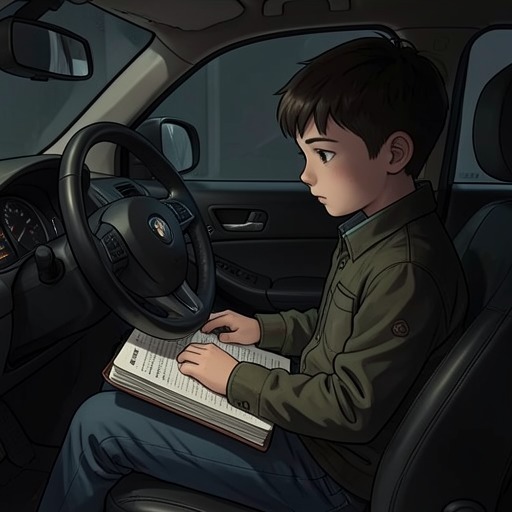
That promise is compromised by Bunny’s view of the journey as training. Driving slowly through the Wellborne Estate in Portslade, he searches for addresses on Geoffrey’s customer list and begins explaining how a tree stands firm when shaken. Bunny Junior listens closely, stores the lesson, and admits that he does not yet understand it. Bunny’s teaching presents paternal care as the transfer of toughness and business knowledge. The boy’s attention is genuine, but the metaphor’s meaning remains beyond him, making the scene as much about his desire to learn from his father as about Bunny’s ability to teach.
The tension becomes more explicit when Bunny asks whether his son would rather stay with him and learn the business or return to school. Bunny frames the choice as a test of ambition and loyalty, while Bunny Junior is trying to tell him that his glasses hurt and that he fears he may be going blind. Bunny demands an answer instead of responding to the eye complaint. The exchange reveals a serious failure of attention: Bunny makes the child responsible for endorsing the father’s preferred future at the very moment the boy is asking for help with a health problem.
The inherited script of fatherhood
Bunny’s relationship with his own father helps explain the harshness and fragility of his ideas about being a father, without making them inevitable. After Poodle mocks Bunny’s father, Bunny reacts with an unusually forceful warning, suggesting that a remark about his father carries more meaning for him than ordinary banter. Later, Bunny Munro Senior angrily claims that he tried to teach Bunny the business and showed him lovely things, then condemns him for selling toilet brushes. The account presents instruction as an inherited expectation, but also shows its failure: Bunny has not become the son his father wanted, and his own attempt to pass on the business to Bunny Junior risks repeating that narrow model of paternal authority.
At the same time, the boy’s attachment is not merely a reflection of Bunny’s demands. During a comic episode that briefly restores Bunny’s confidence among the adults, Bunny Junior appears in his pyjamas and oversized slippers and declares his pride in his father. His intervention stops the laughter. Bunny sends him back to bed, and the brief scene exposes how powerfully the child’s approval matters within the family, even though Bunny does not consistently respond to the child’s vulnerabilities.
Meaning of the relationship
The novel builds fatherhood through these contrasts rather than through a stable portrait of either devotion or neglect. Bunny Junior is loving, observant, and eager to accompany his father; he also faces bereavement, untreated discomfort, and pressure to accept Bunny’s plans. Bunny can offer the promise of a journey, a lesson, and moments of protection, yet his attention repeatedly turns toward his own crisis or his own definition of success. Their dependence is therefore mutual in feeling but unequal in responsibility: the boy’s reliance on Bunny is unavoidable, while Bunny’s reliance on the boy’s loyalty helps sustain his sense of himself as a father. The sales trip becomes a test of whether that inherited, performative idea of fatherhood can make room for listening to the child who is already standing beside him.