Ghosts
The Death of Bunny MunroGhosts are not presented as a settled supernatural fact in the novel; they emerge instead at the unstable border between memory, grief, and apparent encounter. Most importantly, Libby Munro appears differently to her son, Bunny Junior, and her husband, Bunny Munro. The boy’s visions sustain a tender connection with his mother, while Bunny’s sense of being haunted makes his bereavement feel like both longing and accusation.
The fading image of Libby
Bunny Junior is exceptionally good at storing and retrieving factual knowledge, arranging what he learns in mental boxes he can call up at will. Remembering his mother is harder. He can picture himself being pushed on a swing at St Ann’s Well Gardens, but the person pushing him has dissolved into an incomplete, ghostlike figure. He tries to preserve their shared past as if it were a series of exhibits in the Booth Museum, yet these carefully arranged memories cannot make Libby’s image stay whole. The contrast is painful: information can be kept intact, but the face he most wants to recall is vanishing.
The ghostly image registers both the persistence and the failure of memory. Bunny Junior remains suspended in the remembered swing scene, unable to recover the mother who once set it in motion. Later, while he waits in the Punto on Meeching Road in Newhaven, he believes his mother will find him. He becomes aware of her hand cream and feels a touch tracing his face; a voice tells him he is luminous, though he cannot tell whether the voice is his or hers. The moment offers an intimate sense of contact, while leaving its source uncertain.
Apparitions and different forms of grief
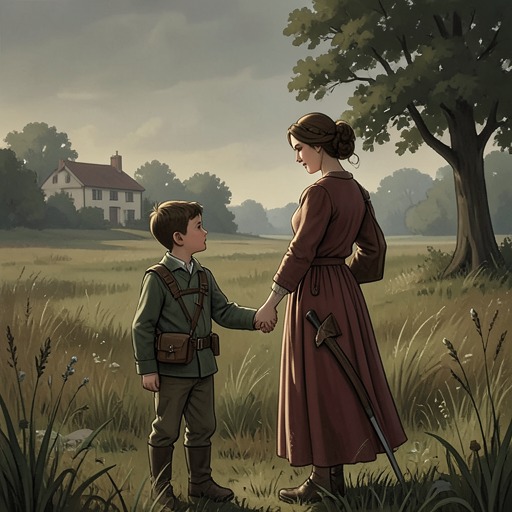
In another encounter, mist surrounds the Punto and Bunny Junior sees Libby in her Orange dressing gown on a low wall. She beckons him closer, and he joins her, apologizes, and rests against her. The boy experiences the reunion as real and comforting. His mother’s appearance answers his fear that her image is disappearing, not by restoring an ordinary shared life, but by giving him a moment of closeness within a vision.
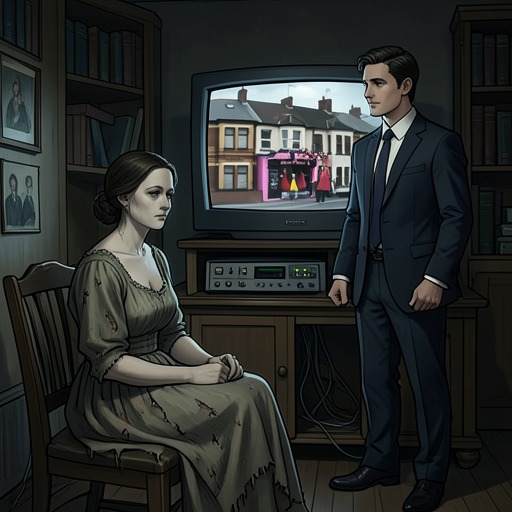
Bunny’s experience is more threatening. At Mrs Brooks’s home, he becomes certain that Libby is sitting on a piano stool beside the Bösendorfer Piano, wearing the Orange dressing gown associated with their wedding night and her death. The room seems to change around this expectation: the radio stops, the light and temperature shift, and the starlings become agitated. Heavy piano chords follow, and Bunny tries to scream. The scene makes haunting bodily and immediate, but it does not establish whether Libby is physically present or whether Bunny is experiencing a grief-shaped vision.
Denial, reunion, and narrative ambiguity
The contrast between the two mourners sharpens when Bunny sees Libby through the crowd at the public gathering. He moves towards her and asks her forgiveness, explaining his absence as a consequence of missing her. When he asks about being haunted, Libby denies that she ever haunted him. She then says she will see him in a minute and disappears among the mourners. Her denial unsettles Bunny’s earlier certainty without erasing the encounter: the apparition can be read as an answer to his longing, but the scene supplies no independent confirmation that she has returned from the dead.
Ghosts thus give form to relationships that death has interrupted but not emotionally ended. Bunny Junior’s visions preserve maternal tenderness as his memories fade; Bunny’s perceived haunting turns absence into a confrontation with guilt and loss. The repeated appearances resist a single explanation, allowing the novel to hold together the supernatural possibility of contact and the intimate force of bereavement.